
Eco labels on coffee are third-party or brand claims that certify a specific slice of how the beans were grown, priced, or sourced, never the whole sustainability picture at once. If synthetic chemicals worry you most, look for USDA Organic. If farmer pay is your priority, look for Fairtrade. If bird and forest habitat matters to you, Bird Friendly is the strictest option on shelf.
TL;DR:
- Certification costs and audit cycles vary widely, making some labels more accessible to small farmers and ensuring different standards of verification.
- The most common labels—Organic, Fairtrade, Rainforest Alliance, and Bird Friendly—each focus on specific sustainability pillars, rarely covering all issues comprehensively.
- A bag with multiple labels generally indicates stacked benefits, such as chemical-free growing plus farmer income protection, rather than redundant guarantees.
- Traceability technology and direct trade are increasingly supplementing or replacing traditional certification, but they lack standardized third-party verification.
- Certification remains challenging for smallholders due to high costs, lengthy transition periods, and administrative barriers, often limiting environmental benefits to better-capitalized farms.
Table of Contents
- Why Coffee Eco Labels Don’t All Measure the Same Thing
- The Six Labels You’ll Actually See on a Bag
- How to Read a Coffee Bag Without Getting Fooled
- Do Shoppers Actually Pay More for Certified Coffee?
- How a Small Roaster Handles Sourcing Transparency
- Where Coffee Certification Came From
- What Certification Actually Changes on the Ground
- Where One Label Ends and Another Begins
- What’s Changing in How Coffee Gets Certified
- Why Certification Is Hard for the Farmers Who Need It Most
- A Realistic Take on What Labels Can and Can’t Do
- Taste the Difference a Transparent Sourcing Page Makes
- Sources
- FAQ
Why Coffee Eco Labels Don’t All Measure the Same Thing
Coffee certifications fall into two rough camps: voluntary sustainability standards with independent auditors checking farms against written criteria, and marketing claims like “responsibly sourced” that no outside party ever verifies. That distinction alone explains most of the confusion shoppers feel staring at a bag covered in seals.
Every credible label picks a lane rather than covering all three sustainability pillars, environmental, social, and economic, equally. Fairtrade leans hardest into economic protection for farmers. Bird Friendly leans hardest into environmental habitat metrics. Few labels do both well, and none do all three at maximum strength, because a standard that tries to verify everything becomes too expensive to audit and too slow to certify new farms.
Certification cost is the hidden variable behind what you see on shelf. Audits run on multi-year cycles, farmers pay fees relative to their harvest size, and buyer demand in wealthier markets determines which labels roasters bother pursuing. A few structural facts explain the variation you’ll see bag to bag:
- Some standards audit annually, others on multi-year cycles, so “certified” doesn’t always mean “checked this year.”
- Certification fees scale with farm size, which can price out the smallest cooperatives even when their practices qualify.
- Retail demand in North America and Europe drives which labels roasters bother paying for, regardless of which standard is strictest.
- A single bag can carry more than one seal, and each seal is verifying something different, not duplicating the others.
The Six Labels You’ll Actually See on a Bag
Here’s what each major seal is actually checking, since the acronyms rarely explain themselves.
USDA Organic bans synthetic pesticides and fertilizers, and it requires a three-year transition period with no synthetic inputs before a farm can even apply. It says nothing about what farmers were paid or whether forest canopy was preserved. A coffee can be organic and grown in a clear-cut field.
Fairtrade sets a minimum price floor plus a separate community development premium, and it requires farmers to organize into democratic cooperatives. It’s a social and economic standard first. Environmental criteria exist but are secondary to price protection.
Rainforest Alliance blends environmental and social criteria into one standard, but the seal carries a real caveat: it can appear on a blended product even when only a percentage of the beans inside are certified, with audits run on a multi-year cycle rather than annually.
Bird Friendly, run through the Smithsonian, layers strict shade-canopy and tree-species-diversity requirements on top of an organic baseline. It’s the toughest habitat standard in the industry, which is exactly why Bird Friendly farms remain rare in retail.
Bird Friendly certified farms represent a small share of global coffee production, according to Coffee & Conservation’s certification guide, a scarcity that reflects how demanding the canopy and biodiversity thresholds are.
4C and UTZ function as commodity-level baseline standards. They raise the floor on traceability and basic agricultural practice but keep biodiversity requirements general rather than strict, which is why they’re often the entry point for large-volume commercial coffee rather than a premium signal.
Read our breakdown of why organic coffee benefits taste and ethics and our explainer on what Fairtrade actually guarantees for more detail on the two most common seals.
How to Read a Coffee Bag Without Getting Fooled
A bag covered in green leaves and words like “sustainably sourced” is not the same thing as a bag carrying an audited seal. Here’s how to tell the difference in under a minute, standing in the aisle or scrolling a product page.
- Ask who paid the farmer. A specific price or a named cooperative on the label beats a vague “direct trade” claim with no numbers attached.
- Check for a percentage-certified disclosure. If the bag says “contains certified coffee,” look for what share of the blend that actually covers, since seals can legally appear on partially certified blends.
- Look for the audit body’s name, not just the logo. USDA, Fairtrade International, Rainforest Alliance, and the Smithsonian all publish who does their inspections; a claim with no auditor named is unverifiable.
Vague terms like “responsibly sourced” without a named certifier or origin detail are a reliable red flag, industry sourcing guides note, since anyone can print those words with zero third-party check behind them. If a roaster’s sourcing page names the farm, the price paid, and the certifying body, that’s a good sign. If it just says “ethically sourced” with no specifics, ask before you buy.
Pro Tip: Email the roaster and ask what percentage of the blend is certified and who audited it. A roaster with nothing to hide answers in one paragraph; a roaster dodging the question usually can’t.
Do Shoppers Actually Pay More for Certified Coffee?
Yes, and the effect is measurable, not anecdotal. A meta-analysis pooling 97 observations from 22 studies between 2005 and 2020 found a consistent, positive willingness to pay for Organic and Fairtrade coffee, with Organic showing up as the single most influential attribute across the pooled studies.
That premium isn’t evenly distributed. Higher income, more education, and stronger environmental activism all raise both the likelihood and the size of the premium a shopper will pay, meaning the same bag of Fairtrade Organic coffee sells differently depending on who’s standing in front of it. One food-quality study even found consumers preferring agrochemical-free claims over biodiversity-focused ones in head-to-head stated-preference tests, suggesting “no pesticides” resonates faster than “protects forest habitat,” even though both matter.
The practical takeaway: a dual-certified bag, Organic plus Fairtrade, captures two of the premiums the research measures separately, chemical-free production and farmer price protection, instead of just one.
How a Small Roaster Handles Sourcing Transparency
A single seal never tells the whole story, which is why sourcing transparency matters as much as the logo itself. Tri Crow Coffee’s approach centers on small-batch roasting, ethical sourcing relationships, and ritual-focused blends built around specific origins rather than anonymous commodity lots.
What good disclosure looks like in practice, whether you’re reading a roaster’s page or ours:
- Naming the farm or cooperative instead of just the country of origin.
- Publishing what was paid for the green beans, not just a certification logo.
- Listing which certifications apply and to what percentage of the bag.
- Offering sample formats so you can evaluate sourcing claims before committing to a full bag.
Our own ethical sourcing overview and notes on why traceability matters walk through what to expect from a roaster that takes this seriously.
Where Coffee Certification Came From
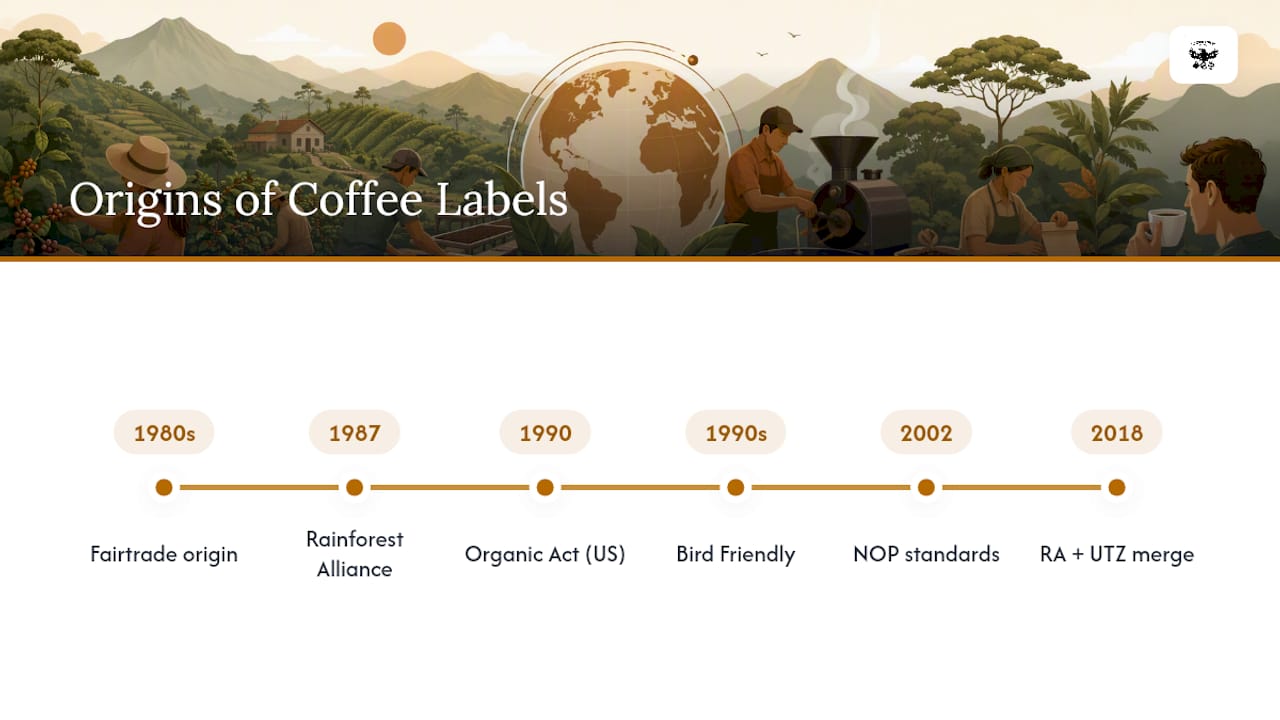
USDA Organic’s coffee-relevant rules trace back to the Organic Foods Production Act of 1990, though the finalized National Organic Program standards didn’t take effect until 2002, decades after organic farming itself existed as a fringe practice. Fairtrade emerged earlier and more directly from crisis: the international Fairtrade labeling movement grew out of 1980s Dutch and European solidarity trade networks responding to collapsing coffee prices that were bankrupting small farmers.
Rainforest Alliance started in 1987 focused on rainforest conservation broadly, then built out coffee-specific criteria as deforestation tied to agriculture became impossible to ignore. It later merged with UTZ Certified in 2018, combining a habitat-focused legacy with UTZ’s traceability and baseline agricultural-practice model into one standard.
Bird Friendly came last and narrowest, developed by the Smithsonian Migratory Bird Center in the 1990s after researchers found that sun-grown coffee monocultures were devastating migratory bird habitat across Latin America. It stayed deliberately strict rather than scaling to compete on volume, which is exactly why it never became a mass-market seal.
The pattern across all four: each label was a reaction to a specific harm, price collapse, deforestation, chemical runoff, habitat loss, not a generic sustainability initiative. That origin story is why no single label covers everything. Each one was built to fix one problem, not the whole system.
What Certification Actually Changes on the Ground
Certification’s real-world impact splits along the same lines as the labels themselves. Fairtrade’s minimum price floor and cooperative premium give farming communities a buffer against the commodity price swings that have historically devastated coffee-growing regions when global prices crash. That premium often funds community projects, schools, clean water infrastructure, chosen by the cooperative rather than imposed from outside.
Organic and Bird Friendly certification changes farming practice directly rather than farmer income. Banning synthetic inputs protects local water sources and farmworker health from pesticide exposure. Bird Friendly’s shade-canopy requirements preserve forest structure that migratory birds, and the broader ecosystem around a farm, depend on. Farms that maintain that canopy also tend to see better soil retention and natural pest control, since a diverse tree canopy hosts the insects and birds that would otherwise require chemical intervention.
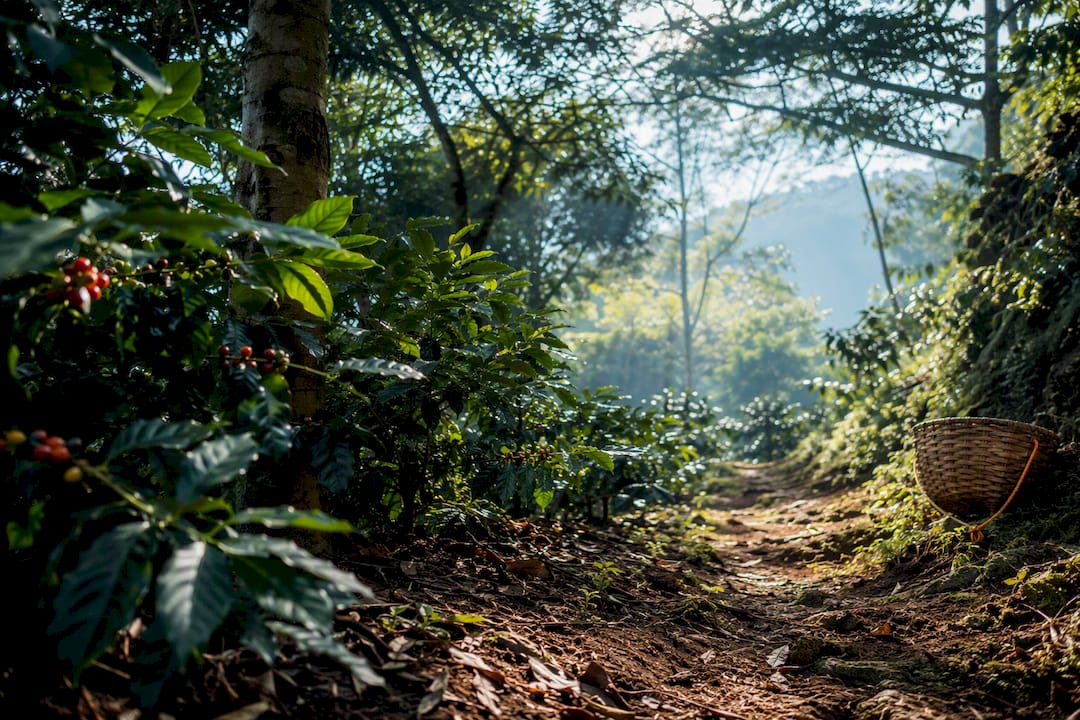
The catch is scale. Because Bird Friendly and Organic both demand practices that reduce yield per acre in the short term, at least until soil health rebuilds, the farms that can afford to certify tend to be the ones with capital reserves already. Smaller, poorer cooperatives sometimes get squeezed out of the exact certifications that would most reward their existing low-input practices, simply because they can’t absorb a multi-year transition with reduced yield and no guaranteed buyer waiting on the other side.
That’s the uncomfortable trade certification research keeps surfacing: the labels that do the most environmental good are often the hardest for the most vulnerable farmers to reach.
Where One Label Ends and Another Begins
The overlap between these standards is real, but it’s narrower than most shoppers assume. Consumers routinely assume a single seal covers every sustainability dimension at once, when in practice each certification was built to measure a distinct outcome.
USDA Organic and Bird Friendly share a floor, Bird Friendly requires organic compliance as a baseline, then adds habitat metrics on top. That makes Bird Friendly strictly harder to earn, never easier, than Organic alone. Fairtrade and Rainforest Alliance overlap on social criteria but diverge sharply on price mechanics: Fairtrade sets a hard minimum price floor, while Rainforest Alliance focuses more on practice standards and leaves pricing closer to open market negotiation.
4C and UTZ sit apart from all of the above as baseline commodity standards. They were never designed to compete with Organic or Bird Friendly on strictness. They exist to raise the floor for large-volume, lower-cost coffee, which is why you’ll see them more often on grocery-store shelf brands than on specialty small-batch bags.
The practical rule: stacking labels usually means stacking distinct benefits, not redundant ones. A bag that’s Organic and Fairtrade gets you chemical-free growing plus a price floor for the farmer, two different guarantees, not one guarantee said twice. A bag that’s Rainforest Alliance and nothing else gets you a broader but shallower mix of both, with the caveat that the seal might apply to only part of the blend.
What’s Changing in How Coffee Gets Certified
Traceability technology is reshaping certification faster than the standards bodies themselves are updating their rulebooks. Blockchain-based origin tracking and QR codes linking to farm-level data are starting to appear on specialty bags, letting a shopper verify a specific lot’s journey instead of trusting a logo alone. That shift favors small roasters who already know their supply chain over large blenders sourcing from dozens of anonymous cooperatives.
Direct trade relationships, where a roaster buys straight from a specific farm or cooperative without a certifying body in between, are also growing precisely because certification is expensive and slow for small farms to obtain. The catch, and it’s a real one, is that “direct trade” carries no third-party audit at all. It’s only as trustworthy as the roaster publishing it, which is exactly why the provenance and price-paid questions from earlier in this guide matter more, not less, as direct trade grows.
Expect more roasters to disclose percentage-certified content voluntarily, even where regulation doesn’t require it, simply because shoppers increasingly ask. Combined certifications, stacking Organic with Fairtrade or Rainforest Alliance with a direct-trade relationship, are likely to keep growing as the way both large and small roasters signal depth rather than picking one seal and stopping there.
Why Certification Is Hard for the Farmers Who Need It Most
Certification sounds like a straightforward stamp of approval, but the process behind it is expensive, slow, and structurally tilted against the smallest producers. Audit fees are charged per farm or per cooperative, and they don’t scale down proportionally for a five-acre plot versus a five-hundred-acre estate, which means the relative cost burden lands hardest on exactly the farmers certification is meant to help.
The three-year Organic transition window compounds the problem. A farmer has to farm organically, absorbing lower yields during the transition, for three full years before earning the premium that organic certification usually commands, with no guarantee a buyer will still be there paying that premium once certification finally arrives. That’s a multi-year bet many smallholders simply can’t afford to make without outside financing or a committed buyer locked in ahead of time.
Paperwork and language barriers add another layer. Certification standards are typically written and audited in the language of the certifying body’s home market, not the farmer’s, and the documentation requirements, batch tracking, input records, financial statements, assume a level of administrative infrastructure that many smallholder cooperatives are still building from scratch. Cooperatives that pool resources to share an audit fee and hire shared administrative staff tend to clear these hurdles far more often than farmers trying to certify alone.
A Realistic Take on What Labels Can and Can’t Do
Labels are useful filters, not proof of virtue. They tell you one thing was verified, not that everything else about the coffee is clean. Pair a seal with a roaster who actually publishes where the beans came from and what was paid.
— David P.
Taste the Difference a Transparent Sourcing Page Makes
Reading about certification is useful, but nothing replaces tasting what a transparently sourced bag actually offers. Some small-batch roasters produce every roast in limited quantities to protect flavor consistency, with sourcing details published rather than buried behind a generic “ethically sourced” label.
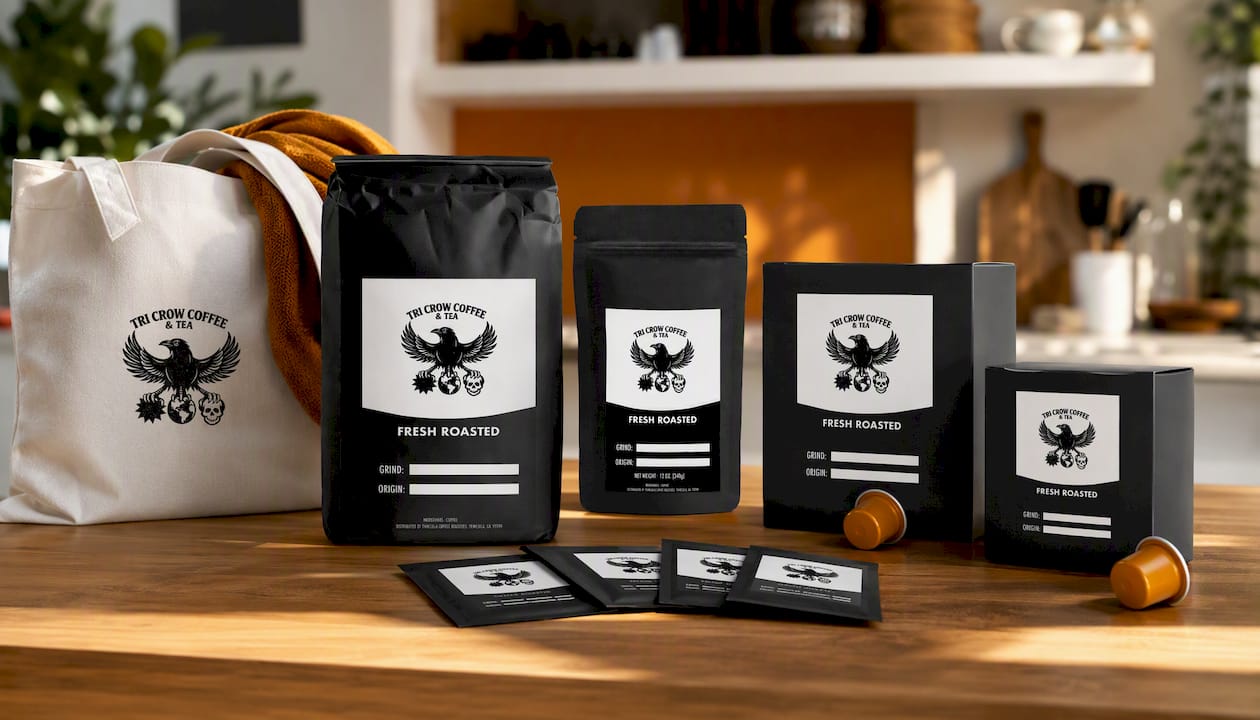
If you want a low-commitment way to test that claim yourself, the Single Origin Favorites sample pack, six 2oz packs from six distinct origins, lets you compare provenance and flavor side by side before committing to a full bag. Prefer single-serve convenience without giving up on small-batch sourcing? The 60-count capsule box and the 12-count capsule pack both carry the same roast-level care in a single-serve format. Browse the full single-origin coffee collection to see which origin’s sourcing story matches what you’re looking for, and check the product pages for the specific provenance details behind each blend.
Sources
- Willingness to pay for socially responsible products: A meta−analysis of coffee ecolabelling
- Transition to certified organic production
- Quick guide to coffee certifications – Coffee & Conservation
- Sustainable Coffee: Farming, Certifications & Sourcing | Coffee Maker Buyer Guides
FAQ
What coffee brand has the least chemicals?
No single brand claims across-the-board “least chemicals,” but any coffee carrying USDA Organic certification has passed a three-year transition period with no synthetic pesticides or fertilizers. Looking for that specific seal, rather than a brand name, is the reliable way to confirm chemical-free growing practices.
Can you give an example of an eco-label on coffee?
USDA Organic, Fairtrade, Rainforest Alliance, and Bird Friendly are the four most common eco-labels shoppers encounter on coffee bags. Each verifies something different: Organic checks inputs, Fairtrade checks farmer pay, and Bird Friendly checks forest habitat quality.
Which coffee brand is the most eco-friendly?
There’s no single “most eco-friendly” brand, since eco-friendliness depends on which pillar matters to you, chemical inputs, farmer pay, or habitat protection. A roaster like Tri Crow Coffee that publishes sourcing details and small-batch origins alongside its certifications gives you the transparency needed to judge that for yourself rather than taking a marketing claim at face value.
What is the healthiest, cleanest coffee?
“Cleanest” usually refers to freedom from synthetic pesticide residue, which is exactly what USDA Organic certification verifies through its mandatory transition period. Pairing Organic certification with a roaster that discloses sourcing and roast batching adds another layer of confidence beyond the seal alone.