
TL;DR:
- Fair trade coffee is certified to meet strict social, economic, and environmental standards that protect smallholder farmers. It guarantees a minimum price floor and funds community projects through democratically controlled premiums. The certification focuses on fairness and sustainability rather than tasting qualities, which depend on various agricultural and processing factors.
Fair trade coffee is coffee certified to meet strict social, economic, and environmental standards designed to protect smallholder farmers from exploitative market conditions. Fairtrade International, the leading certifying body, sets a minimum floor price of $1.80 per pound for conventional Arabica and $2.20 per pound for organic Arabica as of 2026. That price floor exists regardless of what commodity markets are doing on any given day. For farmers in countries like Ethiopia, Colombia, and Peru, that guarantee is the difference between covering costs and going under. If you’ve ever wondered why choose fair trade coffee, the answer starts here: it’s a certified safety net, not just a feel-good label.
What is fair trade coffee certification, and how does it work?
Fair trade coffee certification is a formal, third-party verified system that sets minimum standards for pricing, labor practices, and environmental responsibility. Not every coffee farm qualifies. Only smallholder cooperatives organized democratically are eligible. Large plantations that rely on permanent hired labor are generally excluded from the program.
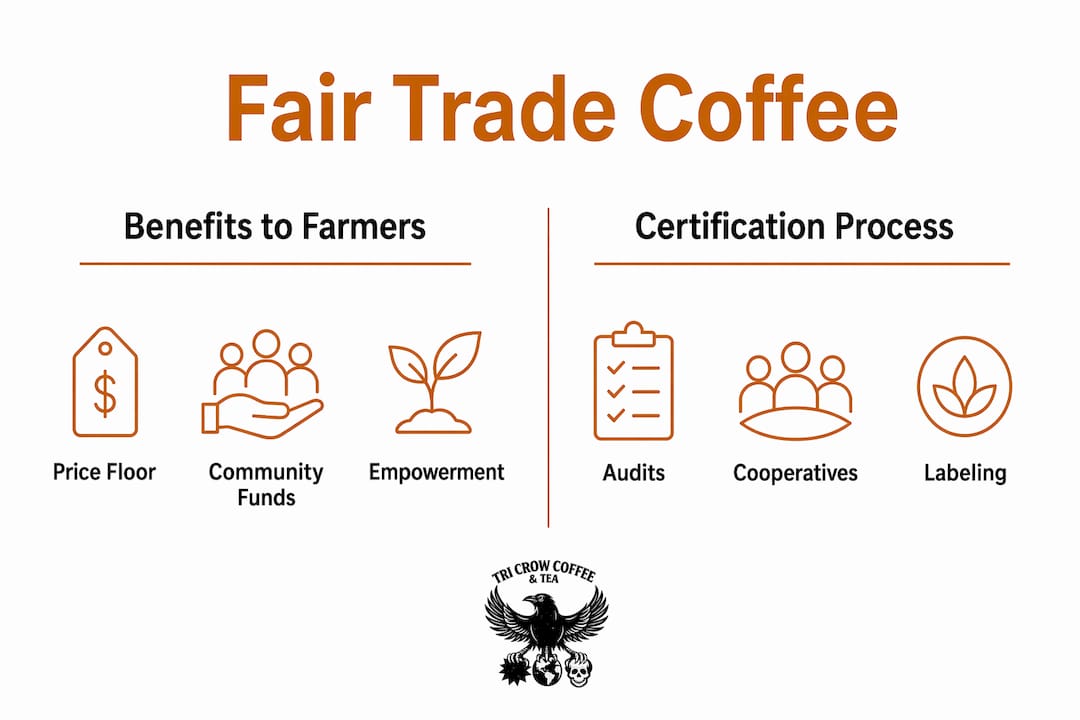
The certification process covers three core areas:
- Fair pricing: Farmers receive at least the Fairtrade minimum floor price, protecting them when global coffee prices drop below the cost of production.
- Ethical labor: Standards prohibit child labor and forced labor, and require safe working conditions for all cooperative members.
- Environmental practices: Certified cooperatives must follow guidelines that limit harmful pesticide use and encourage sustainable land management.
Third-party audits by FLOCERT, the independent certification body that works with Fairtrade International, verify compliance annually. FLOCERT auditors visit farms, review financial records, and confirm that cooperatives meet governance requirements. This annual review cycle keeps the system accountable rather than relying on self-reporting.
Pro Tip: When you see the Fairtrade mark on a bag of coffee, look for the FLOCERT certification number. That number confirms the product passed an independent audit, not just a brand promise.
The cooperative structure matters beyond paperwork. When farmers organize democratically, they collectively negotiate contracts, share resources, and make decisions about how community funds are spent. That structure shifts power away from middlemen and toward the growers themselves.
What benefits does fair trade coffee provide to farmers?
The most direct benefit of fair trade certification is economic protection. Fairtrade International’s minimum price floor is the only guarantee of its kind in coffee commodity markets. When global prices crash, as they have repeatedly throughout coffee history, certified farmers still receive the floor price. That stability allows farmers to plan ahead, invest in their farms, and avoid the debt cycles that trap many smallholders.
Beyond the floor price, certified cooperatives receive the Fairtrade Premium. This is an additional sum paid on top of the purchase price, currently set at $0.20 per pound for conventional coffee. The premium does not go directly into individual farmers’ pockets by default. Instead, cooperative members vote democratically on how to allocate those funds collectively.
The results of that democratic process are concrete:
- School construction and education programs funded by premium dollars have expanded access to schooling in remote farming communities.
- Health clinics and clean water projects address basic infrastructure gaps that government programs often miss in rural areas.
- Processing machinery upgrades help cooperatives improve coffee quality at the farm level, which can unlock access to specialty markets and higher prices.
- Emergency funds provide a buffer when natural disasters or crop failures hit, reducing the need for predatory loans.
The Fairtrade Premium is one of the few mechanisms in global commodity trade that puts spending decisions directly in the hands of the people who earned the money. Farmers vote on priorities. That democratic control is what separates fair trade from charity.
One common misconception is that fair trade certification automatically means farmers are earning a living wage. The floor price and premium together provide meaningful protection, but new standards are evolving toward a “living income” model that accounts for regional cost-of-living data. The current system is a foundation, not a finished solution.
Understanding coffee origin and ethical sourcing together gives you a fuller picture of what your purchase actually supports.
How does fair trade coffee differ from organic and direct trade?
Fair trade, organic, and direct trade are three distinct approaches to ethical coffee sourcing. Consumers often assume they overlap completely. They do not.
| Label | Focus | Certification | Price guarantee |
|---|---|---|---|
| Fair Trade | Labor, pricing, governance | Yes, third-party (FLOCERT) | Yes, minimum floor price |
| Organic | Farming methods, ecology | Yes, government-regulated | No |
| Direct Trade | Roaster-farmer relationship | No formal certification | No floor price |
Organic certification focuses entirely on how the coffee is grown. It prohibits synthetic pesticides and fertilizers and requires documented farming practices. Organic certification says nothing about whether farmers were paid fairly or whether labor conditions were safe. A coffee can be certified organic while still paying farmers below the cost of production.
Direct trade takes a different approach. Roasters who source direct trade coffee build personal relationships with specific farms, often paying well above market rates for exceptional quality. Direct trade can pay higher premiums than fair trade in some cases, but it lacks formal third-party certification. There is no auditor verifying the claims, no floor price protecting farmers if the relationship ends, and no governance standard requiring democratic cooperative structures.
Fair trade is certification-based with enforceable standards. Organic is certification-based with a different focus. Direct trade is relationship-based with no formal verification.
Pro Tip: Coffee labeled “fair trade organic” carries both certifications independently. The two standards do not overlap, so a bag with both marks has passed two separate audits covering different criteria.
The coffee processing method also intersects with these labels. Ethical sourcing practices at the processing stage can complement certification, but they are separate considerations.
What should consumers know about fair trade coffee quality and price?
Fair trade certification does not guarantee coffee quality. This is the most important misconception to clear up before you buy. Certification audits exclude sensory evaluation entirely. FLOCERT auditors assess social, economic, and environmental criteria. No one is cupping the coffee to score its flavor.
Quality in the cup depends on factors that certification does not control:
- Variety: Arabica varieties like Gesha or Bourbon produce different flavor profiles than commodity-grade Catimor, regardless of certification status.
- Processing method: Natural, washed, and honey processing each produce distinct results. The care taken at this stage shapes the final flavor more than any label.
- Roasting: A skilled roaster can coax exceptional results from good green coffee. Poor roasting can ruin excellent raw material.
- Freshness: Coffee degrades after roasting. A fair trade bag sitting on a shelf for six months will taste worse than a non-certified bag roasted last week.
Fair trade acts as a foundational safety net for commodity-grade coffee farmers rather than a quality premium indicator. That framing is useful. You are paying more for fair trade coffee because the supply chain is more equitable, not necessarily because the coffee tastes better.
The price premium is real. Fair trade certified coffee typically costs more at retail than conventional coffee. That difference reflects fair compensation paid upstream, not a flavor upgrade. Consumers who understand this distinction make better purchasing decisions. They choose fair trade because they value the social impact, and they choose quality separately by researching origin, processing, and roast date.
Exploring a coffee tasting guide alongside your fair trade purchases helps you evaluate both dimensions independently.
Key Takeaways
Fair trade coffee is the only certified system in coffee markets that guarantees a minimum price floor, protecting smallholder farmers from volatile commodity prices while funding community development through democratically controlled premiums.
| Point | Details |
|---|---|
| Minimum price floor | Fairtrade International guarantees $1.80/lb for conventional Arabica, regardless of market prices. |
| Cooperative-only eligibility | Only democratically organized smallholder cooperatives qualify; large plantations are excluded. |
| Fairtrade Premium impact | Cooperative members vote on how to spend premium funds, directing money to schools, clinics, or farm upgrades. |
| Certification vs. quality | Fair trade audits cover social and economic standards only; cup quality depends on variety, processing, and roasting. |
| Fair trade vs. organic vs. direct trade | Each label addresses different concerns; only fair trade provides a certified minimum price guarantee. |
Why fair trade coffee deserves more credit than it gets
Fair trade gets criticized from both sides. Specialty coffee insiders sometimes dismiss it as a commodity-grade program that does nothing for cup quality. Skeptics on the other side argue the premiums are too small to create real change. Both critiques contain truth, and both miss the larger point.
I’ve spent years paying attention to how coffee reaches the cup, and the fair trade floor price is genuinely meaningful in contexts where market prices collapse. When the C market dropped below $1.00 per pound in 2019, certified farmers still received $1.80. That gap kept cooperatives solvent. No amount of relationship-based sourcing or organic certification provided that protection at scale.
The real limitation of fair trade is not the model itself. It’s that the floor price has not kept pace with rising production costs. The evolution toward living income standards is the right direction, and it reflects honest self-criticism from within the Fairtrade system. That willingness to revise is a sign of institutional health, not weakness.
My honest view is that fair trade works best when consumers treat it as one part of a broader sourcing picture. Pair it with attention to origin, roaster transparency, and coffee traceability. A certified bag from a cooperative you can research is more meaningful than a certified bag from an anonymous supply chain. The label opens the door. What you do with the information behind it determines the real impact.
— David
Tri Crow Coffee and ethically sourced coffee worth trying
Tri Crow Coffee sources with intention. Every small-batch roast reflects a commitment to knowing where the coffee comes from and why that origin matters.

If you want to experience ethically sourced coffee without committing to a single origin or roast profile, the Best Sellers Sample Pack gives you six varieties in 2oz portions, including selections from Peru and Mexico where fair trade cooperatives are well established. For a more focused exploration, the single origin sample pack lets you compare origins side by side and develop your own sense of what ethical sourcing tastes like in the cup. Both packs are roasted in limited batches so you receive coffee at peak freshness.
FAQ
What is the fair trade coffee definition?
Fair trade coffee is coffee certified by Fairtrade International to meet minimum standards for farmer pricing, labor practices, and environmental responsibility. The certification guarantees a minimum floor price of $1.80 per pound for conventional Arabica as of 2026.
Does fair trade certification guarantee better-tasting coffee?
No. Fair trade audits focus on social, economic, and environmental criteria and exclude sensory evaluation entirely. Cup quality depends on variety, processing method, roasting, and freshness, not certification status.
Who can receive fair trade coffee certification?
Only democratically organized smallholder cooperatives are eligible. Large plantations that rely on permanent hired labor do not qualify for Fairtrade International certification.
How is fair trade coffee different from organic coffee?
Fair trade addresses farmer pricing and labor standards. Organic certification addresses farming methods and ecological practices. The two certifications are independent, and coffee can carry one, both, or neither label.
Why does fair trade coffee cost more?
The higher retail price reflects fair compensation paid to farmers upstream, including the minimum floor price and Fairtrade Premium. The added cost is not a quality indicator. It is the financial expression of a more equitable supply chain.
Recommended
- Why trace your coffee? The real benefits of transparency – Tri Crow Coffee
- Why coffee origin matters: flavor, ethics, and sustainability – Tri Crow Coffee
- Advantages of Small Batch Coffee: Flavor, Freshness, Ethics – Tri Crow Coffee
- What is coffee extraction? A brewer’s guide to better flavor – Tri Crow Coffee