
Coffee certifications are genuinely useful trust signals for production practices and socio-environmental claims, but they are not reliable proxies for cup quality or guaranteed fair income for producers. The role of certifications in coffee is real and worth understanding, yet it is only part of the picture. According to Coffee Intelligence, from 2020 to 2022 roughly 55% of global coffee production carried a certification, but less than 26% of that certified coffee was purchased as certified. Producers paid the costs; the market premium often did not follow. For ritual-focused buyers shopping small-batch roasters like Tri Crow Coffee, that gap matters.
Certifications are most useful when you are:
- Seeking pesticide-free beans and want third-party verification of chemical-free farming practices
- Supporting minimum-price schemes that protect farmers from commodity market swings
- Looking for broad sustainability assurances when you have no direct relationship with the roaster
Table of Contents
- What do the main certifications actually guarantee?
- Who actually pays for certification, and where do premiums go?
- What certifications can’t tell you about taste or outcomes
- How to use certifications when choosing small-batch coffee
- Direct trade, traceability, and micro-lots as alternatives
- How Tri Crow Coffee approaches sourcing and labeling
- Key Takeaways
- Certifications are a tool, not a verdict
- Tri Crow Coffee’s small-batch range for ritual-focused exploration
- Useful sources
- FAQ
What do the main certifications actually guarantee?
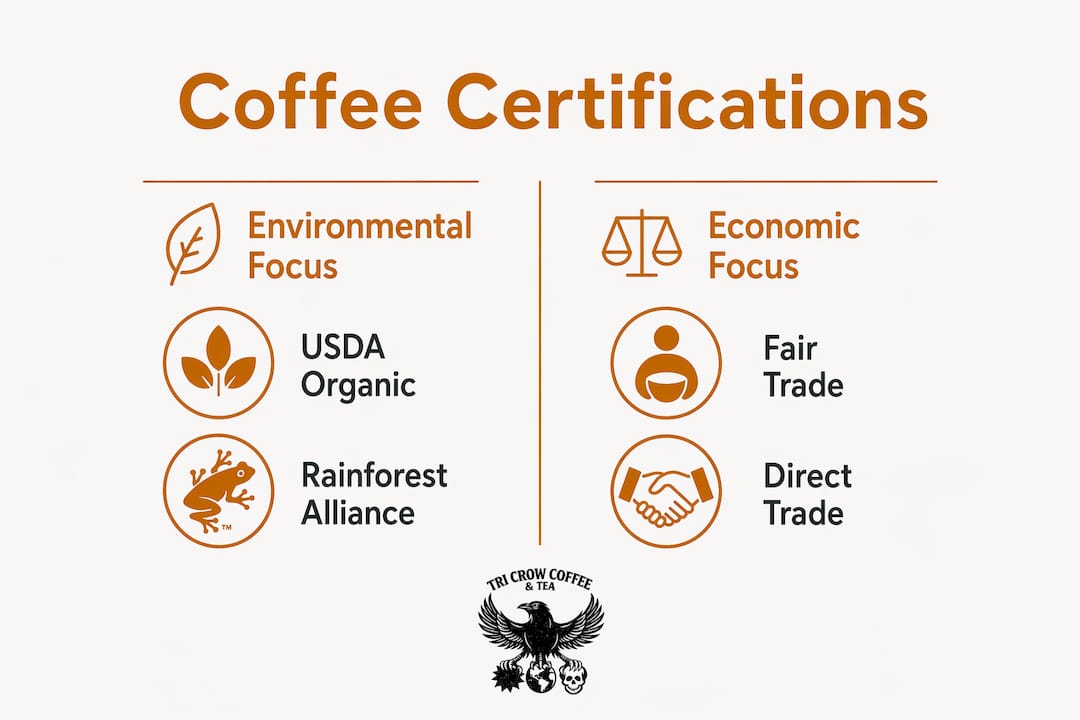
Three labels dominate North American coffee bags: USDA Organic, Fair Trade, and Rainforest Alliance. Each covers different ground.
USDA Organic focuses on inputs. Per USDA Agricultural Marketing Service, it guarantees no synthetic pesticides or fertilizers were used and requires farms to maintain chemical-free practices for a minimum of three years before certification is granted. It says nothing about price fairness or labor conditions.
Fair Trade centers on economics and community. It guarantees a minimum price for green coffee and requires community development premiums that cooperatives must reinvest in local projects, per Root Capital. It does not regulate chemical use.
Rainforest Alliance (which merged with UTZ) takes a holistic approach: environmental, social, and economic criteria are scored together, and farms follow an improvement-pathway model rather than a pass/fail threshold. A single logo does not tell you which criteria scored highest.
| Certification | Primary Focus | Price Guarantee | Chemical Standards | Audit Type |
|---|---|---|---|---|
| USDA Organic | No synthetic inputs | No | Yes (multi-year transition) | Third-party inspection |
| Fair Trade | Minimum price, community premium | Yes | No | Third-party inspection |
| Rainforest Alliance/UTZ | Holistic sustainability score | No | Partial | Scored improvement pathway |
In North American retail, all three appear as bag seals. USDA Organic is the most recognized by general consumers. Fair Trade carries strong social-equity associations. Rainforest Alliance’s green frog logo is common on mass-market bags but less familiar to specialty buyers.
Who actually pays for certification, and where do premiums go?
Certification costs stack up fast. FreshCup reports that costs include application fees, annual renewals, third-party inspection visits, and for roasters pursuing organic status, dedicated storage and inventory tracking to prevent cross-contamination. Remote smallholder farms face higher per-audit travel costs, making access even harder.
The 55% vs. 26% gap: Producers certified roughly 55% of global coffee output, yet less than 26% was purchased as certified. Many farmers absorbed the full cost of certification without receiving the market premium it was supposed to unlock.
That gap functions as a producer tax. A smallholder who spends money on annual renewals and inspection visits, then sells most of their crop at commodity prices because certified buyers did not show up, ends up worse off than a neighbor who skipped certification entirely. Some certifiers and industry actors are developing co-investment models to reduce this burden, but uptake is uneven.
Pro Tip: Ask your roaster directly: “Do you co-invest in certification costs with your producers, or pay a premium above the certified floor price?” A roaster who can answer that question specifically is one worth trusting.
What certifications can’t tell you about taste or outcomes
Certifications can credibly support these claims:
- Chemical-use practices during farming (Organic)
- A minimum price floor and community premium payment (Fair Trade)
- Audit-based progress toward sustainability benchmarks (Rainforest Alliance)
They cannot reliably tell you:
- How the coffee will taste. Cup quality is determined by variety, processing, altitude, and roast skill, none of which certifications measure.
- Exactly how much of the premium reached the individual farmer, especially in large cooperative structures.
- Which specific Rainforest Alliance criteria were met, since the scored pathway system means a logo can represent very different levels of compliance.
Research published in Journal of Behavioral and Experimental Economics (Long, Gómez-Miñambres, and Liu) found that environmental labels mainly influence consumers who already care about sustainability, while popularity cues like “best-seller” badges sway other segments more. Certification labels, in other words, preach largely to the converted. For everyone else, the signal is weak.
How to use certifications when choosing small-batch coffee
Start with what you value most, then use the label as a partial filter, not a final verdict.
At the bag level, check:
- Which certification is present and what it actually covers (use the table above)
- Whether the roast is small-batch or a mass-market blend
- Whether a single origin or cooperative is named
- Any traceability statement linking the coffee to a specific farm or region
Questions worth asking the roaster:
- How much of the premium reaches the producer?
- Do you co-invest in certification costs, or pay above the certified floor?
- Can you name the farm or cooperative?
Pro Tip: Scan the roaster’s website for lot-level traceability pages. If they can tell you the harvest date, the processing method, and the farmer’s name, that transparency is worth more than most seals.
Direct trade, traceability, and micro-lots as alternatives
Third-party certification is one path. Several others can deliver equivalent or stronger assurances for small-batch buyers.

Direct trade means the roaster buys directly from the producer, bypassing intermediaries. Prices are negotiated relationship by relationship, and premiums often exceed Fair Trade minimums. There is no third-party audit, so the roaster’s transparency is everything.
Lot-level traceability links a specific bag to a specific harvest, farm, and processing run. It is the specialty-coffee equivalent of a paper trail. When a roaster publishes this information publicly, you can verify it.
Micro-lots are small, distinct parcels from a single farm or even a single field. The limited volume creates a natural accountability loop: the roaster knows exactly where the coffee came from because they bought so little of it.
Cooperative-held certifications are worth noting separately. When a cooperative holds the Fair Trade or Organic certificate collectively, individual smallholders share costs and access the premium together, which is more equitable than a single farm bearing the full burden.
When weighing these against third-party seals, ask: How often does the roaster visit or communicate with the producer? Is the price premium documented? Can you taste the difference in the cup?
How Tri Crow Coffee approaches sourcing and labeling
Tri Crow Coffee roasts in limited batches specifically to maintain control over flavor and consistency. That constraint is also a sourcing discipline: small volumes make it easier to know exactly where a coffee came from and to pay premiums that actually reach the producer.
The range reflects that philosophy across roast styles and origins. The Tanzania Medium-Light is a single-origin example where terroir and traceability are the point. The 6 Bean Dark Roast is a small-batch house blend built for consistency and ritual. The Medium Roast Cold Brew, French Roast, and Italian Roast round out the range for buyers who want to explore roast profiles without committing to a full bag of each.
Key Takeaways
Certifications are useful filters, not final verdicts. Pair them with traceability questions and direct-trade awareness for the clearest picture of what you are buying.
| Point | Details |
|---|---|
| Certifications cover specific claims | USDA Organic covers inputs; Fair Trade covers price floors; Rainforest Alliance covers sustainability scores. |
| The gap between certified production and certified purchases is significant, meaning many producers bore costs without premiums. | |
| Labels don’t predict cup quality | Taste depends on variety, processing, and roast skill, none of which any certification measures. |
| Direct trade often outperforms seals | Named farms, lot-level traceability, and co-investment tell you more than a logo on a bag. |
| Tri Crow Coffee’s sample pack | The Best Sellers Sample Pack lets you compare six roast profiles and evaluate sourcing transparency firsthand. |
Certifications are a tool, not a verdict
The conventional wisdom treats certification as the gold standard of ethical sourcing. The data tells a more complicated story. A label proves that someone paid for an audit. It does not prove the premium reached the farmer, that the coffee tastes good, or that the environmental outcome was meaningful. The importance of coffee certifications lies in what they can verify, not in what consumers assume they verify.
The more useful question is not “Is this certified?” but “Can the roaster tell me where this coffee came from and what they paid for it?” That question cuts through the logo noise faster than any seal.
Tri Crow Coffee’s small-batch range for ritual-focused exploration
Ritual-minded buyers who want to evaluate sourcing transparency without committing to a full bag of an unfamiliar roast have a low-friction option: the Best Sellers Sample Pack includes six 2oz varieties covering the full range of Tri Crow’s approach.
From the single-origin Tanzania Medium-Light to the bold Italian Roast Dark (an Arabica/Robusta blend built for the darkest-roast drinker), each bag in the pack reflects the same small-batch discipline: limited quantities, controlled roast, and sourcing decisions made at a scale where traceability is practical. The French Roast and Medium Roast Cold Brew round out the range for buyers who want both everyday ritual and something worth savoring slowly. Start with the sample pack, then ask Tri Crow which lots came from named farms.
Useful sources
- Coffee Intelligence: “Certification adds value — but for whom?” — Source for the 55% certified production vs. less than 26% purchased statistic and co-investment models.
- Root Capital: What Fair Trade and Other Coffee Certifications Mean for Farmer Livelihoods — Covers Fair Trade minimum prices, community premiums, and Rainforest Alliance’s improvement-pathway model.
- USDA Agricultural Marketing Service — Primary source for USDA Organic standards and the three-year transition requirement.
- FreshCup: The Challenges of Coffee Certifications Go Beyond the Retail Shelf — Breaks down certification cost components and the opacity of scored certification systems.
- Homegrounds: Coffee Certifications Explained — Consumer-facing overview of common certifications and why multiple standards create buyer confusion.
FAQ
What does USDA Organic actually guarantee on a coffee bag?
USDA Organic guarantees that no synthetic pesticides or fertilizers were used during farming and that the farm maintained chemical-free practices for at least three years before certification. It does not cover price fairness or labor conditions.
Do coffee certifications improve farmer income?
Fair Trade sets a minimum price floor and community premium, but the Coffee Barometer data shows less than 26% of certified production was purchased as certified, meaning many producers paid certification costs without receiving the corresponding market premium.
Can I trust a Rainforest Alliance logo to tell me how sustainable a coffee is?
Not precisely. Rainforest Alliance uses a scored, improvement-pathway system, so the logo does not reveal which specific criteria were met or how highly the farm scored on any individual dimension.
Is direct trade better than Fair Trade certification for small-batch buyers?
Direct trade often delivers higher negotiated prices and stronger traceability than Fair Trade minimums, but it relies entirely on the roaster’s transparency since there is no third-party audit. Ask the roaster for specifics before assuming either model is superior.
Where can I try Tri Crow Coffee’s range without committing to a full bag?
The Best Sellers Sample Pack includes six 2oz varieties covering blends and single origins, making it a practical starting point for comparing roast profiles and evaluating sourcing claims.