
Citric acid is the better natural descaler for most home coffee machines: it dissolves limescale as well as vinegar, leaves no lingering smell, and is gentler on rubber seals. Vinegar still works well for many drip brewers or emergency cleans. Check your manual first, since some manufacturers flag vinegar as a warranty risk, and always rinse until no taste remains before brewing your next cup.
TL;DR:
- Citric acid is the preferred natural descaler due to its strong mineral dissolution, minimal odor, and gentleness on rubber seals, unlike vinegar which can cause odor and damage over time.
- Always follow manufacturer instructions, avoid overnight soaking, and thoroughly rinse the machine with multiple water tanks after descaling to prevent lingering taste and corrosion risks.
- Use about 8 to 12 grams of citric acid per liter of warm water for effective internal descaling, and run the solution through all water outlets, including steam wands if available.
- Vinegar is suitable for some drip machines but is discouraged for espresso and bean-to-cup models because it can accelerate internal seal deterioration and void warranties.
- Frequency of descaling depends on water hardness, with monthly descaling recommended for very hard water and several months for softer water, complemented by filtered water use and regular reservoir cleaning.
Table of Contents
- How to Descale a Coffee Machine Naturally: Citric Acid vs. Vinegar vs. Baking Soda
- Step-by-Step: The Universal DIY Descaling Method
- Does Your Machine Type Change the Descaling Rules?
- What Manufacturers Actually Warn About
- How Often Should You Actually Descale?
- Tri Crow Coffee’s Practical Take on Equipment Care
- What to Brew Once Your Machine Is Clean
- Sources
- FAQ
How to Descale a Coffee Machine Naturally: Citric Acid vs. Vinegar vs. Baking Soda
Three household staples handle limescale, but they don’t do it the same way, and picking the wrong one costs you either flavor or a rubber seal.
Citric acid is a food-grade powder that dissolves mineral deposits through mild acidity, without the sharp smell vinegar leaves behind. Comparative testing shows citric acid often combines strong dissolving power with minimal residual odor, which is why it has become the default recommendation for general-purpose DIY descaling.
White vinegar is stronger and cheaper, and it works fast on drip machines. The tradeoff is smell that lingers for days and a real risk of drying out rubber gaskets over repeated use.
Baking soda doesn’t belong inside your machine at all. It’s a surface scrubber for the carafe, drip tray, and exterior grime, but it isn’t an effective internal descaler and won’t touch mineral buildup in your boiler or heating element.
Here’s the quick breakdown:
- Citric acid: best all-purpose choice, low odor, gentle on seals, needs full dissolution before use.
- Vinegar: strong and cheap, but smelly and harsher on rubber over time.
- Baking soda: great for exterior parts and neutralizing odor, useless for internal scale.
Pro Tip: Keep a small jar of food-grade citric acid powder next to your coffee maker. It’s shelf-stable for years, so you’re never stuck improvising with random pantry acids when the descale light comes on.
Step-by-Step: The Universal DIY Descaling Method
This procedure works whether you’re using citric acid or vinegar, with adjustments noted where the two diverge.
- Check your manual first. Look for a specific descaling mode or a manufacturer warning about vinegar. Some brands void warranties over it.
- Empty and prep the machine. Remove the water filter, empty the reservoir, and take out the brew basket or portafilter.
- Mix your solution. For citric acid, dissolve roughly 8 to 12 grams (about 1 to 2 tablespoons) per liter of warm water and stir until it’s fully dissolved, no gritty residue left. For vinegar, KitchenAid recommends a 1:1 dilution with water for many drip machines, though some machines call for a lighter 1:3 mix.
- Run it through. Pour the solution into the reservoir and run a brew cycle, or activate the machine’s dedicated descale mode.
- Let it dwell. Stop partway and let the solution sit for 15 to 30 minutes; following best practices similar to those recommended in limescale removal for combi ovens helps protect your machine’s small boiler and internal parts. Dwell time does more work than raising the acid concentration, since it gives the solution time to break down mineral deposits inside the boiler.
- Push it through every outlet. If your machine has a steam wand or hot water spout, run solution through those too. Scale builds anywhere water sits.
- Rinse thoroughly. Run at least two full tanks of clean water through the machine. If you used vinegar, plan on three or more rinse cycles, since the smell clings longer than citric acid residue does.
- Taste-test before you brew. Sip a bit of the rinse water. If you catch any sour or acidic note, run another rinse cycle.
Never mix descaling acids with bleach or other cleaning chemicals, and don’t let a solution sit overnight. A quick 15 to 30 minute dwell is the sweet spot; leaving acid in a boiler for hours invites corrosion, not extra cleaning power.
Does Your Machine Type Change the Descaling Rules?
Yes, and the differences matter more on expensive equipment.
Drip coffee makers tolerate diluted vinegar or citric acid well. Most brands, including KitchenAid’s own guidance, walk you through a brew-cycle-plus-rinse routine that takes under an hour total.
Single-serve pod machines are pickier. Keurig-style machines often have a long, multi-stage rinse protocol built into their descale mode, and running homemade solutions through sealed internal pathways can trip clogs that a branded descaler is formulated to avoid.
Espresso and bean-to-cup machines carry the highest risk. Many manufacturers push their own branded descaler specifically because vinegar’s acetic acid can accelerate wear on the rubber seals and gaskets packed into these more complex internals. Citric acid is the safer natural substitute here.
Watch for symptoms that aren’t actually scale:
- A stuck flow sensor or erratic brew strength (electronic fault, not mineral buildup).
- A clogged needle on a pod machine (physical blockage, needs a paperclip or pin, not acid).
- A pump that’s suddenly noisy or weak (mechanical wear, which descaling won’t fix).
If any of those show up after a full descale cycle, stop and troubleshoot the mechanical issue instead of running more acid through the system.
What Manufacturers Actually Warn About
Some manufacturers state outright that vinegar can void your warranty, and for machines running several hundred dollars, that’s not a small detail to skip past. Acetic acid is more aggressive on rubber gaskets and silicone tubing than citric acid, and some brands warn explicitly that vinegar use can void coverage on higher-end machines.
The seals inside a coffee machine are the parts that fail first from repeated vinegar exposure. Citric acid’s milder pH puts less strain on those materials, which is part of why it’s become the preferred DIY option for machines with more complex internals, like espresso makers and bean-to-cup units.
A few habits cut the risk regardless of which acid you use:
- Measure ingredients instead of eyeballing them. Too concentrated a mix does more harm than good.
- Dissolve powders completely. Undissolved citric acid grit can scratch internal surfaces.
- Never let a solution soak overnight. A 15 to 30 minute dwell is plenty.
- Add one extra rinse cycle beyond what you think you need, especially after vinegar.
- If your machine is under warranty and the manual names a specific descaler, use that product instead of a DIY mix.
That last point is the one people skip most often, and it’s the one that actually protects your investment. Branded descalers exist because they balance mineral removal with material safety, and for a machine still under warranty, the cost of the branded product is cheap insurance against a denied claim.
How Often Should You Actually Descale?
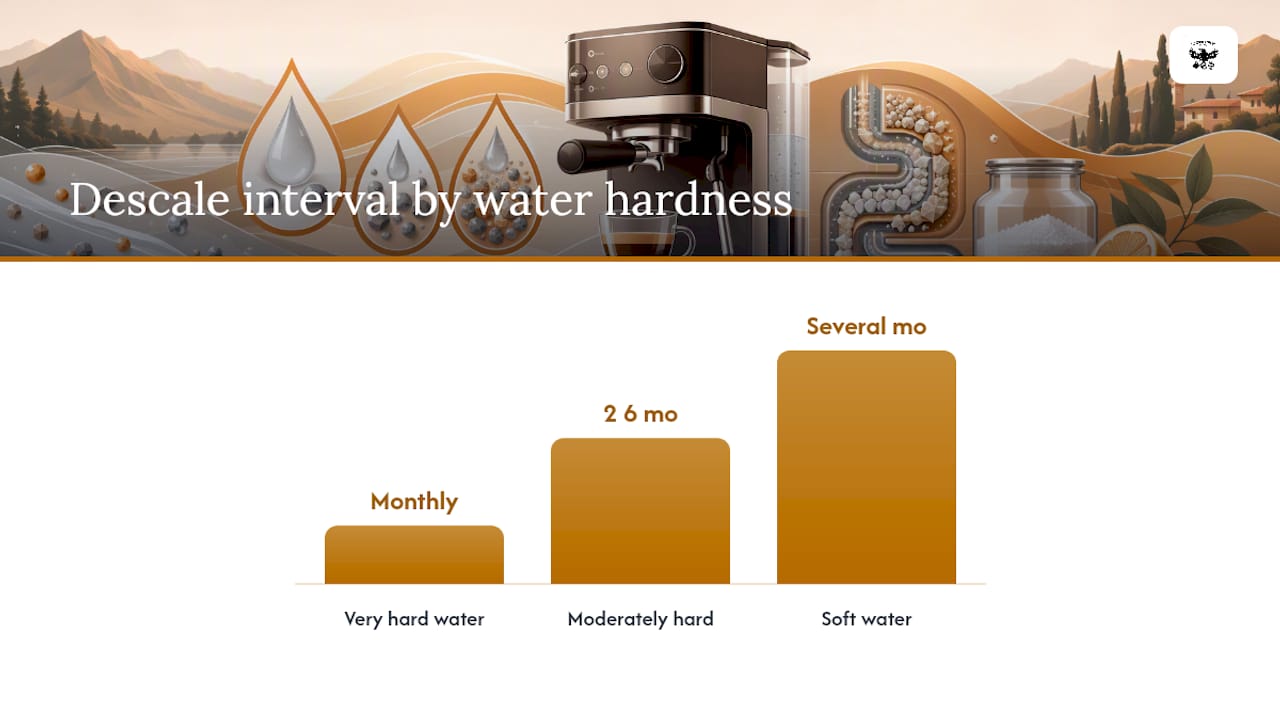
Water hardness drives this more than usage does. If you’re on very hard water, plan on descaling monthly. Moderately hard water usually stretches that to every 2 to 3 months, and soft water can push the interval out to descale several months apart.
A few habits keep you closer to the long end of that range:
- Brew with filtered or distilled water instead of straight tap water.
- Set your machine’s water hardness dial if it has one; most bean-to-cup machines do.
- Empty the reservoir when the machine sits idle for more than a day or two.
- Rinse the reservoir and dry removable parts weekly, since standing water accelerates mineral crystallization.
Slower brew times, lower output temperature, a rattling or gurgling boiler, and a lit descale indicator are the early warning signs. Catch those before flow drops off a cliff, and one round of citric acid usually solves it. Wait too long, and you’re looking at a stronger dose and a longer dwell time to break down what’s built up.
Tri Crow Coffee’s Practical Take on Equipment Care

David here. Descaling isn’t glamorous, but it’s the single maintenance habit that decides whether your coffee tastes the way it’s supposed to. My working rule: run citric acid between whatever cycle your manufacturer recommends, and default to the branded descaler if your machine is still under warranty. It’s not worth the argument with a manufacturer over a $10 mixup.
Scale buildup mutes flavor before it fails a machine outright. It insulates the heating element, drops your water temperature, and pulls the bitterness and acidity balance out of whack, long before you notice a mechanical problem. A clean machine is part of the ritual we build blends around: consistent water, consistent heat, consistent cup. Pair that discipline with attention to how freshly roasted coffee changes with time, and you’re controlling the two variables that matter most.
— David
What to Brew Once Your Machine Is Clean
A freshly descaled machine restores the flavor clarity that scale buildup slowly erodes, so it’s worth pairing that clean slate with coffee that can actually show it off.

Tri Crow Coffee roasts in small batches specifically so each cup reflects the water, heat, and timing you just dialed back in. If you’re running a drip machine or a cold brew setup, the Cold Brew Coffee, Dark French Roast, Coarse Ground holds up well against the crisp, mineral-free water you just rinsed through your system. Pod machine owners have two sizes to try: the 60-count Original Roast capsules for regular brewing, or the 12-count Original Roast pack if you’d rather test a smaller batch first. Order a bag or a box of capsules today, and taste the difference a truly clean machine makes on your very next brew.
Sources
For model-specific instructions, KitchenAid’s descaling walkthrough covers standard drip machines. The Takeout’s reporting on vinegar and warranties explains manufacturer pushback in more detail. Sweeter Grind’s citric acid recipe breakdown and CoffeeFixHub’s descaling agent comparison go deeper on ratios and material safety.
- How to clean and descale a coffee maker
- Why you shouldn’t clean your coffee maker with vinegar (The Takeout)
- DIY Descaling Solution: Citric Acid vs Vinegar Recipes | Sweeter Grind
- Descaling agents comparison (MoneyHub)
FAQ
What is the best homemade descaler?
Food-grade citric acid dissolved at roughly 8 to 12 grams per liter of water is the best homemade descaler for most machines, since it clears mineral buildup as well as vinegar without the lingering smell or seal wear.
What household items can I use to descale my coffee machine?
Citric acid powder and white vinegar are the two household staples that actually descale a machine internally; baking soda is useful only for cleaning external parts, not for removing scale from the boiler or water lines.
What can I use instead of a coffee machine descaler?
A DIY mix of citric acid and warm water, or a diluted white vinegar solution, works as a substitute for branded descaler on most drip machines. Espresso and bean-to-cup machines under warranty do better with the manufacturer’s own product.
How many rinse cycles do I need after descaling?
Run at least two full tanks of clean water after any descaling solution, and bump that to three or more if you used vinegar, since its smell and taste linger longer than citric acid’s.
How often should I descale my coffee machine?
Descale monthly if you have very hard water, every 2 to 3 months with moderately hard water, and descale several months apart if your water is soft.