
Store whole beans in an airtight, opaque container in a cool, dark spot and grind only what you need right before brewing. That single habit will do more for your cup than any expensive gear. Here’s what to do right now:
- Keep whole beans, not pre-ground. Ground coffee loses aroma within 15–30 minutes of grinding.
- Use an opaque, airtight container sized for 1–2 weeks of coffee. Ceramic jars with tight-fitting lids work well.
- Store in a cool, dark place away from the stove, window, or any heat source.
- Freeze only if you must, and only in vacuum-sealed, single-use portions. Never refreeze.
- Check the roast date, not just the best-by date. Fresh means roasted within the last 2–4 weeks.
Pro Tip: If your bag arrived within a few days of roasting, leave it in the original valve bag for the first 5 to 10 days. The one-way valve lets CO₂ escape without letting oxygen in. Transfer to a sealed jar only after degassing slows.
Key Takeaways
Keeping coffee tasting fresh requires an airtight, opaque container, a cool dark location, whole beans ground just before brewing, and portion sizes matched to 1–2 weeks of actual use.
| Point | Details |
|---|---|
| Container choice matters | Use an opaque, airtight container; clear glass accelerates light-driven staling. |
| Freshness window is short | Opened whole beans stay fresh roughly 2–4 weeks; ground coffee degrades in 1–2 weeks. |
| Freeze correctly or not at all | Portion into single-use sealed bags, freeze around 10 days post-roast, thaw sealed, never refreeze. |
| Match bag size to consumption | Buy quantities you’ll finish in 1–2 weeks to avoid managing long-term storage entirely. |
| Tri Crow Coffee | Small-batch roasts shipped close to roast date; the Best Sellers Sample Pack offers 2 oz portions ideal for freshness-first brewing. |
Table of Contents
- Why does coffee go stale so fast?
- How long does coffee actually stay fresh?
- What are the best ways to store coffee at home?
- Tri Crow Coffee’s small-batch storage checklist
- Quick do’s and don’ts for your coffee station
- The real trade-off between freshness and convenience
- Fresh coffee without the storage math
- Sources
- FAQ
Why does coffee go stale so fast?
Four things destroy coffee flavor: oxygen, moisture, heat, and light. Oxygen triggers oxidation, which flattens the aromatic compounds responsible for brightness and complexity. Heat speeds every chemical reaction involved in staling. Light, especially UV, breaks down volatile compounds directly. Moisture is the one most people underestimate.
Laboratory research confirms that roasted beans are highly hygroscopic, meaning they absorb ambient moisture readily. That absorbed water accelerates staling and, in humid conditions, can allow mold or rancid odors to develop. Professional multi-layer roaster bags are engineered to limit moisture transfer alongside oxygen, not just one or the other.
Degassing adds another layer of complexity. Freshly roasted beans off-gas CO₂ for days, sometimes weeks. During that window, sealing beans in a fully airtight jar can trap gas and create pressure. A bag with a one-way degassing valve lets CO₂ out while blocking oxygen in. Once degassing slows, typically 5–14 days post-roast depending on roast level, transferring to a sealed container makes sense. Packaging research found that vacuum packaging and high-barrier trilaminate bags with valves preserved polyphenols and extended shelf life significantly compared with permeable containers.
How long does coffee actually stay fresh?
Roast level and packaging both shift these windows. Light roasts retain some volatiles longer at moderate temperatures; darker roasts tend to stale faster once opened. Accelerated storage studies show most chemical and sensory deterioration in ground coffee occurs in the first two weeks after roast when exposed to oxygen and humidity. That’s why grinding fresh matters so much.
| Coffee State | Typical Freshness Window | Notes |
|---|---|---|
| Unopened bag (valve bag) | Up to best-by date, often 3–6 months | Quality peaks 5–30 days post-roast |
| Opened whole beans, room temp | 2–4 weeks | Airtight, opaque container required |
| Opened ground coffee | 1–2 weeks | Degrades rapidly; grind fresh when possible |
| Brewed coffee | 30 min (hot), 12–24 hrs (cold/sealed) | Flavor drops sharply after brewing |
| Frozen whole beans (vacuum-sealed) | 2–3 months | Single-use portions; never refreeze |
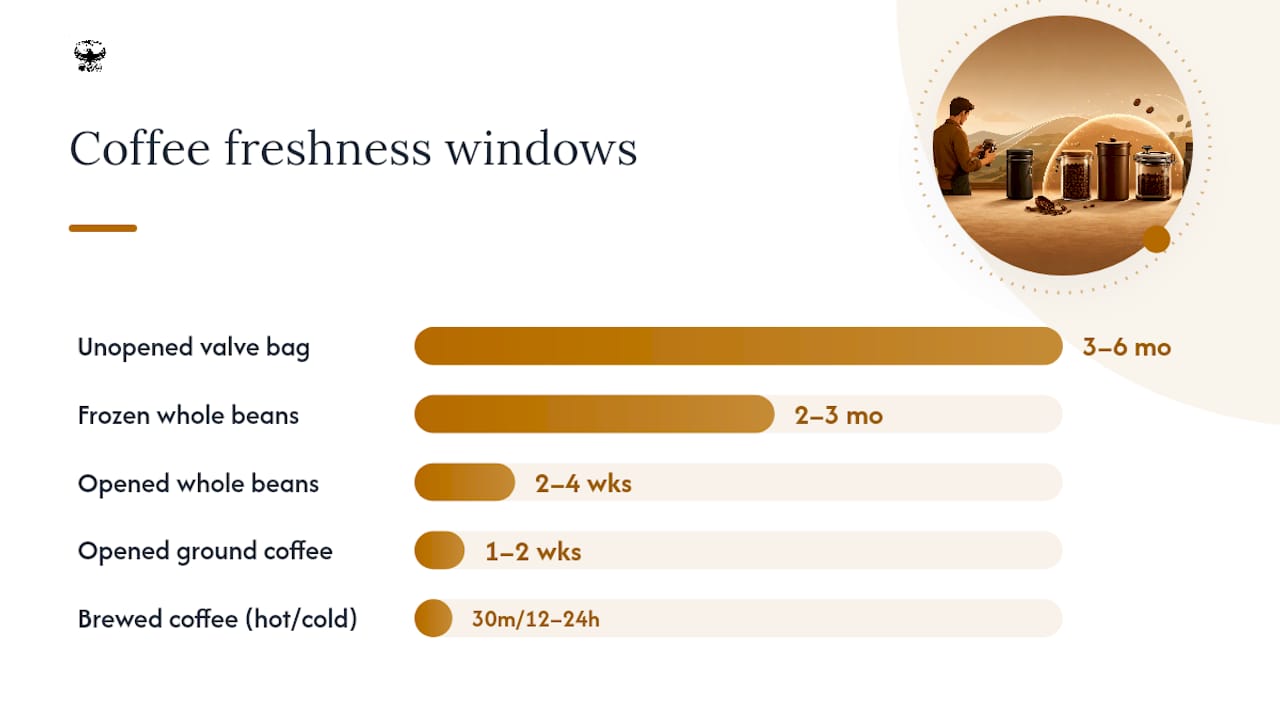
Per National Coffee Association guidance (no exact freshness figure stated), buying quantities you’ll use within 1–2 weeks and storing in airtight containers after the degassing window are the two most reliable ways to preserve flavor at home.
Pro Tip: Live somewhere humid? Shorten the opened-bean window by about a week. Moisture in the air accelerates staling faster than most people expect, even in a sealed container that gets opened daily.
What are the best ways to store coffee at home?
Everyday counter storage
An opaque, airtight container sized to hold 1–2 weeks of beans is the foundation of good home coffee storage. Keep it away from the stove, toaster, or any spot that gets warm. A cabinet or pantry shelf beats the counter if your kitchen runs hot.
Working with roaster valve bags
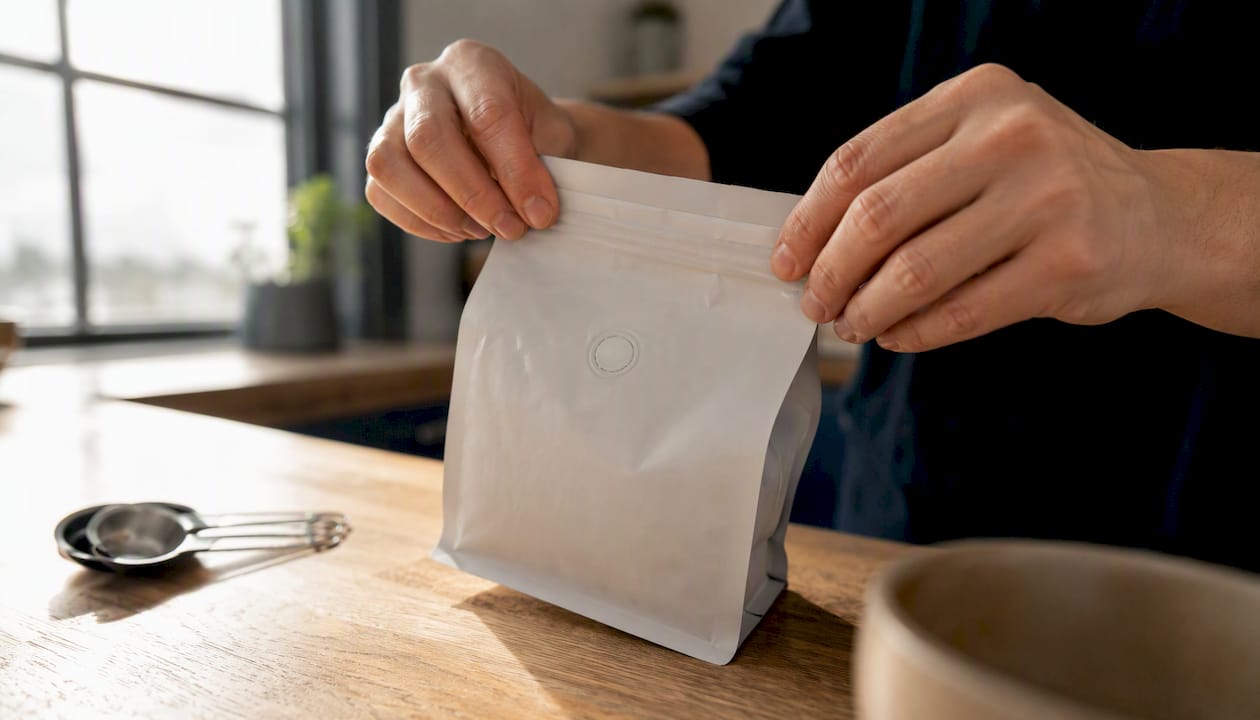
During active degassing (roughly the first 5–10 days post-roast), keep beans in the original valve bag, rolled and clipped at the top. Once you notice the bag no longer puffs up when you squeeze it, degassing has slowed, and it’s time to transfer to a sealed container.
Portioning to limit air exposure
Every time you open a container, you expose the remaining beans to oxygen. Split a large bag into two or three smaller sealed portions at the start. Use one portion daily and keep the rest sealed until needed.
Freezing protocol (step-by-step)
Freezing works, but only when done correctly. WIRED’s guidance on freezing coffee and Food & Wine’s roaster interviews both point to the same approach: wait until degassing has progressed (around 10 days post-roast), then vacuum-seal or double-seal beans in single-use portions before freezing.
- Portion into 25–50 g single-dose bags or small airtight containers.
- Remove as much air as possible; vacuum-seal if you have the option.
- Label each portion with roast date and freeze date.
- Thaw at room temperature, sealed, before opening. Never open a frozen bag while cold.
- Use within 2–3 months. Never refreeze a thawed portion.
Storage method comparison
| Method | Best For | Main Drawback |
|---|---|---|
| Opaque airtight jar/container | Daily use, 1–2 weeks of beans | Requires consistent cool, dark location |
| Original valve bag (rolled/clipped) | First 5–14 days post-roast | Not ideal once degassing stops |
| Vacuum-sealed portions | Longer storage, 2–3 months | Requires vacuum sealer or careful manual sealing |
| Freezer (portioned, sealed) | Buying in bulk or preserving rare lots | Thawing discipline required; no refreezing |
Tri Crow Coffee’s small-batch storage checklist
As a small-batch roaster, Tri Crow Coffee’s approach to storage starts before the bag even reaches your shelf. Roasting in limited quantities means every bag ships close to roast date, which gives you a genuine freshness window to work with rather than a bag that’s already weeks old.
Here’s a labeling template worth keeping near your coffee station:
- Roast date: ___________
- Origin / blend: ___________
- Opened on: ___________
- Grind date (if pre-ground): ___________
- Freeze date (if frozen): ___________
Recommended portion sizes by brewing habit:
- 1–2 cups daily: 100–150 g per container; replenish weekly.
- 3–4 cups daily: 200–250 g per container; replenish every 5–7 days.
- Occasional brewing or sampling: 25–50 g single-dose portions; ideal for the Best Sellers Coffee Sample Pack, which comes in 2 oz portions across six varieties.
For daily drinkers who want a reliable house blend, the 6 Bean Dark Roast is sized for consistent weekly use. If you prefer single-origin variety, the Tanzania Medium-Light is a small-batch option worth keeping in a dedicated 100–150 g container to preserve its brighter flavor notes.
Quick do’s and don’ts for your coffee station
Do:
- Buy in quantities you’ll finish within 1–2 weeks
- Keep whole beans and grind just before brewing
- Use an opaque, airtight container at room temperature
- Label everything with roast date and open date
- Freeze in single-use, sealed portions if storing longer than a month
Don’t:
- Store coffee near the oven, toaster, or a sunny window
- Refrigerate an open bag (temperature cycling and moisture are both problems)
- Use a clear glass jar for anything you plan to keep more than a few days
- Grind a week’s worth of coffee at once
- Refreeze a thawed portion
Memory aid: Airtight. Opaque. Cool. Dark. Fresh-ground.
The real trade-off between freshness and convenience
Most storage guides treat freezing as the gold standard. It can be, but for the average home brewer, buying smaller batches more often is simpler and produces better results with less effort. Freezing requires discipline: portioning before freezing, thawing correctly, never refreezing. One slip and you’ve wasted a good bag.
Where freezing genuinely earns its place is with rare or limited lots you can’t easily reorder, or when you’ve bought in bulk and know you won’t finish the bag within three weeks. For a single-origin like the Tanzania Medium-Light, freezing a portion to compare fresh versus frozen side-by-side is actually a useful experiment.
The habit worth adopting this week: check the roast date before you buy, match the bag size to your actual weekly consumption, and store in an opaque container the moment you get home. That’s it. No vacuum sealer required.
Fresh coffee without the storage math
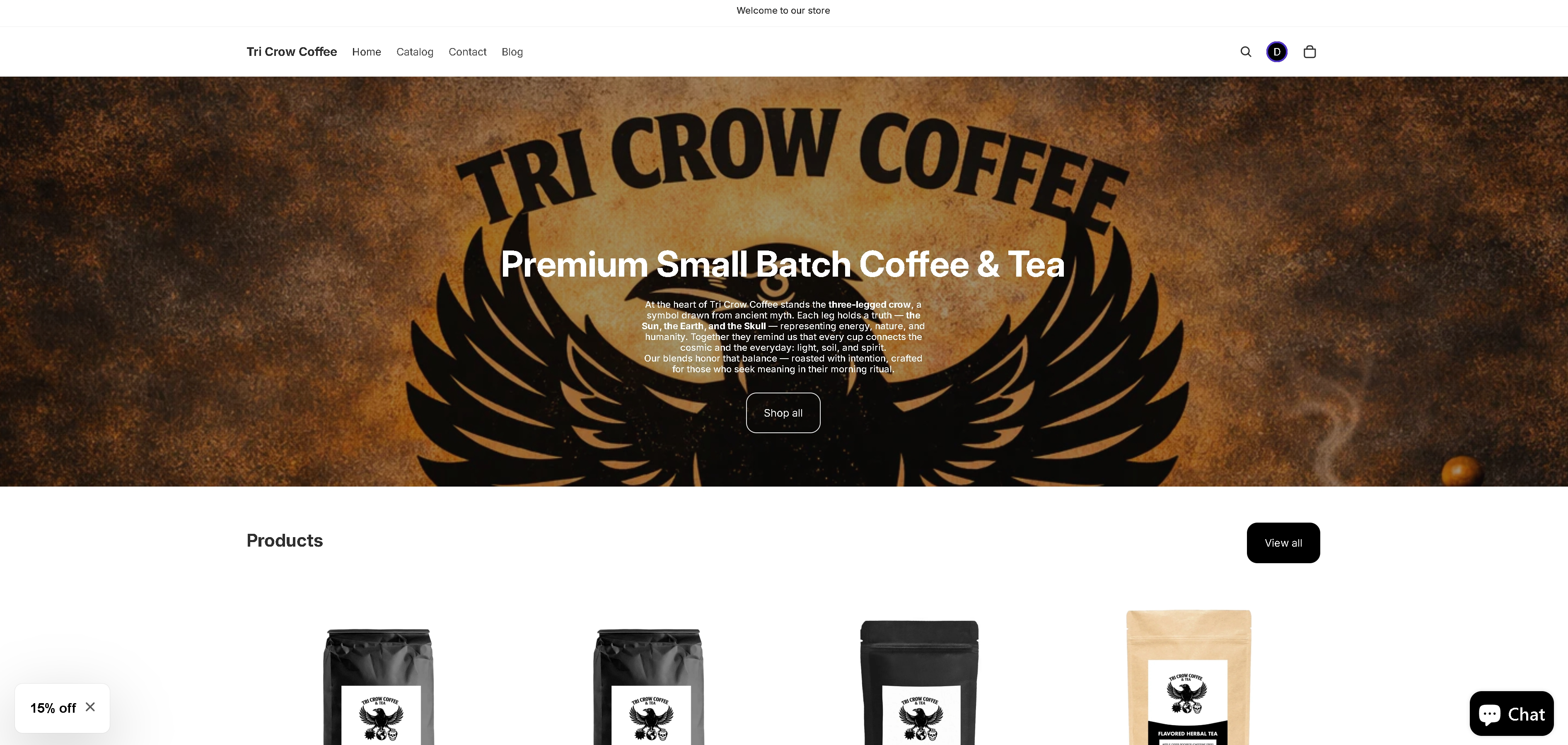
Tri Crow Coffee roasts in small batches and ships close to roast date, so the freshness window starts when the bag reaches you, not weeks earlier in a warehouse. The Best Sellers Coffee Sample Pack gives you six 2 oz varieties, each sized to use within a few days of opening. No bulk storage, no freezer protocol, no labeling system needed. For a consistent daily cup, the 6 Bean Dark Roast and the Tanzania Medium-Light both ship as small-batch roasts with clear roast-date transparency. Try the sample pack first and see which roast fits your routine before committing to a larger bag.
Sources
- Scientists note that moisture is a silent killer of coffee quality (Nature article)
- Storage and shelf life - Beans - National Coffee Association
- Should You Freeze Coffee Beans? Only if You Do It the Right Way | WIRED
- Packaging and polyphenol kinetics study (MDPI Foods)
FAQ
Is it better to keep coffee in the bag or in a jar?
It depends on how recently the coffee was roasted. In the first 5–14 days post-roast, the original valve bag is better because it lets CO₂ escape without letting oxygen in. After degassing slows, transfer to an opaque, airtight jar for daily use.
Does refrigerating coffee keep it fresher?
No. An open bag in the refrigerator picks up moisture and food odors, and the repeated temperature changes when you take it in and out accelerate staling. Store at room temperature in a sealed, opaque container instead.
How long do whole coffee beans stay fresh once opened?
Opened whole beans stored in an airtight, opaque container at room temperature typically stay fresh for 2–4 weeks, per National Coffee Association guidance. Ground coffee degrades much faster, within 1–2 weeks.
When should I freeze coffee beans?
Freeze only when you can’t use beans within about three weeks. Portion into single-use sealed bags, wait roughly 10 days post-roast so degassing has progressed, then freeze. Thaw each portion at room temperature while still sealed, and never refreeze.
What container is best for storing coffee beans?
An opaque, airtight container kept in a cool, dark cabinet is the practical standard. Ceramic jars with rubber-sealed lids work well for everyday use. Avoid clear glass for anything stored longer than a few days.