
For most people starting out, the best choice is an electric variable-temperature kettle with a stainless steel (304 grade) or borosilicate glass interior. Pick a stovetop kettle if you want the ritual and lasting durability, or a gooseneck only if you’re brewing small batches with precise pours. Manufacturer specs, The Spruce Eats, and Tri Crow Coffee’s own tasting notes all point the same way. The checklist below walks you through why.
TL;DR:
- Most beginners should choose an electric kettle with variable temperature control, food-grade stainless steel or borosilicate glass, and a capacity suited to their household size.
- Features like preset temperatures for specific teas and a hold function are essential for consistent flavor and brewing convenience.
- Compatibility with your stove matters: induction requires magnetic bases like stainless steel or cast iron, while gas and electric ranges are more versatile.
- Regular descaling is necessary in hard-water areas, and choosing a kettle with a wide opening simplifies maintenance.
- Reputable brands offer longer warranties and better support, making them a safer investment than cheaper, feature-limited options.
Table of Contents
- How to Choose the Right Tea Kettle by Type
- What Kettle Materials Are Safest for Tea?
- What Features Actually Matter for Brewing Tea?
- Which Kettle Works Best for Your Tea Type?
- How Do You Maintain a Kettle in Hard-Water Areas?
- Tea Kettle Buying Checklist: What to Ask Before You Buy
- How Loud Is a Kettle When It Boils?
- Does Kettle Brand Actually Matter?
- Will Your Kettle Work on Your Stovetop?
- How Do You Match a Kettle to Your Kitchen Style?
- Why Beginners Overthink This More Than They Should
- Try a Kettle-Ready Blend From Tri Crow Coffee
- Sources
- FAQ
How to Choose the Right Tea Kettle by Type
Before comparing specs, figure out which category fits your kitchen and your habits. Electric, stovetop, and gooseneck kettles solve different problems, and knowing which one matches your routine saves you from buying twice.
Electric kettles heat fast, often include digital presets, and shut off on their own. They’re the practical pick for apartments, offices, and anyone who wants consistency without babysitting a stove.
Stovetop kettles are simple, generally last longer since there’s no circuit board to fail, and appeal to people who like the whistle-and-pour ritual. They also work anywhere you have a burner, gas or electric.
Gooseneck kettles (usually electric, sometimes stovetop) have a narrow, curved spout built for control. Slow, steady flow matters when you’re pouring over a gaiwan or a small teapot and don’t want to disturb the leaves.
- Electric: fast, precise, but relies on electronics that can eventually wear out.
- Stovetop: durable and low-tech, but no temperature readout unless you add a thermometer.
- Gooseneck: excellent pour control, overkill if you mostly steep bags in a mug.
What Kettle Materials Are Safest for Tea?
Material choice shapes taste, how long the kettle lasts, and what ends up in your cup. Borosilicate glass is chemically inert, so it won’t alter flavor and lets you watch the water heat. Food-grade stainless steel, ideally 304 or 316 grade, resists corrosion and holds heat a bit longer than glass. Cast iron retains heat the longest of the bunch but adds weight and usually costs more. Ceramic exteriors look great but rarely touch the water directly. What to check before buying:
- Look for “304 stainless” or “borosilicate” explicitly stated in the product description, not just “stainless steel,” which can mean lower grades.
- Check whether the lid, spout, or internal filter is plastic. Even a small plastic piece near boiling water is a design flaw worth avoiding, since glass and metal minimize any leaching risk that lower-grade plastics can introduce.
- Avoid kettles with decorative interior tints or coatings you can’t identify.
- Read the base and handle materials too. Cheap plastic handles near a heating element degrade faster than they should.
Pro Tip: Search the product page for the words “food-grade” and a specific grade number. If a listing only says “stainless steel” with no grade, treat that as a missing detail, not a good sign, and look for a model that states it plainly.
What Features Actually Matter for Brewing Tea?
Marketing copy loves to highlight sleek design, but only a handful of features change what ends up in your cup. Variable temperature control tops that list. Delicate teas scorch easily, and presets around typical temperatures covering main tea categories cover green, white, oolong, and black tea without guesswork. A hold function that keeps water at temperature for 30 to 60 minutes is genuinely useful if you’re brewing more than one cup in a sitting.
Capacity matters more than people expect. A small-capacity kettle suits one or two people; a larger one covers a household without multiple reheats. Wattage affects speed: higher-powered electric kettles boil faster on a standard home circuit, which matters if you’re impatient in the morning.
- Insist on auto shut-off and boil-dry protection. These aren’t luxury extras, they’re basic safety.
- A readable digital display beats a vague dial when you’re trying to hit a specific temperature.
- A gooseneck spout only earns its price if you’re pouring over loose leaf in a small vessel; for mug-and-bag brewing, a standard spout is fine.
Skipping variable temperature is the single most common mistake first-time buyers make, and it’s the one upgrade that changes flavor the most.
Which Kettle Works Best for Your Tea Type?
Your daily cup should decide your kettle more than any spec sheet. Here’s how to match the two:
- Green and white tea: Use a variable-temp electric kettle set to 160 to 185°F. These leaves scorch at a full boil, and a borosilicate interior helps keep the water flavor-neutral.
- Oolong: A variable-temp kettle with a hold function works well since oolong often gets steeped multiple times. A gooseneck spout helps if you’re pouring into a small gaiwan.
- Black tea and pu-erh: These tolerate a full boil, so a basic electric or stovetop kettle does the job. Choose durable stainless steel if you’re brewing for a family every day.
- Herbal blends: Full boiling water is standard here. Prioritize capacity and boil speed over precision, since herbal infusions aren’t picky about a few degrees.
- Gongfu-style sessions: A small-capacity gooseneck kettle with a hold function is worth the investment. Reheating between short steeps changes extraction, so holding temperature steady preserves consistency round after round.
If you drink a mix of everything, which most people do, a variable-temp electric with a hold function covers the widest range without forcing you to own three kettles.
How Do You Maintain a Kettle in Hard-Water Areas?
Mineral scale builds up wherever water sits and heats repeatedly, and it changes flavor before it becomes a visible problem. Kettles with exposed heating coils scale faster than models with concealed plates, and that buildup eventually slows boil times and dulls taste.
- Descale every 2 to 4 weeks in hard-water regions using a vinegar or citric acid soak, then rinse thoroughly.
- Choose kettles with a wide-mouth opening or removable filter; both make scrubbing out mineral deposits far easier.
- If scale is severe where you live, stick with smooth stainless or glass interiors over exposed-coil designs, and consider a water softening solution if the problem is house-wide, not just kettle-deep.
Pro Tip: Fill the kettle to its max line with equal parts water and white vinegar, let it sit an hour, then boil once and dump it. Rinse three times before making tea.
Tea Kettle Buying Checklist: What to Ask Before You Buy
Use this on any product page in under a minute:
- What tea do I drink most, and does this kettle offer a preset for that temperature range?
- Does it have a hold function if I steep multiple rounds?
- Is the interior explicitly labeled food-grade stainless (304/316) or borosilicate glass?
- Where, if anywhere, does plastic touch water or steam?
- Is the capacity (1.0L vs 1.7L) right for how many people I’m serving?
- Does the wattage support a reasonably fast boil on my circuit?
- What does the warranty actually cover?
Budget shapes what you’ll find: under $50 gets basic presets and simpler builds, $50 to $120 covers most usable variable-temp kettles, and above $120 buys sharper accuracy or professional-grade construction that most home drinkers won’t need.
How Loud Is a Kettle When It Boils?
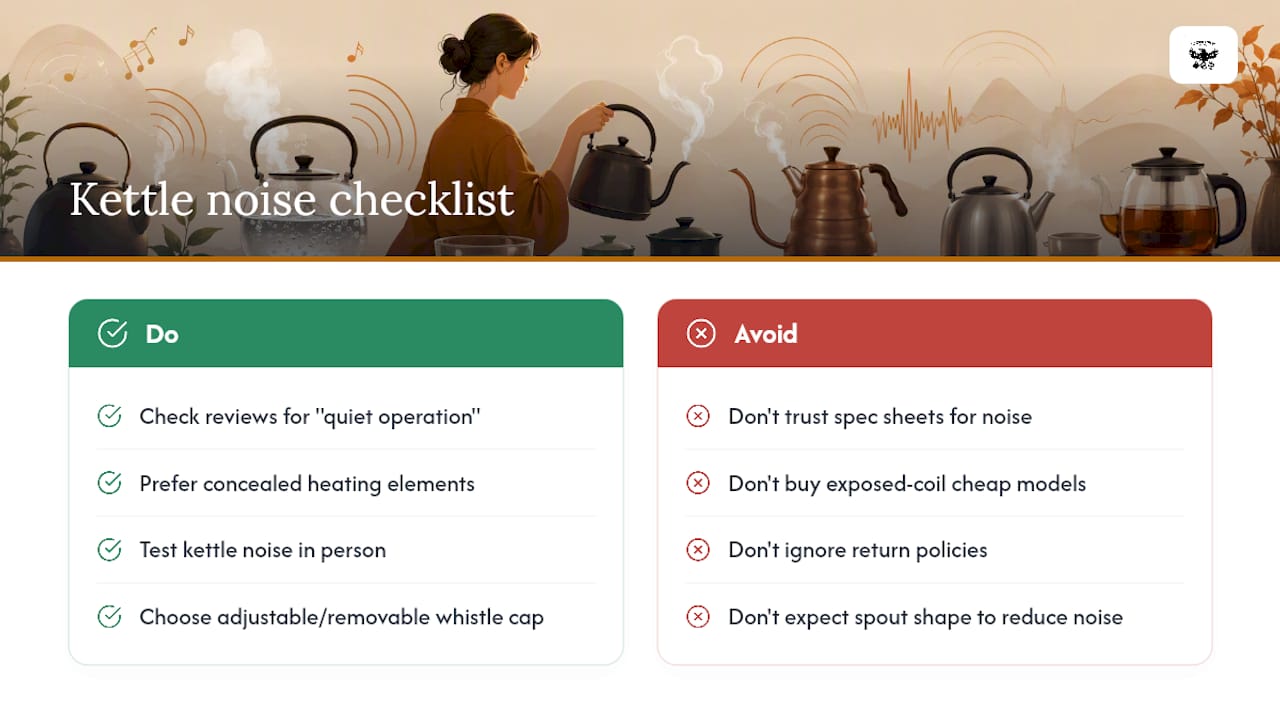
Boiling noise is one of those details nobody mentions until they’re standing in a quiet kitchen at 6 a.m. with a kettle that sounds like a jet engine. Electric kettles vary widely here. Cheaper models with basic heating elements tend to rattle and hiss as the water agitates, especially near the end of the boil cycle when steam pressure builds fastest. Higher-end electric kettles often use insulated bases and quieter heating elements that cut the noise down to a low hum.
Stovetop kettles introduce a different variable: the whistle. Some people love it as a built-in timer that tells them exactly when water is ready. Others find it jarring, particularly in small apartments or shared living spaces. If you’re sensitive to noise, look for stovetop models with an adjustable or removable whistle cap.
Gooseneck kettles, whether stovetop or electric, tend to run about as loud as their category average, since the spout shape doesn’t affect the boiling mechanism itself.
If quiet matters to you, a few practical signals help before you buy. Product reviews that mention “quiet operation” or “low noise” usually reflect genuine testing, not marketing fluff. Kettles with concealed heating elements (common in glass and stainless electric models) tend to run quieter than older designs with exposed coils, partly because concealed elements distribute heat more evenly and avoid the sharp rattling sound of water hitting a coil directly. If you share a kitchen with a sleeping household or work from home on calls, this is worth testing before you commit, since return policies vary and noise levels are hard to judge from a spec sheet alone.
Does Kettle Brand Actually Matter?
Brand reputation matters less for flavor and more for what happens when something breaks. A kettle with a one-year warranty and a company that actually answers support emails beats a slightly cheaper model backed by nothing.
Look at warranty length first. Most electric kettles in the $50 to $120 range carry warranties between one and two years. Anything with a warranty shorter than a year on a $100 kettle is a red flag, not a bargain. Stovetop kettles, having fewer components to fail, often carry longer warranties simply because there’s less that can break.
Reputation shows up in smaller ways too: whether replacement parts (lids, filters, cords) are available separately, whether the company publishes clear material specs instead of vague marketing language, and whether customer reviews mention responsive support when a unit fails early. A brand that hides its material grades or warranty terms behind vague language is telling you something about how it will handle a problem down the line.
None of this means you need to chase the most expensive name on the shelf. It means reading the warranty page before you read the five-star reviews, since the warranty tells you what the company expects from its own product.
Will Your Kettle Work on Your Stovetop?
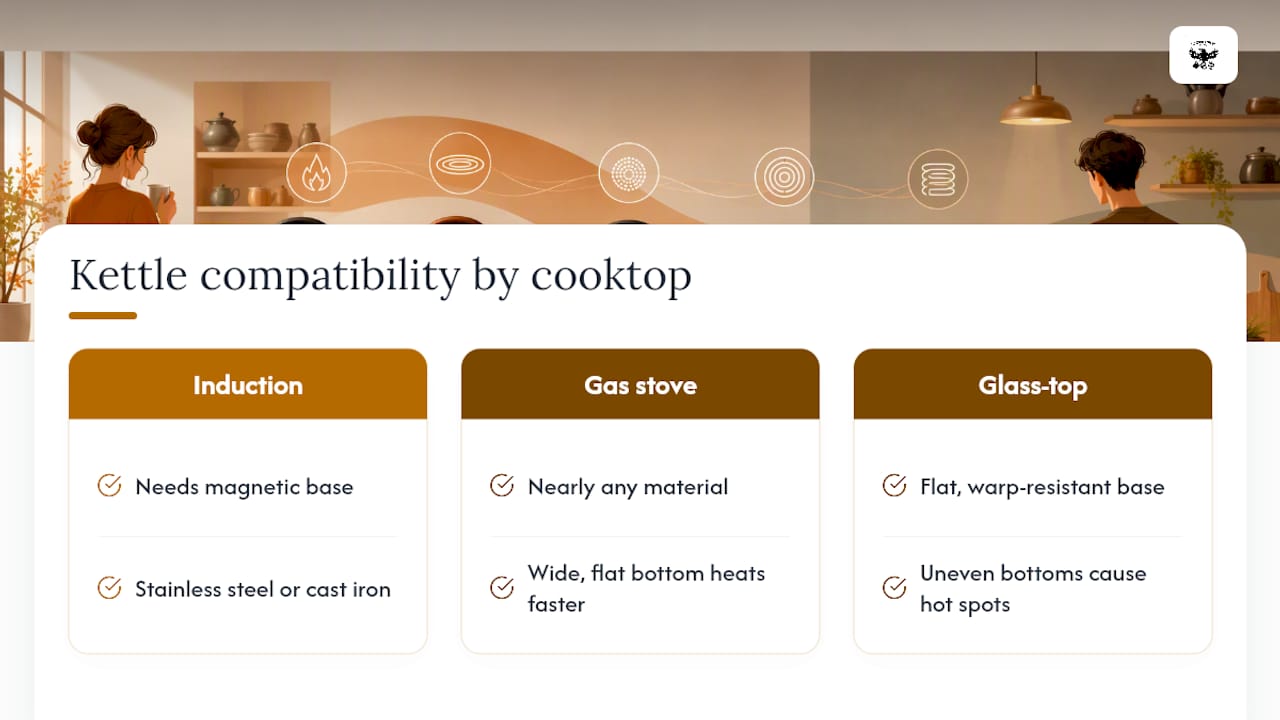
Compatibility with your specific heat source is easy to overlook until you unbox a kettle that doesn’t work on your stove. Induction cooktops only heat kettles with a magnetic base, typically stainless steel or cast iron. Glass and aluminum stovetop kettles generally do not work on induction, no matter how good they look in photos.
Gas stoves are more forgiving. Nearly any stovetop kettle material works, though wide, flat-bottomed kettles heat faster and more evenly over an open flame than narrow, rounded ones. Electric coil and glass-top stoves fall in between: they heat most kettle bases fine, but a warped or uneven kettle bottom can create hot spots or scorching on glass-top ranges specifically.
Electric kettles skip this problem entirely since they plug into a standard outlet and never touch a cooktop. That’s part of why they’re the default recommendation for renters or anyone who’s moved kitchens more than once and doesn’t want to gamble on compatibility again.
Before buying a stovetop kettle, check the base material against your cooktop type: stainless steel or cast iron for induction, nearly anything for gas, and a flat, warp-resistant base for glass-top electric ranges.
How Do You Match a Kettle to Your Kitchen Style?
Function should come first, but a kettle sits on your counter every day, so looks aren’t irrelevant. Matte black and brushed stainless finishes tend to blend into modern, minimalist kitchens without competing for attention. Enamel-coated stovetop kettles in solid colors work well in kitchens with warmer, more traditional palettes, and they double as a small pop of color if your cabinetry and counters are neutral.
Glass kettles offer a practical design bonus: you can see the water level and watch it heat, which some people genuinely enjoy as part of the tea ritual. Cast iron kettles, often finished in matte black or deep enamel colors, suit kitchens leaning toward a heavier, more rustic aesthetic.
Size matters visually as much as functionally. A bulky 1.7-liter kettle can dominate a small counter, while a slim 1.0-liter model tucks more easily next to other appliances. If counter space is tight, measure your intended spot before falling for a kettle’s photos online.
The honest advice here: don’t let aesthetics override the material and feature checklist above. A beautiful kettle with a low-grade stainless interior or no temperature control will disappoint you daily, while a good one will still look fine on your counter even if it’s not the flashiest option in the store.
Why Beginners Overthink This More Than They Should
Most people researching kettles spend hours comparing spec sheets when the real decision boils down to one question: what do you actually drink? If you’re steeping green tea and oolong most days, a $70 variable-temp electric kettle with a hold function will serve you better than a $200 model with features you’ll never touch.
At Tri Crow Coffee, we pair specific water temperatures with specific blends when we talk brewing with customers. Our Earl Grey does well around 200 to 212°F, while a caffeine-free blend like our Apple Cider Rooibos tolerates a full boil without turning bitter. A variable-temp kettle removes the guesswork on both ends.
— David
Try a Kettle-Ready Blend From Tri Crow Coffee
Once you’ve settled on a kettle, the next step is having something worth brewing in it. Tri Crow Coffee roasts and blends in small batches specifically because consistency matters, whether that’s a coffee roast or a tea leaf, and the same care that goes into picking a kettle should go into what you actually pour into it.
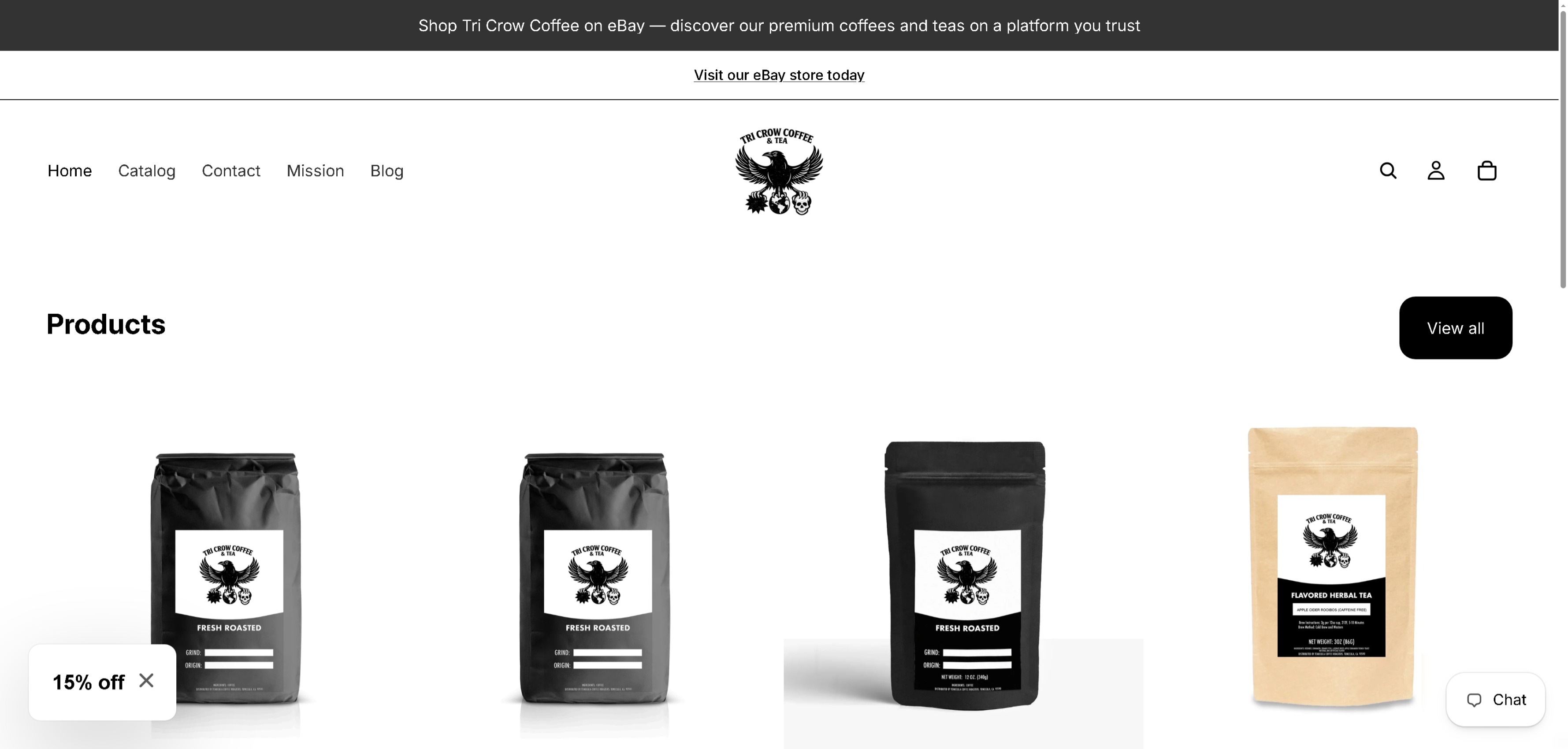
Our Earl Grey Tea, made with Ceylon OP leaves, bergamot oil, and blue cornflowers, is a natural companion for a full-boil brew around 200 to 212°F, exactly the range a basic or variable-temp kettle handles easily. If you want a caffeine-free option that’s more forgiving on temperature, our Apple Cider Rooibos works well straight off the boil. Not sure where to start? Browse the full Tri Crow Coffee shop and pick a blend that matches the tea style you just chose a kettle for.
Sources
- The Best Kettle for Tea: Variable-Temp and Gooseneck Options · The Tea Hearth
- The 7 Best Tea Kettles of 2026, Tested & Reviewed
- Precision electric gooseneck kettle product information
- Types of tea kettles: The ultimate kettle buying guide | KitchenAid
FAQ
Are there any tea kettles to avoid?
Avoid kettles that don’t specify their interior material grade, especially ones that only say “stainless steel” without a grade number, and skip any model with visible plastic touching the water or steam path.
What is the difference between a cheap and expensive kettle?
Budget kettles under $50 typically skip variable temperature control and use lower-grade materials, while kettles in the $50 to $120 range add accurate presets, better insulation, and sturdier stainless or glass interiors.
What is the healthiest kettle to boil water in?
Borosilicate glass and food-grade stainless steel (304 or 316) are the safest interior materials since both are chemically inert and resist leaching, while stovetop kettles tend to have fewer hidden plastic components overall.
What should I look for in a tea kettle?
Prioritize variable temperature presets (160, 175, 185, and 212°F), a hold function if you steep multiple rounds, a verified food-grade interior, and auto shut-off with boil-dry protection.