
Smoky black tea is black tea intentionally dried over wood smoke, and the defining example is Lapsang souchong, a Wuyi Mountain tea smoke-dried over pinewood fires. Expect pine resin, dried fruit, and campfire notes in the cup, and brew it exactly the way you’d brew any black tea: hot water, a few minutes, no special equipment required.
TL;DR:
- Authentic smoky black teas like Lapsang souchong are made with pine, cedar, or fruit woods during a traditional cold-smoking process that bonds aroma into the leaf.
- The intensity and character of smokiness depend on the wood type, smoking method, and whether the tea is single-origin, blended, or unsmoked.
- Good-quality smoked tea should smell like smoke with underlying notes of fruit, sweetness, or malt, and poor or over-smoked batches often smell like ash.
- Drinking smoked tea is safe at normal consumption levels, as PAHs transfer only limited amounts into infusions, but inhaling combusted leaves poses health risks similar to other smoke inhalation.
- To explore smoky tea, start with small samples and blend into familiar black teas to control flavor strength, avoiding homemade smoking or inhalation of raw leaves.
Table of Contents
- What Are the Main Types of Smoky Black Tea?
- How Is Smoky Black Tea Made?
- How Do You Brew Smoky Black Tea?
- Is Drinking Smoky Tea Safe? What About PAHs?
- How Tri Crow Coffee Thinks About Smoky Notes
- What Most Guides Get Wrong About Smoky Tea
- Ready to Try Smoky Tea? Start Small and Smart
- Sources
- FAQ
What Are the Main Types of Smoky Black Tea?
Almost every smoky black tea on the market traces back to Lapsang souchong, but the category has more range than most shelves suggest.
Traditional Lapsang souchong comes from the Wuyi Mountains and gets its character from smoke-drying over pinewood, often inside a smoking tower called a Qinglou. The result is resinous, slightly sweet, with dried longan fruit hiding under the campfire smoke, according to the tea’s own processing history.
Russian Caravan is a blend, not a single-origin tea. It usually mixes a smaller portion of smoky leaf with unsmoked black teas like Keemun or Assam, which tones the campfire intensity down to something more like a warm, woody background note.
Here’s where it gets confusing for shoppers: not everything labeled “Lapsang” is smoky. Zheng Shan Xiao Zhong, the unsmoked version of the same original tea, has become increasingly common in Chinese domestic markets, prized for its natural sweetness rather than smoke. The export style most Americans know is the smoked branch of that same family, a distinction worth knowing because it changes what’s in your cup.
When you’re reading a product description, look for these signals:
- “Traditional” or “Wuyi” usually signals heavier, pine-forward smoke
- “Blended” or “Caravan-style” usually signals a milder, rounder smoke
- “Unsmoked” or “Zheng Shan” (without “souchong”) means no smoke at all
- Vague terms like “smoky flavor” with no origin mentioned often mean the smoke was added, not processed in
How Is Smoky Black Tea Made?
The smoke you taste in genuine Lapsang souchong isn’t sprayed on. It’s built into the leaf during processing, which is the single biggest factor separating real smoked tea from imitation.
Traditional production uses cold smoking during withering, sometimes followed by a second, hotter smoking pass, a method that lets aromatic compounds bond with the leaf’s own chemistry rather than just coating the surface. That double pass is part of why authentic Lapsang tastes integrated instead of like an ashtray. Cheaper alternatives skip this entirely and use liquid smoke flavoring, which sits on top of the leaf and tastes flat and one-dimensional by comparison.
Wood choice matters just as much as the method:
- Pine produces resinous, camphorous, classic campfire notes
- Cedar gives a lighter, more aromatic smoke
- Fruit woods (apple, cherry) lean sweeter and less aggressive
A well-made smoky tea should smell like smoke with something underneath it, whether that’s fruit, sweetness, or malt. If the wet leaf smells like nothing but ash, that’s a sign of poor smoking or stale leaf, not a feature.
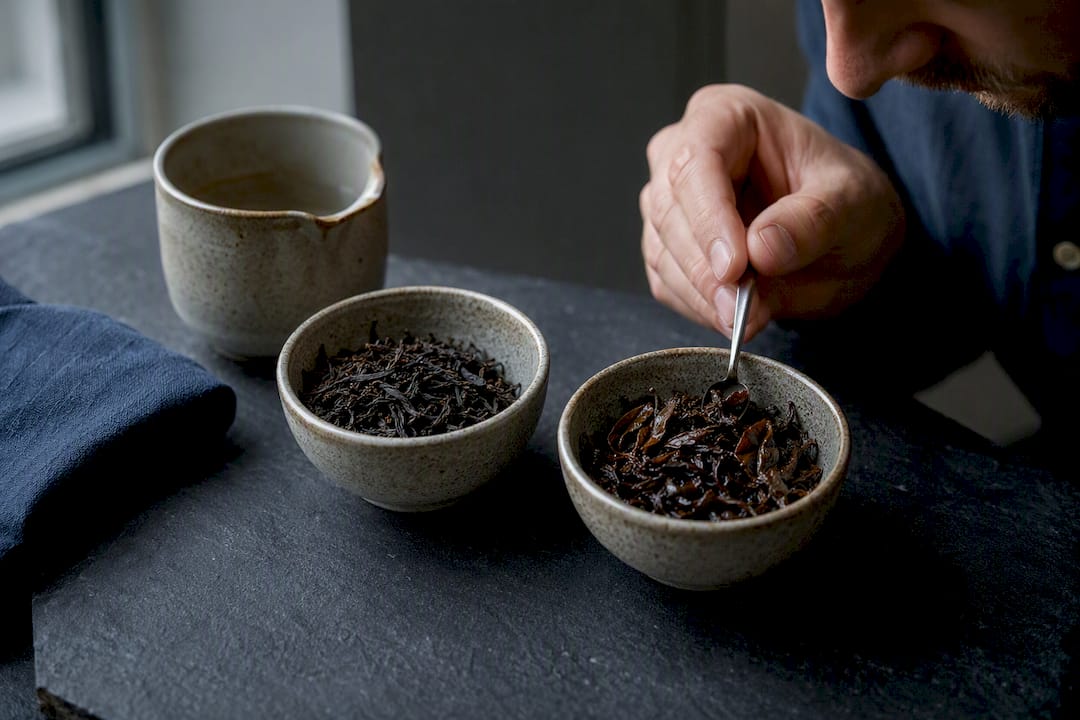
Pro Tip: Before you even brew, smell the dry leaf and then the wet leaf after a quick rinse. If both smell purely of ash with no fruit or sweetness underneath, the batch is likely low quality or over-smoked, no matter what the price tag says.
How Do You Brew Smoky Black Tea?
Smoky black tea behaves like any full-bodied black tea, so you don’t need special gear, just attention to ratio and time.
- Heat water to near boiling temperature. Full near-boiling water is standard for this leaf, per brewing guidance for Lapsang souchong.
- Use about one teaspoon of loose leaf per a standard cup of water. Adjust up slightly if you want a bolder smoke presence.
- Steep for 2 to 3 minutes for a Western-style cup. Pull the leaves earlier if you taste bitterness creeping in.
- For gongfu brewing, use a higher leaf ratio and steep in short 10 to 20 second flashes across multiple infusions, which reveals dried-fruit sweetness that a longer single steep can bury.
- Taste before adding anything. Smoky tea changes a lot with milk or lemon, and you want to know the baseline first.
Shortening your steep time or dropping the water temperature by a few degrees can soften an overly ashy or bitter cup while keeping the smoke aroma intact, a small adjustment tea guides recommend for anyone who finds their brew too harsh.
Milk rounds out the smoke and mutes some of the resinous edge, which makes it a reasonable choice if you find straight Lapsang too intense. Lemon does the opposite: it brightens the citrus-adjacent sourness in the tea and sharpens the smoke rather than softening it, so it works better for a black-tea drinker who already likes bold flavors.
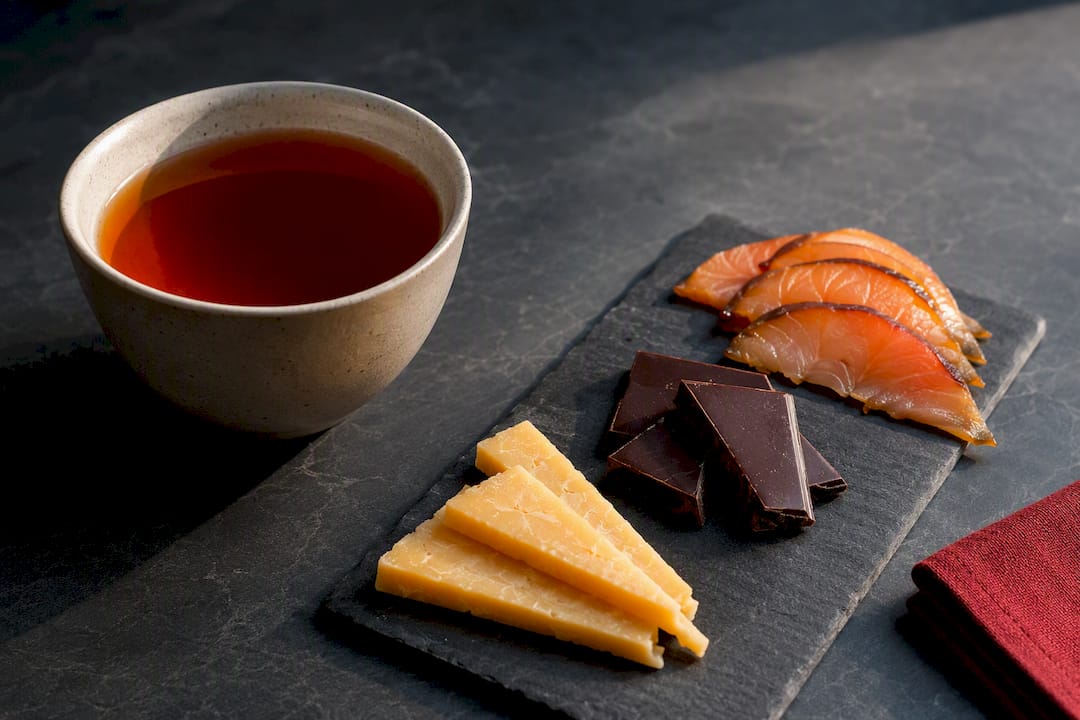
On the food side, smoky tea holds its own against strong flavors instead of getting lost. Aged cheddar, dark chocolate, and smoked meats or fish all work because the tea’s smoke doesn’t compete with them, it complements them, the same logic behind classic smoke-and-cheese or smoke-and-chocolate pairings.
Is Drinking Smoky Tea Safe? What About PAHs?
Drinking smoked tea and inhaling smoked tea are two entirely different risk categories, and conflating them is where most of the confusion starts.
Drinking Lapsang souchong in normal quantities carries no unusual safety concern beyond what applies to any caffeinated black tea. Smoking, meaning inhaling, tea leaves is a different story entirely. Medical News Today’s review is direct on this point: inhaling combusted tea offers no proven health benefit and can damage the lungs in ways comparable to other inhaled smoke. It is not a safer alternative to tobacco.
The other question worth understanding is PAHs, polycyclic aromatic hydrocarbons that form during wood combustion and attach to tea leaves during smoking.
Leaf-level PAH content in smoked tea can run high, but most PAHs are lipophilic and transfer into a water infusion only to a limited degree, which is why regulators in some markets have tightened limits on smoked tea products without banning the category outright.
That distinction, leaf content versus what actually ends up in your cup, is the piece most alarmist headlines skip, based on analysis from Sciences Thé.
Practical takeaways for shoppers:
- Buy from reputable producers who can speak to their smoking process
- Never attempt to smoke or inhale loose tea leaves at home
- Treat PAH exposure from drinking infused tea as a low-level, contextual concern rather than an emergency
- Moderate, regular consumption is the standard-sense approach here, the same logic that applies to other combustion-adjacent habits worth understanding before you worry about a cup of tea
How Tri Crow Coffee Thinks About Smoky Notes
Some producers roast and blend in small batches, which matters more for smoky tea than almost any other category, because smoke intensity is one of the easiest things to get wrong at scale.
A small-batch approach means tighter control over how much smoky leaf goes into a blend and how consistent that ratio stays from batch to batch. Too much smoky leaf overwhelms everything else in the cup; too little and you’re just paying for a marketing term. That balance is easier to hold when a batch is limited rather than mass-produced.
If you want to experiment without committing to a full smoky tea, consider these approaches:
- Start with a small sample rather than a full bag
- Blend a small portion of smoky leaf into a base you already know, like a strong breakfast black tea
- Taste the base alone first, then taste it with the smoky addition, so you can judge the actual effect
| What to try first | Why it works |
|---|---|
| A small smoky tea sample | Lets you test intensity before buying more |
| English Breakfast Tea as a blending base | Strong enough to carry smoke without disappearing |
| Guidance on blending teas | Helps you find your own ratio instead of guessing |
What Most Guides Get Wrong About Smoky Tea
The conventional advice treats smoky black tea like a novelty, something you try once and either love or dismiss. That framing undersells it. Lapsang souchong isn’t a gimmick flavor; it’s a genuine processing tradition with real technical depth, and the difference between a good and bad example comes down to craft, not just personal taste.
Where most guides fall short is safety messaging. They either ignore the PAH question entirely or swing to the opposite extreme and treat any smoked tea as dangerous. Neither is accurate. The evidence points to a narrow, specific risk (inhaling combusted leaves) and a much smaller, contextual one (trace PAH transfer into an infusion). Readers deserve that nuance instead of a blanket reassurance or a scare headline.
My honest recommendation: don’t judge smoky tea by one bad cup. A stale or over-smoked batch tastes like an ashtray, and it’s easy to assume that’s just what the category tastes like. Try a well-made version, at the right temperature, for the right time, before deciding it’s not for you. The flaw is usually in the leaf or the brew, not the concept.
— David P.
Ready to Try Smoky Tea? Start Small and Smart
There’s a smarter way to explore smoky black tea than buying a full bag of something you might not love: start with samples, store them properly, and test your own ratio before committing.
Keep any smoky leaf in an airtight container, away from other teas and coffee, since smoke aroma migrates fast and will taint anything nearby. Brew it straight first, then try it with a splash of milk, since the two experiences are genuinely different cups. Tri Crow Coffee’s artisan tea collection is built around that same small-batch philosophy of control over flavor and consistency, so quantities stay limited and quality stays even from one batch to the next. If you’d rather build your own blend, pick up a English Breakfast Tea as your base and add smoky leaf a little at a time until you find your ratio. Browse the collection, grab a starting size instead of a full bag, and taste your way to the blend that actually fits your mornings.
This article is general information, not a substitute for advice from a qualified doctor. Consult a qualified healthcare professional about your own circumstances before acting on anything here.
Sources
- Smoking tea: Risks, benefits, and more — Medical News Today
- Lapsang souchong — Wikipedia
- The Toxicity of Smoked Tea: What Are the Health Risks? — Sciences Thé
- Lapsang Souchong: The Complete Guide to the World’s First Black Tea | TeaDelight
FAQ
What tea has a smoky flavor?
Lapsang souchong is the tea most associated with smoky flavor, smoke-dried over pinewood in the Wuyi Mountains to produce pine-resin and campfire notes. Blends like Russian Caravan also carry smoky character, usually in a milder form.
Is smoky tea good for you?
Drinking smoky black tea in normal amounts carries no unusual health risk beyond what applies to black tea generally, and PAH transfer into the brewed infusion is limited even though leaf-level PAH content can run higher. The real risk lies with inhaling, not drinking.
Is Lapsang souchong good for you?
Lapsang souchong is safe to drink as a regular black tea, with the same general profile as other black teas plus trace, limited PAH exposure from the smoking process. It offers no unique health risk when consumed as a beverage rather than inhaled.
Which teas are smokable?
No tea is safe to smoke or inhale. Medical reporting is clear that inhaling combusted tea leaves, including Lapsang souchong, offers no proven benefit and can damage the lungs the way other inhaled smoke does. Smoky black teas are meant to be brewed and drunk, never burned and inhaled.