
TL;DR:
- Third wave coffee treats coffee as an artisanal product focused on single-origin beans, lighter roasts, and transparency. The movement emphasizes quality grading, manual brewing, and ethical sourcing, transforming consumer expectations. Its principles continue to influence the industry even as the wave metaphor becomes outdated.
Third wave coffee is defined as a craft movement that treats coffee as an artisanal product rather than a commodity, emphasizing single-origin beans, lighter roasts, and full supply chain transparency. The Specialty Coffee Association (SCA) anchors this movement through its 80-point scoring system, which certifies beans as specialty grade based on 10 evaluated attributes. Third wave coffee meaning goes beyond a brewing style. It represents a fundamental shift in how growers, roasters, and drinkers relate to the cup. Tri Crow Coffee operates squarely within this tradition, sourcing with intention and roasting in small batches to protect flavor integrity.
What is third wave coffee and what defines it?
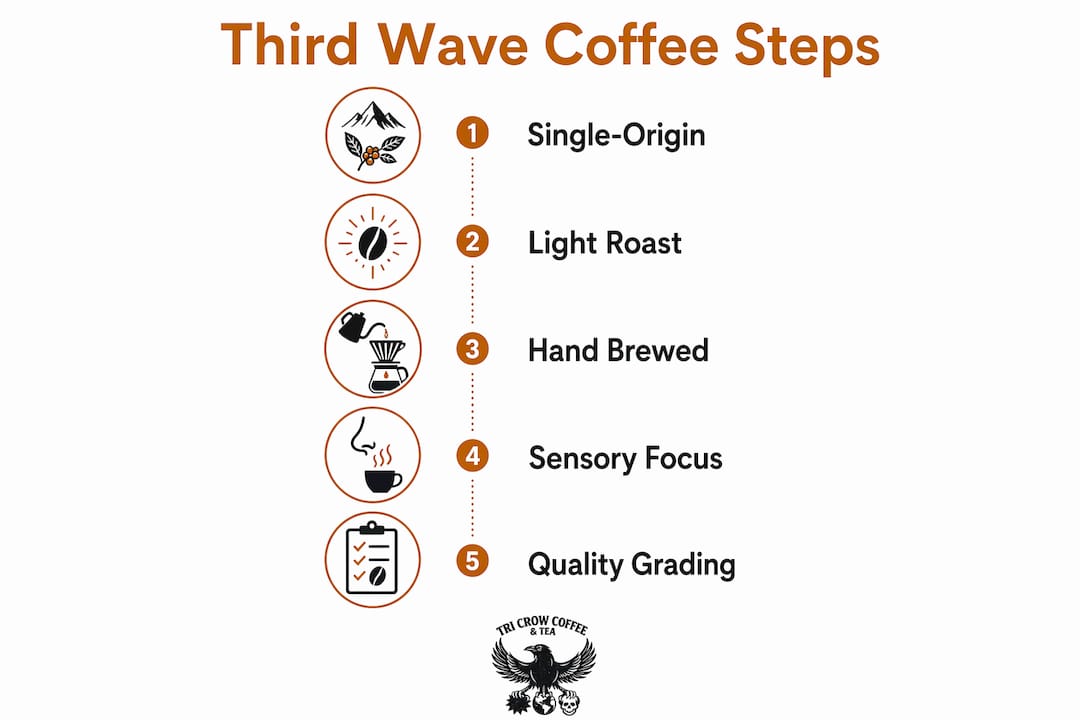
Third wave coffee is a movement built on the belief that every cup should reflect where it came from. The defining characteristics separate it sharply from mass-market coffee culture.
- Single-origin sourcing. Beans come from one farm, region, or cooperative. The coffee origin appears on the label alongside altitude, processing method, and harvest details.
- Lighter roast profiles. Roasters apply less heat to preserve the bean’s natural character. This reveals floral, fruity, or nutty notes that darker roasts would destroy. Lighter roasts and origin notes are standard markers of third wave coffee.
- Manual brewing methods. Pour-over, Chemex, AeroPress, and V60 are the preferred tools. Each method gives the brewer precise control over water temperature, grind size, and contact time.
- Direct trade and traceability. Roasters build relationships with farmers and pay above commodity prices. The goal is quality at the source, not just at the roaster.
- Packaging transparency. Third wave labels include roast date, farm name, altitude, and processing method. Freshness windows are shorter than commodity coffee, so that information matters.
Pro Tip: Check the roast date on any bag before you buy. Third wave beans are best within two to four weeks of roasting. A bag without a roast date is a red flag.
Third wave coffee also treats flavor as a sensory experience worth studying. Tasting notes like jasmine, stone fruit, or brown sugar are not marketing language. They describe real compounds produced by specific growing conditions and processing choices.

How did third wave coffee evolve?
Understanding the third wave requires knowing what came before it. Coffee culture moved through distinct phases, each building on the last.
- First wave. Mass-market coffee dominated the mid-20th century. Brands sold pre-ground, canned coffee focused on convenience and caffeine. Origin, roast date, and flavor complexity were irrelevant.
- Second wave. Espresso-based café culture emerged in the 1980s and 1990s. Chains popularized lattes, cappuccinos, and flavored drinks. The focus shifted to the barista’s milk technique and the café as a social space.
- Third wave. Starting in the late 1990s and gaining momentum through the 2000s, a new generation of roasters and drinkers pushed back against commodity thinking. Writer and roaster Trish Rothgeb is credited with coining the term “third wave coffee” in 2002.
“The third wave of coffee is, in many ways, a reaction to the second wave’s focus on milk and sugar. It asks: what does the bean actually taste like?”
The third wave parallels the craft beer and wine movements in a meaningful way. Coffee terroir, the idea that environmental growing factors shape flavor, became a central concept. Just as wine drinkers learn to identify a Burgundy from a Napa Valley Cabernet, third wave drinkers learn to recognize Ethiopian naturals from Kenyan washed coffees. The SCA formalized this culture by establishing grading standards, training programs, and certifications that gave the movement a professional backbone.
What role does specialty coffee grading play?
Specialty coffee grading is the quality control system that gives third wave coffee its credibility. The SCA defines specialty coffee as any coffee scoring 80 or above on a 100-point cupping scale. That score is not assigned casually.
Certified Q-graders perform structured cuppings to evaluate each lot. They assess 10 attributes: fragrance, aroma, flavor, aftertaste, acidity, body, balance, uniformity, cleanliness, and sweetness. A coffee must perform well across all 10 to earn specialty status. That rigor means a high score reflects genuine quality, not marketing.
| Attribute | What it measures |
|---|---|
| Fragrance/Aroma | Dry and wet scent of the ground coffee |
| Flavor | Overall taste impression in the cup |
| Acidity | Brightness or liveliness on the palate |
| Body | Weight and texture of the liquid |
| Balance | How well all attributes work together |
Grading also affects pricing and consumer trust. A coffee grading score above 80 justifies a higher price point because it reflects documented quality. Consumers who understand the system can make informed choices rather than relying on vague “premium” claims.
Pro Tip: Look for the term “Q-graded” or “SCA-certified” on a roaster’s product page. It means the coffee was evaluated by a trained professional, not just marketed as specialty.
Coffee cupping is also a skill any enthusiast can develop. Many specialty roasters host public cupping sessions. Attending one trains your palate faster than any amount of reading.
How do brewing methods shape the third wave experience?
The shift from second to third wave coffee moved the focus from barista milk technique to the inherent quality of beans. Brewing methods followed that logic. Manual devices that give the brewer full control replaced automatic machines that prioritized speed.
The most common third wave brewing tools are:
- V60. A cone-shaped pour-over dripper that produces a clean, bright cup. Grind size and pour rate directly control extraction.
- Chemex. Uses a thick paper filter that removes most oils, producing a clear and delicate cup. Ideal for showcasing floral and fruity notes.
- AeroPress. A pressure-based manual brewer that is forgiving and fast. It produces a concentrated cup with low acidity.
- Kalita Wave. A flat-bottomed dripper that promotes even extraction and consistent results.
Water temperature matters as much as the device. Third wave brewing typically uses water between 195°F and 205°F. Too hot and you extract bitter compounds. Too cool and the cup tastes flat and underdeveloped. Grind size is equally critical. A coarser grind slows extraction; a finer grind speeds it up.
The flavor payoff is real. A light-roasted Ethiopian Yirgacheffe brewed on a V60 can taste like blueberry and jasmine. The same bean roasted dark and brewed in a drip machine tastes like generic coffee. The bean did not change. The approach did. A pour-over workflow is the fastest way to start experiencing that difference at home.
What cultural impact has third wave coffee had?
Third wave coffee reshaped how the entire industry thinks about quality, ethics, and the relationship between growers and drinkers.
- Sustainability became a baseline expectation. The specialty coffee supply chain now includes ethical sourcing and long-term farmer relationships as standard practice, not optional add-ons.
- Transparency became a marketing tool and a moral standard. Consumers began asking where their coffee came from, and roasters who could answer clearly earned loyalty.
- The café became a classroom. Third wave coffee shops post origin maps, brew guides, and tasting notes. The goal is education, not just transaction.
- Farmer economics improved. Direct trade relationships mean farmers receive more per pound than commodity pricing allows. That income stability encourages investment in quality at the farm level.
“Industry experts now recommend moving from the wave metaphor to an ocean metaphor, reflecting ongoing innovation and overlapping traits across eras.” — Perfect Daily Grind
The wave framework itself is becoming outdated. Blending elements from multiple waves creates new and interesting coffee experiences. A roaster might use third wave sourcing standards but serve espresso in a second wave café format. That overlap is not a contradiction. It is the natural evolution of a maturing industry. Coffee trends in 2026 show that sustainability and ritual are now the dominant consumer values, regardless of which “wave” a product belongs to.
Key Takeaways
Third wave coffee is defined by single-origin sourcing, SCA-certified quality standards, lighter roasts, and manual brewing methods that prioritize flavor clarity over convenience.
| Point | Details |
|---|---|
| Specialty grading standard | SCA scores 80+ across 10 attributes confirm a coffee qualifies as specialty grade. |
| Lighter roasts reveal origin | Lower roast temperatures preserve floral, fruity, and nutty notes unique to each farm. |
| Manual brewing controls flavor | V60, Chemex, and AeroPress give brewers precise control over extraction and taste. |
| Transparency builds trust | Labels with roast date, farm name, and altitude let consumers make informed choices. |
| Ethics run through the supply chain | Direct trade and ethical sourcing benefit farmers and produce better beans. |
Why the third wave still matters, even as the labels fade
The wave framework was always a simplification. Coffee culture never moved in clean, discrete phases. What the third wave label did was give a name to something real: the moment when a critical mass of people decided that coffee deserved the same attention as wine or craft beer.
That shift changed consumer expectations permanently. Drinkers who learned to taste the difference between a washed Kenyan and a natural Ethiopian do not go back to anonymous blends. That educated palate is the third wave’s most lasting contribution.
What I find genuinely interesting is how the movement’s values have outlasted its vocabulary. Nobody argues about waves in a serious roasting conversation anymore. But the practices those waves introduced, traceability, lighter roasts, manual brewing, direct trade, are now the baseline for any roaster worth taking seriously. The ocean metaphor is more accurate. Quality, ethics, and craft are not a phase. They are the direction the whole industry is moving.
My practical advice: stop worrying about whether something is “third wave” and start asking better questions. Where did this bean grow? How was it processed? When was it roasted? Those questions get you to a better cup faster than any label.
— David
Tri Crow Coffee and the craft behind every batch
Tri Crow Coffee was built on the same values that define the specialty coffee movement: small batches, traceable origins, and roasting that serves the bean rather than the brand.
The Tanzania single-origin is a direct expression of third wave principles, with a medium-light roast that preserves the region’s natural brightness and clarity. For those who want to compare flavor profiles across origins, the best sellers sample pack offers six varieties in small quantities, making it easy to taste the difference that origin and roast level actually make. Every Tri Crow Coffee batch is roasted to order, so freshness is never a question.
FAQ
What is the simple definition of third wave coffee?
Third wave coffee is a craft movement that treats coffee as an artisanal product, focusing on single-origin beans, lighter roasts, and transparent sourcing to highlight natural flavors.
How is third wave coffee different from specialty coffee?
Specialty coffee is a quality standard defined by the SCA’s 80-point scoring system. Third wave coffee is a cultural movement that uses specialty coffee as its foundation but also includes brewing philosophy, ethics, and consumer education.
What brewing methods are used in third wave coffee?
Pour-over devices like the V60 and Chemex, along with the AeroPress, are the most common third wave brewing tools because they give the brewer precise control over extraction variables.
Who coined the term “third wave coffee”?
Trish Rothgeb, a roaster and writer, is credited with coining the term in 2002 to describe the emerging focus on bean quality, origin, and craft over commodity production.
Is third wave coffee still relevant in 2026?
The term is becoming less common, but the values it introduced, traceability, ethical sourcing, and flavor-first brewing, are now standard expectations across the specialty coffee industry.