
What is Robusta coffee?
Robusta coffee comes from Coffea canephora, a flowering plant native to central and western sub-Saharan Africa. You may also see it labeled as Congo coffee or Rio Nunez coffee, though “Robusta” is the name that stuck commercially. It accounts for roughly 30–40% of global coffee production, making it the second most important coffee species in the world after Arabica.
A few things set it apart immediately:
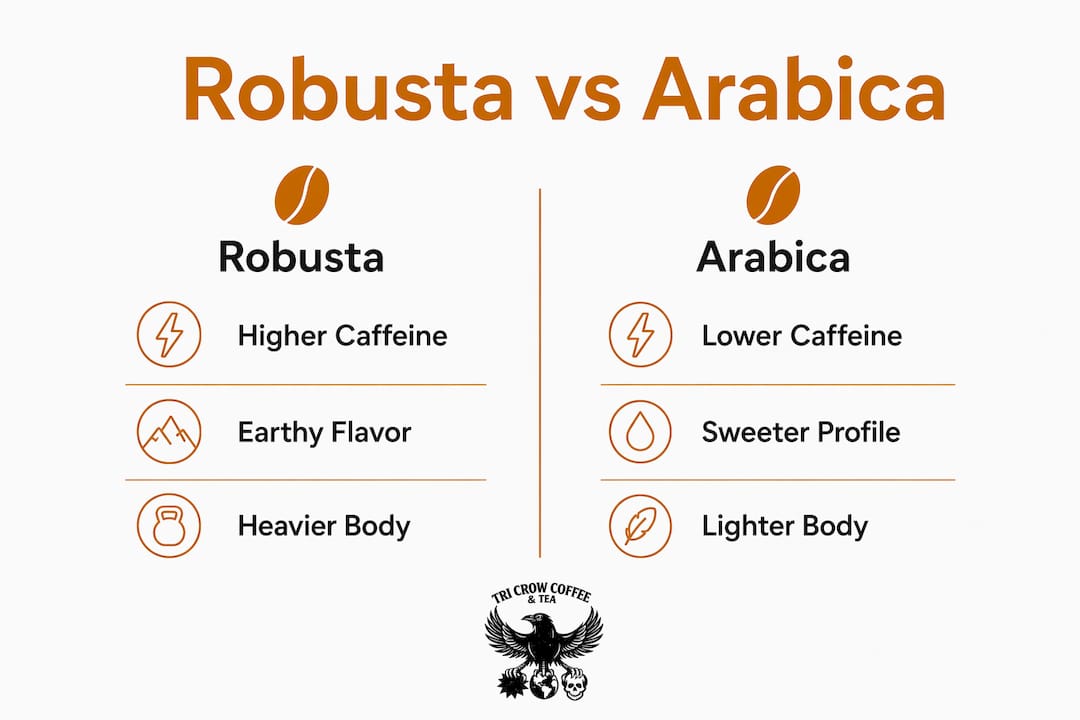
- Higher caffeine: Robusta beans contain approximately 2.2%–2.7% caffeine, nearly double the 1.2%–1.5% found in Arabica
- Bold, earthy flavor: Expect notes of earth, wood, and peanut, with dark chocolate emerging in better-quality roasts
- Heavier body, lower acidity: The cup feels thick and full, without the brightness typical of Arabica
- Commercial backbone: Widely used in instant coffee and espresso blends for crema and body
- Resilient crop: Thrives at lower elevations and in warmer climates, with strong resistance to pests and disease
Botanical classification and native origins of Coffea canephora
Coffea canephora belongs to the family Rubiaceae, the same plant family that includes gardenias and quinine trees. It was not formally recognized as a distinct Coffea species until 1897, more than a century after Coffea arabica was classified. The plant grows as a tree or shrub reaching about 10 meters tall, with glossy elliptic leaves and white, star-shaped tubular flowers.
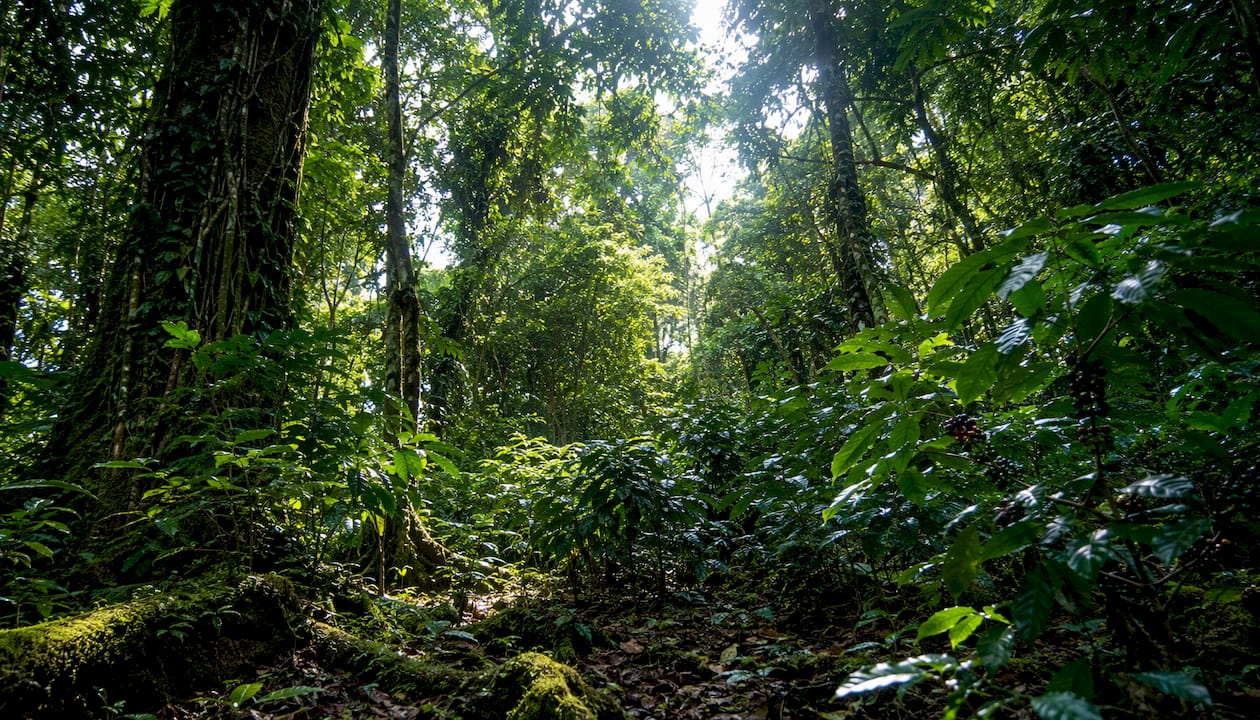
One botanical detail that surprises many coffee drinkers: unlike Arabica, Coffea canephora cannot self-pollinate. It requires cross-fertilization, which drives its higher genetic diversity across both cultivated and wild populations. That diversity is part of why the species adapts so well to different growing environments.
Key botanical and cultivation facts:
- Root system: Shallow, which makes the plant more sensitive to drought but also easier to manage on flat terrain
- Elevation: Thrives at lower altitudes (below 1,000 meters), where Arabica struggles
- Temperature: Prefers warmer conditions, roughly 23°C–30°C, tolerating heat that would stress Arabica plants
- Disease resistance: Less susceptible to pests and coffee leaf rust, requiring fewer pesticides than Arabica
- Bean shape: Produces oval-shaped beans that are smaller and rounder than typical Arabica beans
- Ripening time: Berries take about 10–11 months to ripen after flowering
The plant’s native range spans the Congo Basin and extends into Uganda and West Africa. Today, Vietnam, Indonesia, and Uganda are the world’s leading Robusta producers.
How does Robusta coffee taste compared to Arabica?
Robusta’s flavor profile centers on earthy, woody, and peanut-like notes, with a heavier body and noticeably low acidity. At higher quality levels, roasters pull out something closer to dark chocolate. The cup is dense and filling rather than bright or complex.

The chemistry behind that boldness is straightforward. Robusta contains roughly 60% less fat and sugar than Arabica, which means there is less sweetness to soften the caffeine’s natural bitterness. Its pyrazine content adds a distinctive woody, sometimes rubbery note that Arabica simply does not carry. Chlorogenic acid levels are also higher, amplifying bitterness and astringency.
| Characteristic | Robusta | Arabica |
|---|---|---|
| Caffeine content | 2.2%–2.7% | 1.2%–1.5% |
| Flavor profile | Earthy, woody, peanut, dark chocolate | Fruity, floral, sweet, complex |
| Acidity | Low | Medium to high |
| Body | Heavy, full | Light to medium |
| Typical uses | Espresso blends, instant coffee | Specialty brews, single-origin |
Processing method matters more for Robusta than most drinkers realize. Wet processing tends to clean up the harsher notes, while poor post-harvest handling amplifies the rubbery off-tones. For a deeper look at how coffee flavor profiles develop across species, roast level plays an equally large role.
How Robusta coffee is grown and used around the world
Robusta’s agricultural advantages are real. It yields more fruit per plant than Arabica, tolerates a wider range of climates, and needs less chemical intervention. Those traits make it cheaper to grow and more reliable at scale, which is why it dominates production in Vietnam and Indonesia.
Commercially, Robusta shows up in two main places:
- Instant coffee: Its higher soluble solids content makes it ideal for freeze-dried and spray-dried products
- Espresso blends: Traditional Italian espresso blends include Robusta specifically for thicker crema and a fuller body
- Vietnamese coffee: Robusta is the base for cà phê sữa đá, where its intensity holds up against sweetened condensed milk and ice
- Milk-based drinks: The bold flavor cuts through milk in lattes and cappuccinos without disappearing
- Budget blends: Lower production cost makes it a filler in commercial ground coffee
Robusta accounts for roughly 30–40% of the world’s coffee supply. Vietnam alone produces a large share of that total, having built its entire export industry around Coffea canephora. The perception of Robusta as a lower-grade filler is shifting, though, as specialty roasters explore what careful processing can reveal. Tri Crow Coffee’s Italian Roast Dark is a good example of an Arabica/Robusta blend that uses each species for what it does best: Arabica for complexity, Robusta for body and crema.
Key differences between Robusta and Arabica coffee
The difference between Robusta and Arabica goes well beyond taste. They are distinct species with different genetics, growing requirements, and market positions.
Caffeine is the most measurable gap. Robusta carries nearly double the caffeine of Arabica, a difference driven by specific gene expressions (CaXMT1, CaMXMT1, and CaDXMT2) that regulate caffeine accumulation in the beans. That higher caffeine also acts as a natural insect repellent, contributing to Robusta’s pest resistance.
| Dimension | Robusta | Arabica |
|---|---|---|
| Caffeine | ~2.2%–2.7% | ~1.2%–1.5% |
| Flavor | Bold, earthy, bitter | Sweet, fruity, nuanced |
| Acidity and body | Low acid, heavy body | Higher acid, lighter body |
| Growing elevation | Below 1,000 m | 600–2,000 m |
| Common uses | Instant coffee, espresso blends | Specialty coffee, single-origin |
| Market price | Lower | Higher |
Arabica’s sweeter, more acidic profile comes partly from its higher sugar content (6–9% vs. Robusta’s 3–7%) and higher fat content. Those compounds create the aromatic complexity that specialty coffee culture prizes. For a full breakdown of Arabica’s flavor and origins, the two species are genuinely complementary rather than competing.
What craft roasters and industry experts say about Robusta
The specialty coffee world has spent years dismissing Robusta, and that view is now being revised. The Specialty Coffee Association has documented the rise of “fine Robusta” as a distinct category, with carefully processed beans revealing complex profiles that challenge the harshness stereotype. The rubbery or phenolic off-notes that gave Robusta its bad reputation are largely a product of industrial harvesting, not the species itself.
Industry experts point out that Robusta’s intensity is actually an asset in the right context. Its flavor holds up in milk-based drinks like Vietnamese cà phê sữa đá and Italian-style cappuccinos, where a lighter coffee would simply vanish. Roasters who work with quality Robusta treat it the way they treat any specialty ingredient: with attention to origin, processing, and roast profile.
Key insights from the specialty coffee community:
- Fine Robusta processed with care can show chocolate, nutty, and even fruity complexity
- Wet processing and selective harvesting reduce the rubbery off-notes linked to poor handling
- Robusta’s boldness suits espresso-based drinks and milk-forward preparations
- Arabica and Robusta work best as complements, not substitutes
Pro Tip: If you want to experience Robusta at its best, try it in a well-crafted espresso blend rather than a cheap instant. The crema will be noticeably thicker, and the body will linger in a way that straight Arabica often does not.
Tri Crow Coffee approaches blending with exactly this logic. The French Roast delivers bold Central American character, while the Brazil Santos shows what a clean medium roast can do when the beans are handled with care. Both reflect the same principle: species and roast level are tools, not labels.
Key Takeaways
Robusta coffee (Coffea canephora) carries considerably more caffeine than Arabica, a heavier body, and earthy flavor notes that make it indispensable in espresso blends and instant coffee worldwide.
| Point | Details |
|---|---|
| Botanical identity | Robusta is Coffea canephora, native to central and western sub-Saharan Africa. |
| Caffeine content | Robusta contains a notably higher caffeine percentage compared to Arabica. |
| Flavor profile | Earthy, woody, and peanut-like, with dark chocolate notes in quality roasts. |
| Global production | Robusta accounts for roughly 30–40% of the world’s coffee supply. |
| Best uses | Espresso blends, instant coffee, and milk-based drinks where bold flavor holds up. |
FAQ
What makes Robusta coffee different from other coffees?
Robusta (Coffea canephora) stands out for its higher caffeine content, heavier body, and earthy flavor compared to Arabica. It also grows at lower elevations and resists pests and disease more effectively than other commercial coffee species.
What is another name for Robusta coffee?
Robusta coffee is also called Congo coffee or Rio Nunez coffee, though its scientific name is Coffea canephora. The trade name “Robusta” comes from one of its main botanical varieties, C. canephora var. robusta.
Is Robusta coffee good for espresso?
Yes. Quality Robusta is a traditional ingredient in Italian espresso blends, where it contributes a thicker crema and fuller body. The key is sourcing well-processed beans, since poor handling amplifies bitterness rather than the earthy complexity the species can offer.
Does Robusta coffee have more caffeine than Arabica?
Robusta contains roughly 2.2%–2.7% caffeine by weight, compared to about 1.2%–1.5% in Arabica. That gap is consistent across roast levels, though darker roasts concentrate caffeine slightly as moisture evaporates during roasting.