
TL;DR:
- Direct trade coffee involves roasters buying beans directly from farmers or cooperatives without third-party certification, focusing on quality-linked premiums. The model emphasizes ongoing relationships, transparency, and payment based on cup quality rather than market floors, often exceeding Fair Trade prices significantly. Consumers should verify authenticity by checking for named farms, published prices, and long-term commitments rather than trusting labels alone.
Direct trade coffee is defined as a sourcing model where roasters purchase beans directly from farmers or cooperatives, paying quality-linked premiums and building ongoing relationships without third-party certification. Unlike commodity purchasing, direct trade ties price to cup quality rather than market floors. There is no governing body that certifies or audits these claims. That absence of oversight makes transparency the only real standard. Tri Crow Coffee, like other specialty roasters committed to this model, treats sourcing relationships as the foundation of every cup rather than a marketing footnote.
What is direct trade coffee and how does it work?
Direct trade is a non-certified sourcing model where roasters negotiate directly with producers, paying top-tier lots $3–8 per pound FOB and competition-grade beans $15–50 or more. That pricing sits well above commodity levels, which historically return farmers only 7–10% of a coffee’s retail price. The premium reflects cup quality, not just social goodwill.
The word “direct” deserves scrutiny. Roasters often still use exporters and importers for logistics even in genuine direct trade relationships. “Direct” means direct negotiation and a direct relationship, not the literal removal of every intermediary in the supply chain. Import and export complexity remains. The roaster-producer contact is the focal point.
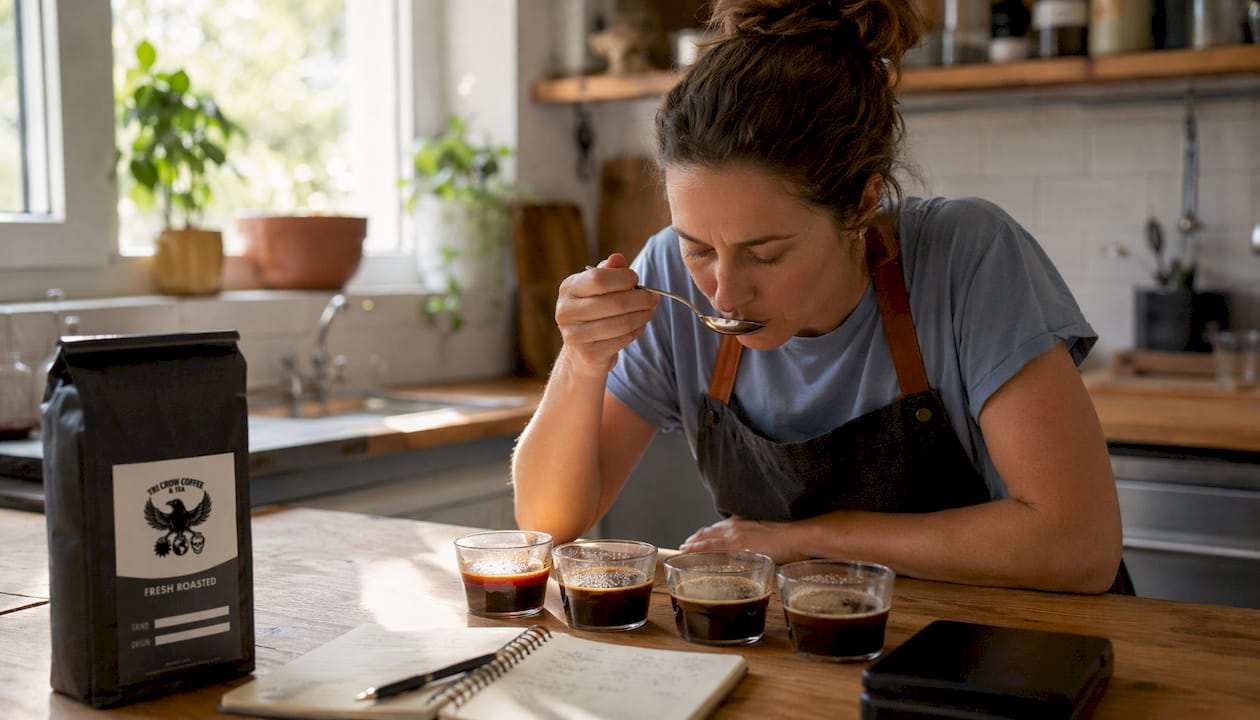
What makes this model work is the feedback loop it creates. A roaster who visits a farm, cups the harvest, and commits to buying that lot for multiple seasons gives the farmer both income certainty and quality guidance. That combination is rare in commodity coffee and largely absent in most certification programs.
How does direct trade differ from Fair Trade and other sourcing models?
Fair Trade sets minimum price floors of roughly $1.40–$1.80 per pound, protecting farmers when commodity prices collapse. That floor matters enormously during market downturns. The limitation is that Fair Trade premiums flow to cooperatives, and how fairly those funds reach individual farmers depends entirely on cooperative governance.
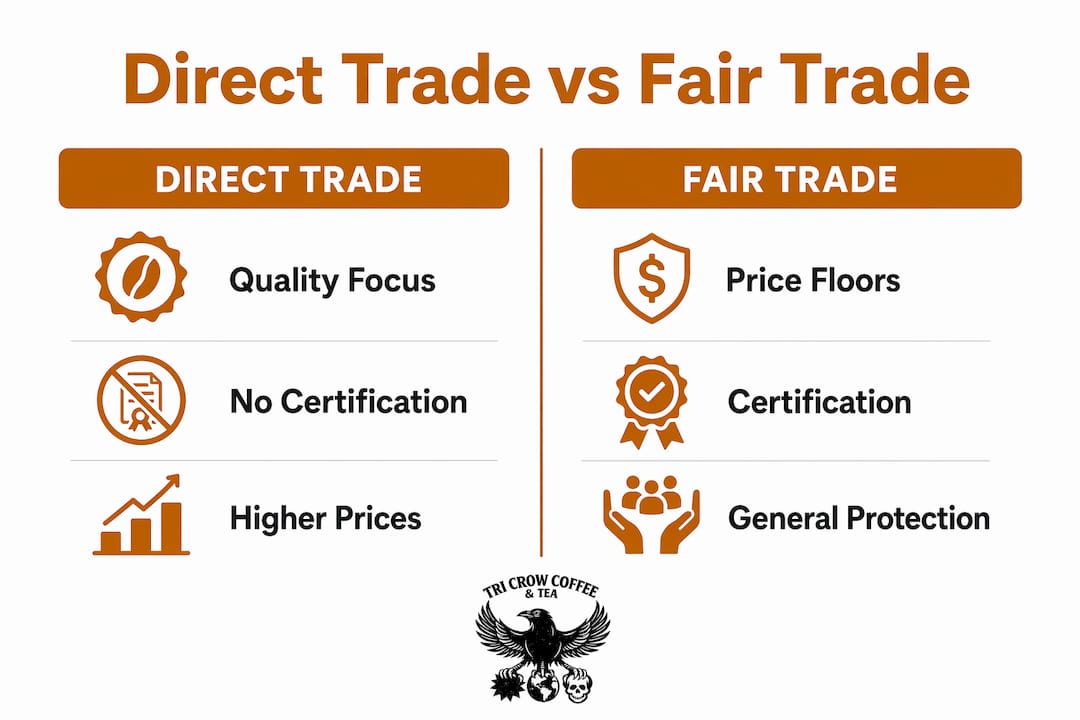
Direct trade has no floor and no ceiling. Price is negotiated based on cupping scores and lot quality, which means premiums often run 2–5 times the C-market price for specialty lots. That creates economic incentives for farm-level innovation that Fair Trade’s structure does not produce.
The structural differences come down to three points:
- Certification: Fair Trade is audited by third parties like Fairtrade International. Direct trade is self-defined and unverified by any external body.
- Pricing: Fair Trade guarantees a minimum. Direct trade rewards quality with higher prices but offers no safety net if quality drops.
- Relationships: Fair Trade works through certified cooperatives. Direct trade requires an ongoing roaster-to-producer relationship, sometimes bypassing cooperatives entirely.
Neither model is universally superior. Fair Trade protects against price collapse. Direct trade rewards excellence. The best sourcing programs often combine elements of both. For a deeper look at how Fair Trade certification works, the Fair Trade sourcing explained article at Tri Crow Coffee covers the certification mechanics in detail.
Pro Tip: When you see both “Fair Trade certified” and “direct trade” on the same bag, check whether the roaster publishes the actual price paid per pound. That number tells you more than any label.
What markers identify authentic direct trade sourcing?
Authentic direct trade requires roasters to publish detailed pricing at FOB, name specific farms or cooperatives, and maintain ongoing purchasing relationships. Without those disclosures, “direct trade” is a marketing phrase with no substance behind it.
The markers that separate genuine sourcing from vague claims are specific:
- Named producers: Packaging or the roaster’s website identifies the farm, cooperative, or washing station by name, not just a country or region.
- Published pricing: The roaster discloses what it paid per pound at origin. Direct trade pricing in 2026 consistently exceeds Fair Trade minimums by more than 25%, and legitimate roasters make that visible.
- Multi-year commitments: A single purchase does not constitute a relationship. Genuine direct trade involves returning to the same producer across multiple harvests.
- Transparency reports: Some roasters publish annual reports with cupping scores, farm visit notes, and pricing data. These documents are the strongest credibility signal available.
- Trip reports and photos: Documented farm visits show the relationship is real, not a story constructed around a broker’s invoice.
The risk of “relationship washing” is real. Consumers are effectively their own auditors when evaluating direct trade claims, since no external body checks them. A roaster that uses vague language like “sourced with care from small farms” without naming those farms is not practicing direct trade. It is practicing storytelling.
Understanding how coffee grading affects pricing helps you read these claims more critically. Specialty-grade lots command the premiums that make direct trade economics work.
Pro Tip: Search the roaster’s website for the words “transparency report” or “FOB price.” If neither appears, ask directly. Roasters who practice genuine direct trade are proud to answer.
How does direct trade benefit farmers and improve coffee quality?
Higher prices drive farm investment. When a farmer receives $5–8 per pound instead of the commodity rate, that margin funds better processing equipment, shade-grown cultivation, and soil health programs. Those investments feed directly back into cup quality, which justifies the premium in the next season.
The quality improvement mechanism is the direct feedback loop. A roaster who cups a lot, identifies a processing defect, and communicates that finding to the farmer before the next harvest creates a quality improvement cycle that commodity buyers never trigger. The farmer learns what the market actually wants. The roaster gets a better product. Both parties have a reason to maintain the relationship.
Direct trade has evolved into a strategic sourcing model that provides supply stability and quality consistency in a volatile market. Climate change, currency fluctuations, and political instability in producing regions create real supply risk. Multi-year direct trade agreements give roasters predictability and give farmers the income security to weather bad seasons without abandoning quality practices.
The limitations are worth naming. Without certification, there is no audit trail. A roaster can claim direct trade without meeting any standard. Farmers in direct trade relationships also have no guaranteed floor price if the roaster walks away. The model works best when both parties treat the relationship as a long-term asset rather than a transactional convenience. For context on how supply chain transparency protects both farmers and consumers, the traceability question runs deeper than most buyers realize.
Direct trade best suits specialty-grade coffees where the price linked to quality justifies the added logistical complexity and premiums. Commodity-grade coffee does not generate the margins that make direct trade relationships financially viable for either party.
What should consumers look for when choosing direct trade coffee?
Choosing genuine direct trade coffee means doing a small amount of research before you buy. The label alone tells you nothing. What the roaster publishes tells you everything.
Start with these practical checks:
- Farm or cooperative name on the bag: If the packaging says “Ethiopia” with no further detail, the roaster is not practicing direct trade. Look for a specific farm name, washing station, or cooperative.
- Pricing transparency on the roaster’s website: A roaster committed to direct trade publishes what it paid. Insiders advise checking roaster transparency rather than trusting the words “direct trade” on packaging.
- Evidence of ongoing partnerships: Look for language about returning to the same producer for multiple harvests, not just a one-time purchase.
- Sourcing stories with specifics: Dates, names, cupping scores, and processing details signal that the roaster actually visited or communicated directly with the producer.
- Annual transparency reports: Some roasters publish annual transparency reports to build trust. These are the gold standard for consumer verification.
The direct trade coffee market rewards curious buyers. Roasters who do this work well are usually eager to talk about it. If a brand’s sourcing page is vague or missing, that absence is its own answer.
Key Takeaways
Direct trade coffee delivers real benefits for farmers and cup quality, but only when roasters back their claims with published pricing, named producers, and multi-year relationships.
| Point | Details |
|---|---|
| No certification exists | “Direct trade” is self-defined; verify claims through roaster disclosures, not labels. |
| Pricing signals authenticity | Genuine direct trade pays above Fair Trade minimums by more than 25%, often $3–8/lb FOB. |
| Relationships drive quality | Multi-year roaster-farmer partnerships create feedback loops that improve cup quality each season. |
| Consumers must self-verify | Check for named farms, published FOB prices, and transparency reports before buying. |
| Climate and supply benefits | Direct trade agreements provide supply stability for roasters and income security for farmers. |
Why direct trade’s credibility problem is also its greatest strength
The absence of certification in direct trade is the feature that frustrates consumers and the feature that makes the model genuinely powerful. Every certified program eventually becomes a compliance exercise. Roasters chase the label. Auditors check boxes. The relationship between buyer and farmer becomes secondary to paperwork.
Direct trade forces the relationship to stay primary. There is no certificate to hide behind. A roaster either knows the farmer, has visited the farm, and can explain the price paid, or the claim falls apart under the first question. That accountability structure, informal as it is, produces more meaningful connections than most certification programs I have seen.
The “relationship washing” problem is real, and I do not want to minimize it. Vague sourcing language has diluted the term. But the solution is not a new certification body. The solution is a more demanding consumer. When buyers ask specific questions and reward roasters who answer them honestly, the market self-corrects faster than any audit cycle.
Direct trade’s role in 2026 coffee trends reflects a broader shift toward sourcing that is both commercially sound and ethically grounded. The roasters doing this well treat it as a business strategy, not a charity. That framing is exactly right. Farmers who receive quality premiums invest in quality. Roasters who invest in relationships secure supply. The ethics and the economics point in the same direction.
My honest advice: stop looking for the label and start looking for the story. If a roaster can tell you the farmer’s name, the price paid, and what changed between last year’s harvest and this one, you have found the real thing.
— David
Tri Crow Coffee and the direct trade difference
Tri Crow Coffee sources with the same intentionality that goes into every small-batch roast. The Tanzania Medium-Light Coffee is a direct example of what genuine sourcing looks like in practice: a single-origin lot with traceable provenance, roasted in limited quantities to preserve the character the farmer worked to develop.
Tri Crow Coffee publishes sourcing details because transparency is not optional in this model. Every batch reflects a commitment to the producer relationship behind it. If you want coffee that connects the cup to the farm, browse the Tri Crow Coffee small-batch single-origin selection and read the sourcing notes before you buy.
FAQ
What does direct trade coffee mean?
Direct trade coffee means a roaster purchases beans directly from a farmer or cooperative, paying quality-linked premiums and maintaining an ongoing relationship without third-party certification or auditing.
How is direct trade coffee different from Fair Trade?
Fair Trade is a certified program with audited price floors around $1.40–$1.80 per pound. Direct trade is self-defined, unregulated, and pays premiums based on cup quality, often exceeding Fair Trade minimums by more than 25%.
Are all direct trade coffee claims verified?
No. Direct trade has no governing body, so claims are unverified. Consumers should check for named farms, published FOB prices, and transparency reports to evaluate whether a roaster’s sourcing is genuine.
What is direct trade tea?
Direct trade tea follows the same principle as direct trade coffee: buyers purchase directly from tea gardens or cooperatives, paying quality premiums and building ongoing producer relationships outside of standard certification frameworks.
What price should direct trade coffee cost at origin?
Genuine direct trade lots typically cost $3–8 per pound FOB for specialty-grade coffee, with competition-grade beans reaching $15–50 or more. Prices this far above commodity levels reflect the quality premium that defines the model.
Recommended
- What Is Fair Trade Coffee? Benefits and Sourcing Explained – Tri Crow Coffee
- Why trace your coffee? The real benefits of transparency – Tri Crow Coffee
- Why Support Local Coffee Roasters: Quality and Community – Tri Crow Coffee
- Why coffee origin matters: flavor, ethics, and sustainability – Tri Crow Coffee