
TL;DR:
- Coffee acidity creates a bright, tangy flavor driven by organic acids in beans, not just pH levels. Roasting level affects perceived acidity most, with light roasts being brightest; brewing variables also control how much acid reaches your cup. Understanding and adjusting these factors helps brewers enhance or soften acidity to match preferences.
Coffee acidity is defined as the bright, tangy flavor sensation in your cup caused by organic acids naturally present in coffee beans. This sensory quality is distinct from chemical pH, even though the two are related. Coffee pH typically ranges from 4.85 to 5.10, placing it in moderately acidic territory alongside orange juice and tomatoes. Most brewers who ask what is coffee acidity are really asking about taste, not chemistry. Understanding both dimensions helps you control flavor and get more from every brew. Tri Crow Coffee builds each roast with this balance in mind.
What is coffee acidity, and where does it come from?
Coffee acidity is the sensory perception of brightness and liveliness on your palate, driven by organic acids formed inside the coffee bean. pH measures hydrogen ions, but sensory acidity depends on the specific organic acids present and how they interact with sugars, minerals, and roasting byproducts. Two cups with identical pH readings can taste completely different. One may feel crisp and lively; the other flat and dull.

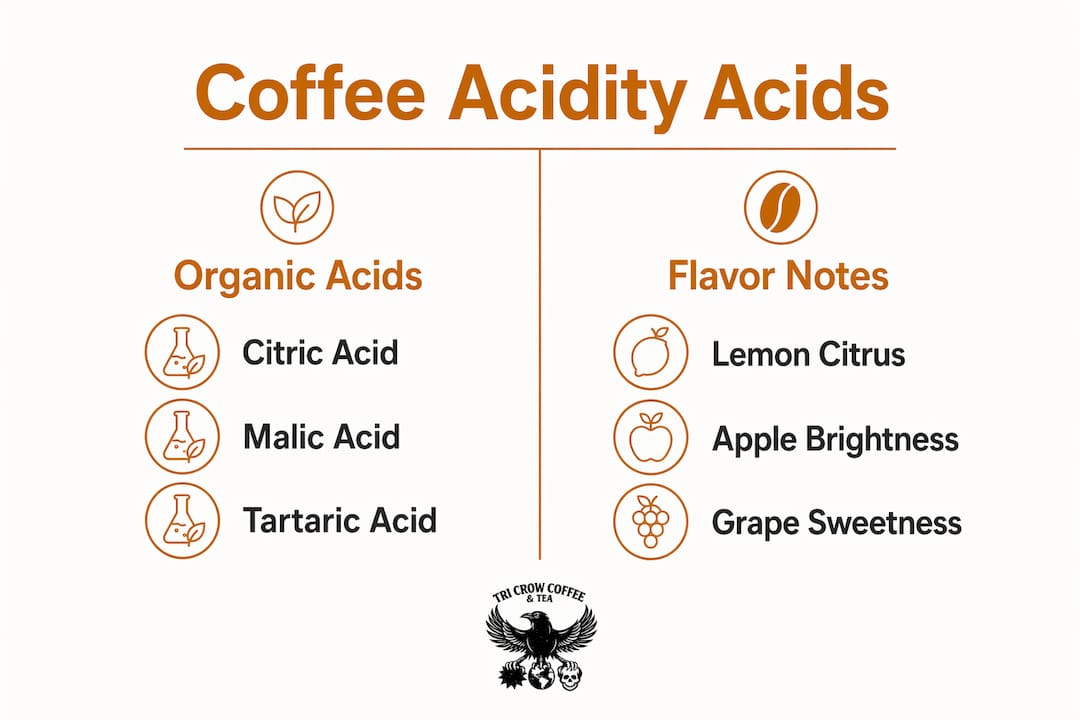
Organic acids such as malic, citric, and tartaric make up roughly 2%–2.5% of green coffee bean mass and are the primary drivers of bright, tangy flavor. Each acid contributes a distinct character. Citric acid delivers citrusy, lemon-like notes. Malic acid adds a softer, apple-like quality. Tartaric acid brings a firm, grape-like tartness. Acetic acid, found in smaller amounts, can add a wine-like edge when balanced, or a sharp vinegar note when it dominates.
Chlorogenic acids deserve special attention. They are the most abundant acids in green coffee, but they break down during roasting into quinic and caffeic acids. Quinic acid is bitter and astringent, which is why darker roasts taste less bright even though their pH does not drop dramatically. Post-harvest processing also shapes the acid profile. Washed coffees tend to show cleaner, more defined acidity. Natural-processed coffees develop a fruitier, more complex acid character because the bean ferments inside the dried fruit.
Terroir plays a role too. High-altitude farms in East Africa and Central America produce beans with more developed organic acid content, because cooler temperatures slow bean development and allow acids to accumulate.
Key organic acids and their flavor contributions
| Acid | Flavor character | Primary source |
|---|---|---|
| Citric | Lemon, citrus, bright | Green beans, light roasts |
| Malic | Apple, stone fruit, soft | Green beans, medium roasts |
| Tartaric | Grape, firm tartness | Green beans |
| Acetic | Wine-like, vinegar | Fermentation, processing |
| Chlorogenic | Bitter, astringent (after roasting) | Breaks down during roasting |
| Quinic | Bitter, dry | Chlorogenic acid degradation |
Pro Tip: If your cup tastes sharp or vinegary rather than bright, acetic acid is likely too high. This often traces back to over-fermentation during processing, not your brewing method.
How does roast level change the acidity you taste?
Roasting transforms the acid profile of coffee more than any other single variable. Light roasts retain the most organic acids, which is why they taste the brightest and most complex. Medium roasts lose roughly 50% of their citric acid content compared to light roasts. That drop explains why medium roasts feel smoother and rounder on the palate, with less of the sharp, citrus-forward brightness you get from a light roast.
Dark roasts go further. Heat continues to break down bright organic acids while simultaneously producing bitter compounds from chlorogenic acid degradation. The result is a cup that tastes less acidic in the sensory sense, even though darker roasts measure only slightly higher pH at 5.05–5.10 versus 4.85–4.95 for light roasts. The chemistry barely shifts, but the flavor shifts dramatically. This is one of the most misunderstood facts in coffee.
A common misconception is that dark roast coffee is easier on the stomach because it is “less acidic.” Reducing sensory acidity through roasting does not reliably ease digestive discomfort, because the chemical causes of stomach sensitivity differ from the taste compounds that create perceived acidity. If you have acid sensitivity, the roast level is not the only variable worth adjusting.
Medium roasts occupy a useful middle ground. They balance retained brightness with developed body and sweetness, making them the most forgiving roast for brewers who want some acidity without sharp edges. You can read more about how roast levels shape flavor to match your preferences more precisely.
Roast level and acidity: a quick comparison
| Roast level | Sensory acidity | pH range | Dominant flavor notes |
|---|---|---|---|
| Light | High | 4.85–4.95 | Citrus, floral, fruit |
| Medium | Moderate | 4.95–5.05 | Stone fruit, caramel, balanced |
| Dark | Low | 5.05–5.10 | Chocolate, smoke, bitter |
Pro Tip: If you want brightness without sourness, choose a medium-light roast from a high-altitude origin like Tanzania or Peru. The natural acid development at altitude gives you complexity without the sharp edges of a very light roast.
What brewing factors affect the acidity in your cup?
Brewing variables including water temperature, grind size, and coffee-to-water ratio directly control how much acid you extract and how bright your cup tastes. This gives home brewers real power to adjust flavor without changing the coffee itself.
Here is how each variable works:
- Water temperature. Hotter water extracts acids faster and more completely. Brewing at 200–205°F pulls more citric and malic acid into the cup, increasing brightness. Dropping to 185–190°F slows extraction and softens perceived acidity.
- Grind size. A finer grind increases surface area and speeds up extraction, which can amplify acidity. A coarser grind slows extraction and reduces brightness. If your cup tastes sharp, try grinding slightly coarser before adjusting anything else.
- Brew time. Shorter contact time underextracts the coffee, leaving it sour and thin. Longer contact time extracts more compounds, which can balance bright acids with sweetness and body.
- Coffee-to-water ratio. A higher ratio (more coffee, less water) concentrates all flavor compounds, including acids. A lower ratio dilutes the cup and softens acidity.
- Cold brewing. Cold water extracts acids slowly and selectively. The result is a cup with noticeably lower perceived acidity and a smoother, sweeter profile. This is the most reliable method for reducing acidity perception without switching to a darker roast.
Water chemistry also matters. Soft water amplifies acidity because it lacks the minerals that buffer acid compounds. Hard water can suppress brightness and make a cup taste flat. Many specialty brewers use filtered water with a controlled mineral content to keep acidity balanced and consistent.
Pro Tip: For a brighter cup, brew at 205°F with a medium-fine grind and a 1:15 coffee-to-water ratio. For a smoother cup, drop to 195°F, grind coarser, and extend brew time by 30 seconds. Small changes produce noticeable results.
You can find more practical guidance on home brewing techniques that help you dial in acidity and sweetness together.
What are the types of coffee acidity that affect taste?
Acidity has two dimensions: intensity and quality. Intensity refers to how much acidity you perceive. Quality refers to whether that acidity is pleasant or not. A coffee can be intensely acidic and still taste wonderful if the quality is high. The same intensity level with poor quality tastes sour, sharp, and unpleasant.
Positive acidity descriptors include:
- Bright: A clean, lively sensation that lifts the flavor and makes the cup feel alive.
- Crisp: A clean, defined tartness similar to biting into a fresh apple.
- Lively: A dynamic quality that keeps your palate engaged through the finish.
- Tart: A firm, fruit-forward sensation that pairs well with natural sweetness.
- Balanced: Acidity that integrates with body and sweetness without dominating.
Negative acidity descriptors signal a problem:
- Sour: Acidity without sweetness, usually from underextraction or poor processing.
- Sharp: An aggressive, almost metallic edge that cuts through the cup unpleasantly.
- Astringent: A drying, puckering sensation caused by excess quinic acid or tannins.
Acidity is one of the three pillars of flavor balance alongside sweetness and bitterness. Without it, coffee tastes flat. Too much of it without sweetness tastes sour. The goal is integration, where acidity lifts the cup rather than dominating it.
East African coffees, particularly those from Ethiopia and Kenya, are known for high-quality acidity with complex fruit and floral notes. Central American coffees from Guatemala and Costa Rica tend toward cleaner, brighter acidity with citrus and stone fruit character. Understanding how origin shapes flavor helps you choose beans that match your acidity preferences from the start.
Key Takeaways
Coffee acidity is a sensory quality driven by organic acids, and controlling it requires understanding both the beans you choose and the way you brew them.
| Point | Details |
|---|---|
| Acidity is sensory, not just chemical | pH and perceived acidity differ; organic acid composition determines how bright a coffee tastes. |
| Roast level changes acid content | Medium roasts lose roughly 50% of citric acid versus light roasts, reducing brightness significantly. |
| Brewing variables control extraction | Temperature, grind size, and brew time each shift how much acid reaches your cup. |
| Intensity and quality are separate | High-intensity acidity can be pleasant or sour depending on extraction quality and bean origin. |
| Dark roast does not fix stomach issues | Sensory acidity and digestive effects are chemically distinct; roast level alone does not resolve sensitivity. |
Why I think most brewers misread their own acidity problems
Most home brewers blame the bean when the real culprit is the brew. I have tasted the same light roast prepared two ways: one cup sharp and sour, the next crisp and lively. The only variable was grind size and water temperature. That experience changed how I think about acidity entirely.
The other misconception I keep encountering is the dark roast stomach fix. Brewers switch to dark roasts expecting relief, and when it does not come, they assume coffee just does not agree with them. The reality is that sensory acidity and the chemical compounds that irritate the stomach are not the same thing. Switching roasts addresses one, not the other.
What actually works is learning to distinguish between a sour cup and a bright one. Sour means underextracted. Bright means well-extracted with quality acids intact. Once you can tell the difference, you stop chasing the wrong fixes. Tri Crow Coffee’s Tanzania single origin is a good reference point for what quality acidity actually tastes like. It is bright, fruit-forward, and balanced, not sharp or aggressive.
Experiment with one variable at a time. Adjust grind size first, then temperature, then ratio. Keep notes. Acidity is not something to avoid. It is something to understand and use.
— David
Tri Crow Coffee blends worth brewing for acidity balance
Acidity is not a flaw to eliminate. It is a flavor tool, and the right coffee makes that clear immediately.
Tri Crow Coffee roasts in small batches to keep acid profiles consistent and intentional. The Tanzania medium-light roast delivers the kind of bright, fruit-forward acidity that shows what quality organic acids actually taste like in the cup. For brewers who prefer lower perceived acidity with full body, the 6-bean dark roast blend offers depth and richness with the sharp edges smoothed out by roasting. The cold brew medium roast takes a different approach entirely, using slow cold extraction to produce a naturally smooth, low-acidity cup without sacrificing flavor. If you want to taste the full range, the best sellers sample pack covers six varieties across roast levels and origins, giving you a direct comparison of how acidity shifts from cup to cup.
FAQ
What is coffee acidity in simple terms?
Coffee acidity is the bright, tangy sensation you taste in a cup, caused by organic acids like citric and malic acid naturally present in coffee beans. It is a flavor quality, not just a measure of pH.
Does dark roast coffee have less acidity?
Dark roast coffee tastes less acidic because heat breaks down bright organic acids during roasting, but its pH is only marginally higher than light roast. The sensory difference is significant; the chemical difference is small.
Is high acidity in coffee bad for your stomach?
Not necessarily. Sensory acidity and the compounds that cause digestive discomfort are chemically different, so switching to a darker roast does not reliably reduce stomach sensitivity. Brewing method and individual tolerance matter more.
How do I reduce acidity in my home brew?
Brew at a lower water temperature around 190–195°F, use a coarser grind, and extend brew time slightly. Cold brewing is the most effective method for reducing perceived acidity without changing your coffee.
What coffee origins have the highest acidity?
East African coffees from Ethiopia and Kenya are known for the highest-quality acidity, with complex fruit and floral notes. Central American coffees from Guatemala and Costa Rica offer clean, bright acidity with citrus character.