
The best tea pairings match intensity first, then aroma. A delicate white tea belongs beside fresh fruit or mild shellfish. A bold Assam or pu-erh holds its own against fatty meats, aged cheese, and rich desserts. Get that one principle right, and most other decisions follow naturally.
Here are the foundational pairings to know before diving deeper:
- Black tea (Assam, English Breakfast, Lapsang Souchong): scones, full breakfasts, smoked salmon, aged cheddar, dark chocolate
- Green tea (sencha, matcha, gyokuro): sushi, steamed dumplings, light salads, white fish, Japanese sweets
- Oolong (floral to roasted): roast chicken, stone fruit, mushroom risotto, caramel desserts, hard cheeses
- Pu-erh: dim sum, BBQ pork, braised meats, fatty soups, dark chocolate
- Darjeeling: mild curries, charcuterie, baked goods, soft-ripened cheeses
- White tea: fresh peach, melon, white chocolate, scallop crudo, panna cotta
- Herbal tisanes: chamomile with honey cake, peppermint with lamb, hibiscus with spicy food
Pairing intensity runs in three tiers: light plus light, medium plus medium, bold plus bold. Seasonal produce sharpens every tier. Tea also plays two distinct roles at the table: it resets the palate between bites and bridges flavors by sharing aromatic compounds with the food beside it. The sections below break down each of those roles in detail.
What are the top tea pairings and how do you build them?
The single most reliable rule in tea pairing is to match by intensity, not by prestige or complexity. A light green tea vanishes beside a rich beef stew. A smoky Lapsang Souchong bulldozes a delicate panna cotta. Keep the weight of the tea and the weight of the food proportionate, and the pairing almost always works.
Beyond intensity, two mechanisms explain why certain combinations feel so right. First, tea polyphenols, specifically catechins and theaflavins, bind fats and proteins on the tongue, scrubbing residual flavors so the next bite lands fresh. That is why pu-erh has been the default pairing for fatty dim sum across southern China for centuries. Second, aromatic congruence between tea and food creates a third flavor that exists in neither alone. A jasmine green tea and fresh mango both carry linalool, a floral terpene, and drinking them together produces something more vivid than either on its own.
Sweetness, salt, and acidity all affect how a pairing lands. If the food is sweeter than the tea can carry, the tea tastes thin and bitter on the second sip. A lightly salted cracker, by contrast, can sharpen a tea’s finish and make its aromatics more defined. Sharp acidity from vinegar or citrus tends to distort the cup rather than brighten it, collapsing the finish that makes tea worth drinking in the first place.
Pro Tip: Look for “bridge flavors” when a pairing feels unintuitive. Earl Grey and lemon shortbread work because bergamot and lemon share the same citrus oils. Roasted oolong and caramel desserts both carry toasty, butterscotch notes from Maillard browning. When you find a shared aromatic thread, follow it.
Practical guidelines for building any pairing:
- Taste the tea alone first. Note its body, sweetness, and finish before introducing food.
- Choose one quality to protect: freshness, roast, floral lift, or earthiness.
- Take one bite, return to the cup, and ask whether the tea became clearer or flatter.
- Lower-sugar accompaniments almost always preserve the tea’s articulation better than rich, sweet ones.
- Crisp, dry textures (plain crackers, rice cakes) tend to sharpen a tea’s definition; creamy textures can mute aroma.
How each tea type pairs with food
The table below maps the five major tea categories to their flavor profiles and best food matches. Brewing strength matters too: a lightly steeped black tea behaves more like a medium-bodied oolong, so adjust food weight accordingly.
| Tea type | Flavor profile | Top food pairings | Brewing note |
|---|---|---|---|
| Black (Assam, Ceylon) | Malty, tannic, bold | Scones, eggs, beef stew, aged cheddar | Brew strong; milk softens tannins for richer dishes |
| Darjeeling (second flush) | Floral, muscatel, medium | Mild curries, charcuterie, baked goods | Medium steep; avoid over-extraction |
| Green (sencha, matcha) | Vegetal, grassy, umami | Sushi, white fish, steamed dumplings, salads | Lower temperature preserves delicacy |
| Oolong (floral to roasted) | Wide spectrum: floral, buttery, toasty | Roast chicken, stone fruit, mushroom risotto, caramel | Match roast level of tea to richness of dish |
| Pu-erh (sheng and shou) | Earthy, mushroom-like, deep | Dim sum, BBQ pork, braised meats, dark chocolate | Rinse leaves once; serve hot to maximize cleansing effect |
Black tea
Black tea is malty, tannic, and built for hearty food. Tri Crow Coffee’s English Breakfast is a strong, smooth example that holds up beautifully against a full breakfast spread, savory pies, and scones with clotted cream. Lapsang Souchong, with its smoky character, pairs with smoked salmon and aged cheddar. Earl Grey, made with bergamot oil and blue cornflowers, is the natural partner for lemon desserts, vanilla pastries, and crème brûlée.
Top black tea pairings:
- Assam or English Breakfast with eggs, bacon, and savory pastries
- Darjeeling second flush with charcuterie boards and mild curries
- Lapsang Souchong with BBQ, smoked salmon, and dark chocolate
- Earl Grey with lemon shortbread, crème brûlée, and blue cheese
Green tea
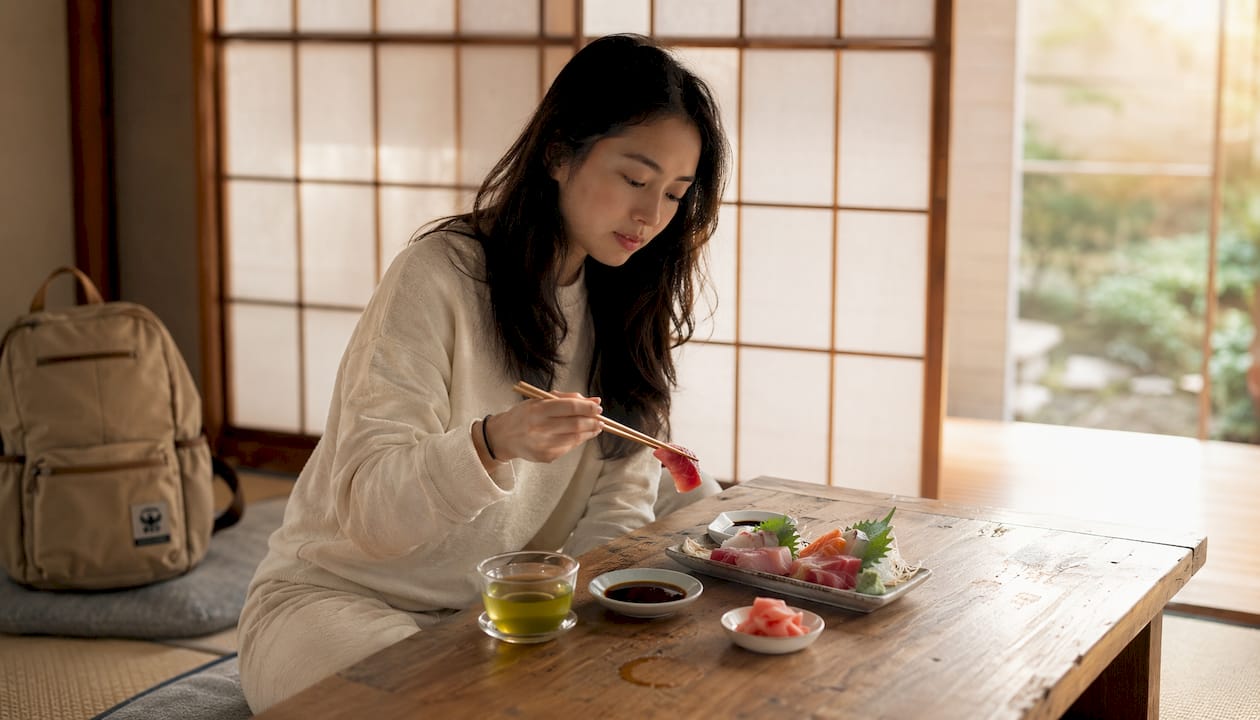
Green tea pairs best with clean, umami-forward, or lightly seasoned food. Sencha and sashimi is a classic for a reason: the tea’s brisk, vegetal astringency clears the palate between bites of raw fish without competing with the delicate flavor. Matcha’s bitterness balances against subtle sweetness, making it a natural match for Japanese wagashi or white chocolate. Gyokuro, the most shaded and umami-rich green, works beautifully with a soft-boiled egg or simple miso soup.
Oolong tea
Oolong covers the widest pairing range of any tea category because the style spans from greenish-floral to dark-roasted-caramel. Lighter oolongs like Tieguanyin suit roast chicken, grilled fish, and fresh stone fruit. Darker, charcoal-roasted oolongs like Da Hong Pao belong beside roast duck, lamb chops, hard cheeses, and caramel desserts. The key is identifying where your oolong sits on that spectrum before choosing the food.
Pu-erh tea
Aged pu-erh is the gold standard for cutting through high-fat dishes like Wagyu beef or pork belly. Its earthy, slightly tannic profile does what no other tea can: hold its own against truly rich, greasy food without disappearing. Shou (ripe) pu-erh with dim sum or BBQ pork is one of the oldest and most satisfying pairings in the tea world. Sheng (raw) pu-erh suits roast meats, mushroom dishes, and aged cheese.
Seasonal and thematic tea pairing menus
Seasonal produce sharpens every pairing. A spring first-flush Darjeeling tastes different beside fresh strawberries in May than it does beside a cheese board in November, and leaning into that contrast is half the pleasure.
Fall and winter menus:
- Roasted oolong with butternut squash soup and a slice of sharp cheddar
- Lapsang Souchong with smoked turkey, cranberry relish, and cornbread stuffing
- Spiced chai (black tea base) with gingerbread, pecan pie, or apple tart
- Shou pu-erh with braised short ribs or a rich mushroom ragù
- Earl Grey with dark chocolate truffles and candied orange peel
Spring and summer menus:
- First-flush Darjeeling with cucumber sandwiches, smoked salmon blinis, and fresh strawberries
- Jasmine green tea with lychee sorbet, mango sticky rice, or a light fruit tart
- Peach Paradise herbal tea, served iced, with peach cobbler, fresh berries, or a citrus salad
- White peony (Bai Mu Dan) with scallop crudo, melon prosciutto, or a plain croissant
- Hibiscus tisane with ceviche, spicy shrimp tacos, or anything with lime and chili
Afternoon tea spread (classic British-American hybrid):
- English Breakfast tea with finger sandwiches (cucumber, smoked salmon, egg salad)
- Earl Grey with lemon curd tarts and shortbread
- Darjeeling with scones, clotted cream, and strawberry jam
Hosting tips for a tea pairing gathering:
- Serve teas in sequence from lightest to boldest, the same logic as a wine flight.
- Offer plain water crackers between pairings to reset the palate fully.
- Label each tea with its origin and roast level so guests can connect what they taste to what they read.
- Sparkling teas, which serve as elegant aperitifs alongside umami-rich dishes, make a striking opening course for a tasting event.
Why quality and ritual make the difference in tea pairing
Tea pairing is moving beyond tradition. The most successful pairings today balance cultural classics with sensory-driven experimentation, using both inherited knowledge and perceptual science. That dual approach is what separates a thoughtful pairing from a lucky one.
Terroir and craft are foundational. As Henrietta Lovell of The Rare Tea Co. puts it:
A tea grown in poor conditions or processed carelessly will lack the nuanced flavor that makes pairing worthwhile. Quality raw material and terroir dictate the tea’s aromatic complexity, which is precisely what food either echoes or contrasts. A flat, generic tea gives you nothing to work with.
Tea is also gaining ground as a sophisticated, alcohol-free alternative in fine dining. Federico Quintavalle, head sommelier at London’s Ikoyi restaurant, notes that one third of diners choose the tea pairing, particularly at lunch, drawn by the clarity it offers without alcohol’s interference. That trend is accelerating in North America as more restaurants and home hosts recognize that tea can carry a tasting menu from start to finish.
Pro Tip: Try blending two teas to tailor a pairing. A small addition of roasted hojicha to a lighter green tea adds body and a toasty note that bridges the gap between delicate and medium-weight dishes. Tri Crow Coffee’s small-batch tea blends are a good starting point for understanding how blend ratios shift flavor and pairing range.
The ritual of tea preparation is part of the pairing experience, not a preamble to it. Brewing at the table, adjusting temperature, and tasting the tea before the food arrives all slow the experience down in a way that makes the pairing more perceptible. Mindful attention is what separates a good pairing from a great one.
How to pair tea with chocolate and desserts
Desserts are where tea pairings most often go wrong. The problem is almost always sweetness. If the dessert is sweeter than the tea can carry, the tea tastes thin and more bitter on the second sip. The palate has been desensitized, not the tea. Very sweet desserts overwhelm delicate teas, while high-tannin or dark-roasted teas handle sugar better and stay articulate through the pairing.
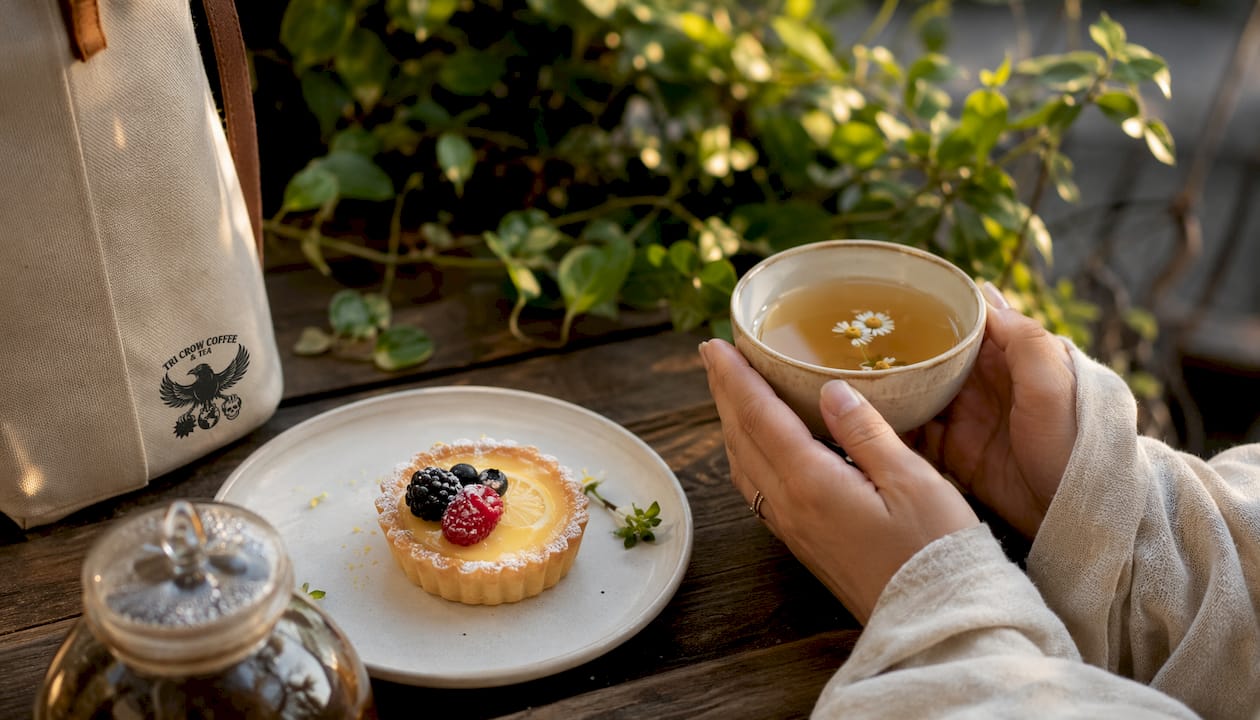
The most reliable approach is to reach for teas with body, tannin, or roast when the dessert is rich or sweet. Shou pu-erh with dark chocolate is one of the most satisfying pairings in this category: the tea’s earthiness and tannin cut through the fat in the chocolate and amplify its bitter cocoa notes. Lapsang Souchong works similarly, adding a smoky counterpoint that makes dark chocolate taste more complex. For milk chocolate or caramel, roasted oolong or hojicha are better choices, since their toasty, butterscotch character echoes the Maillard flavors in the candy.
For a toffee and tea pairing, the intensity framework applies directly: a buttery, lightly salted toffee pairs well with a medium-roasted oolong or a second-flush Darjeeling, both of which have enough body to match the richness without being overwhelmed by the sugar.
Fruit-based desserts call for lighter teas. A lemon tart works with Earl Grey because bergamot and lemon share citrus oils. A peach cobbler or berry crumble suits a first-flush Darjeeling or a floral jasmine green. Cheesecake and panna cotta, which are creamy but not aggressively sweet, pair well with Earl Grey or a lighter oolong. The rule is consistent: lower-sugar, less-dense desserts give the tea room to stay legible.
Chocolate pairing quick guide:
- Dark chocolate (70%+): shou pu-erh, Lapsang Souchong, peppermint herbal
- Milk chocolate: roasted oolong, hojicha, rooibos
- White chocolate: matcha, jasmine green, Silver Needle white tea
- Caramel and toffee: roasted oolong, hojicha, second-flush Darjeeling
Key Takeaways
Matching intensity between tea and food is the single most reliable predictor of a successful pairing, with aromatic congruence as the second lever.
| Point | Details |
|---|---|
| Match intensity first | Pair light teas with light foods, medium with medium, bold with bold. |
| Use tea as a palate reset | Polyphenols bind fats and proteins on the tongue, making each bite taste fresh. |
| Aromatic congruence works | Teas and foods sharing volatile compounds (like linalool in jasmine and mango) create a third, unified flavor. |
| Sweetness is the main risk | Desserts sweeter than the tea can carry make the tea taste thin; choose high-tannin or roasted teas for rich sweets. |
| Tri Crow Coffee’s range | English Breakfast, Earl Grey, and Peach Paradise herbal tea each cover a distinct pairing tier from bold to light. |
Tea pairing rewards the curious more than the cautious
Most pairing guides hand you a list and call it done. What they skip is the more interesting part: the moment a pairing surprises you. A smoky Lapsang Souchong with aged cheddar tastes like it was designed that way. A floral oolong beside a plate of grilled peaches produces a flavor that neither the tea nor the fruit contains on its own. Those moments are not accidents. They follow from the same aromatic logic that sensory scientists have been mapping for years, but they feel like discovery.
The conventional wisdom says to start with classic pairings and work outward. That is fine advice, but it undersells how quickly the principles become intuitive. Once you understand that intensity matching and shared aromatics are the two main levers, you stop needing a list. You start tasting the tea first, noticing what it carries, and asking what food would echo or balance that character. That shift, from following rules to reading the cup, is where tea pairing gets genuinely interesting.
Quality matters more than most beginners expect. A mediocre tea gives you a flat, generic base with nothing to pair against. The terroir-driven complexity in a well-sourced leaf is precisely what food can amplify or contrast. That is why Tri Crow Coffee’s approach to small-batch production, keeping each blend consistent and traceable, translates directly into better pairing outcomes. You need to know what is in the cup before you can decide what belongs beside it.
Start with one pairing from the list above. Taste the tea alone, take one bite, return to the cup. Notice what changed. That single practice, repeated a few times, teaches more than any guide can.
Tri Crow Coffee brings small-batch craft to every pairing
For tea drinkers who want pairings that actually work, the tea itself has to be worth pairing. Tri Crow Coffee produces limited-batch blends with the kind of flavor clarity that makes food matching straightforward rather than guesswork. The English Breakfast is strong, smooth, and built for hearty food: eggs, scones, savory pies, aged cheese. The Earl Grey, made with bergamot oil and blue cornflowers, is the go-to for lemon desserts, vanilla pastries, and anything citrus-forward. For lighter, sweeter pairings, the Peach Paradise herbal tea works beautifully hot or iced alongside fruit desserts, summer salads, and fresh berries.
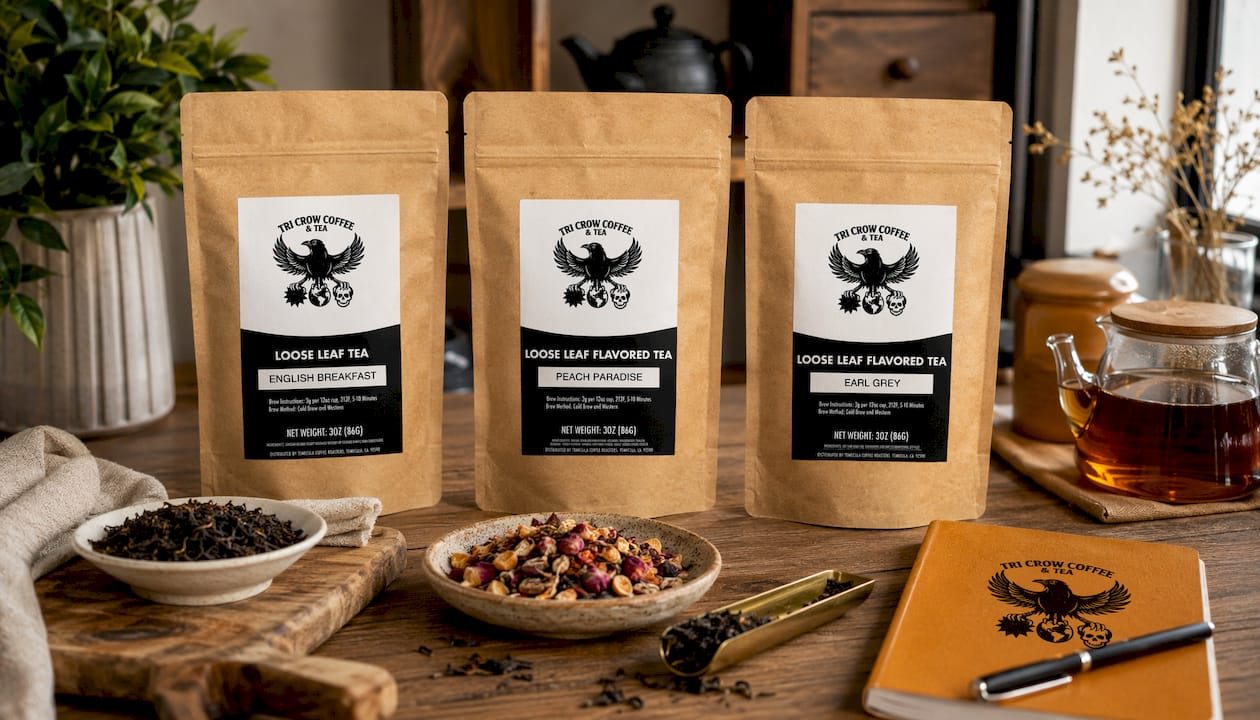
Each blend is crafted in small batches to keep flavor consistent from cup to cup, which is exactly what you need when you are building a pairing around a specific tea character. Browse the full range at Tri Crow Coffee and pick the tea that fits your next meal.
FAQ
What teas pair well together in a blend?
Teas with complementary aromatic profiles blend most naturally: a roasted hojicha adds body and toasty notes to a lighter green tea, while a floral oolong softens the astringency of a bold black. Match roast level and intensity when blending, just as you would when pairing with food.
What is the best food to serve with afternoon tea?
Classic afternoon tea pairs English Breakfast or Earl Grey with finger sandwiches, scones with clotted cream, and lemon curd tarts. The key is keeping savory items lighter than the tea’s body and desserts lower in sugar so the tea stays articulate.
What are the best tea pairings for chocolate?
Dark chocolate pairs best with shou pu-erh or Lapsang Souchong, both of which have enough tannin and body to cut through the fat. Milk chocolate suits roasted oolong or hojicha. White chocolate works well with matcha or jasmine green tea.
What are the two most popular teas in North America?
Black tea and green tea are the two most widely consumed categories in North America. Black tea, including English Breakfast and Earl Grey, dominates breakfast and afternoon drinking, while green tea leads in health-oriented and lighter meal pairings.