
Weigh each component on a digital scale, combine them in a small bowl, smell the dry mix, let it rest for 24 hours, then brew a test cup and adjust. That’s the whole loop.
- Choose your base: black, green, oolong, white, rooibos, or honeybush
- Pick supporting components: a middle note (spice, herb) and a top note (flower, citrus peel)
- Weigh everything in grams using the Pyramid Method ratios (70/20/10 to start)
- Combine, smell, rest 24 hours, then brew with consistent parameters
- Taste, take notes, and adjust one variable at a time
One safety note before you begin: some herbs interact with medications or are contraindicated during pregnancy. If you plan to use medicinal herbs like St. John’s Wort, valerian, or licorice root, check with a healthcare provider first.
Pro Tip: Start with small test batches. Small batches mean you can run several variations in an afternoon without wasting ingredients. Write down every ratio and every steeping parameter — even a small change in steep time changes what you taste.
Key Takeaways
Successful tea blending comes down to three things: a structured ratio (base/middle/top), precise weighing, and a consistent testing loop that documents every change.
| Point | Details |
|---|---|
| Use the Pyramid Method | Start at 70% base, 20% middle, 10% top and adjust from there based on taste. |
| Weigh in grams, always | Volume measures vary too much by ingredient density to produce repeatable results. |
| Rest before you brew | Let blended dry ingredients sit sealed for at least 24 hours so aromas can integrate. |
| Document every batch | Record ratios, steeping parameters, and tasting notes for every variant you make. |
| Tri Crow Coffee as reference | Taste English Breakfast, Earl Grey, or Sweet Hibiscus Berry Tea to calibrate your palate before or alongside DIY blending. |
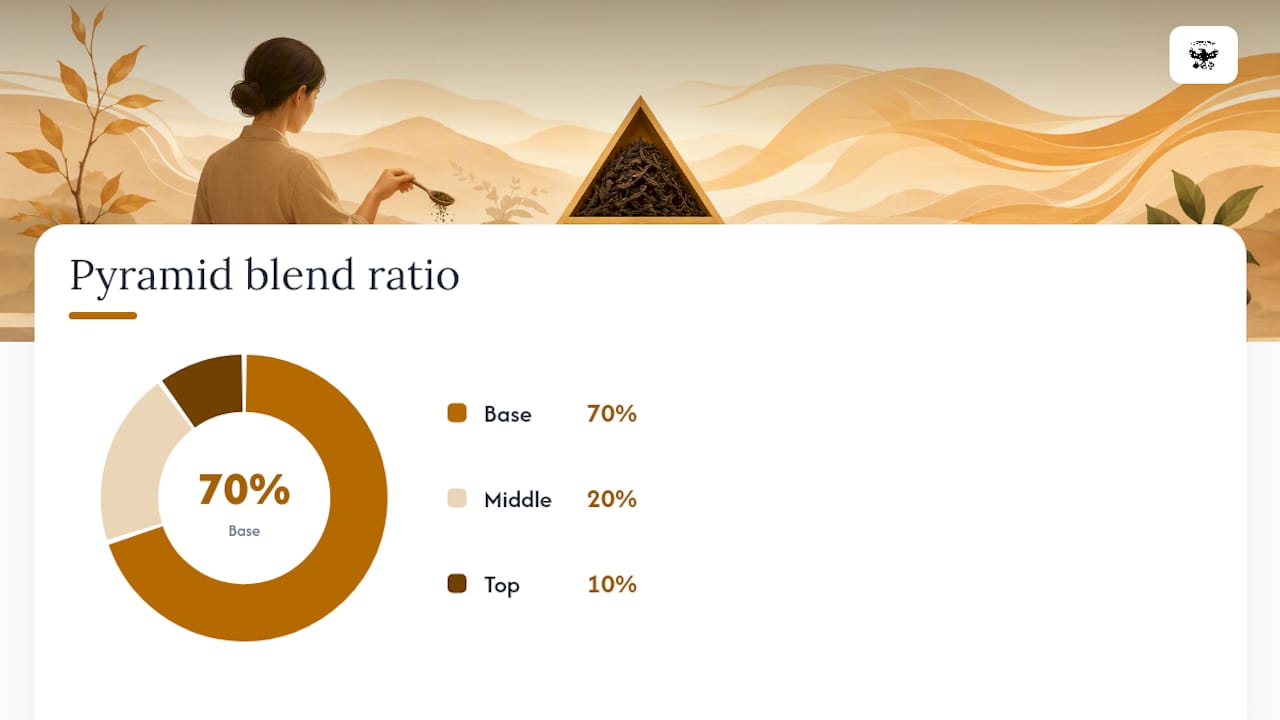
Table of Contents
- How do you choose a tea base and blending components?
- What tools do you need for precise, repeatable blends?
- The tea blending step-by-step process from plan to first cup
- How do you taste and improve a blend reliably?
- How professionals approach blending and what you can borrow
- Starter recipes you can brew on your first try
- What teas and herbs should you never mix?
- How should you store and label your homemade blends?
- How do you brew a test cup to evaluate your blend?
- Why blending tea is a ritual, not just a recipe
- Tri Crow Coffee blends worth tasting as reference points
- Sources
- FAQ
How do you choose a tea base and blending components?
Your base is the backbone of the blend. It sets the caffeine level, the body, and the steeping temperature everything else has to work around. Get the base wrong and no amount of clever top notes will save the cup.
Common tea bases and what they bring
- Black tea (like English Breakfast or Assam): bold, malty, high caffeine, steep at 200–212°F for 3–5 minutes. Takes milk and spice well. The most forgiving base for beginners.
- Green tea (like Sencha or Gunpowder): grassy, vegetal, moderate caffeine, steep at 160–175°F for 1–3 minutes. Pairs beautifully with citrus and light florals; burns bitter above 180°F.
- Oolong: sits between black and green in body and caffeine. Steep at 185–205°F for 2–4 minutes. Handles stone fruit and floral notes without being overwhelmed.
- White tea: delicate, low caffeine, steep at 160–170°F for 2–4 minutes. Best paired with subtle florals or mild fruit; strong spices will bury it.
- Rooibos / honeybush: caffeine-free, naturally sweet, earthy. Steep at 200–212°F for 5–7 minutes. Excellent evening base; pairs well with vanilla, lavender, and dried fruit.
Middle notes, top notes, and accents
Think of your blend in three layers. The middle note adds body and depth: think cinnamon, ginger, cardamom, dried apple, or hibiscus. The top note delivers the first aroma hit and brightness: rose petals, bergamot peel, lemon verbena, lavender, or cornflowers. Accents are the visual and sweet extras — a few dried berries, calendula petals, or a small amount of licorice root for sweetness.
Quick pairing rules that actually hold up:
- Citrus top notes + green tea base: clean, bright, refreshing
- Florals (rose, lavender, cornflower) + black tea base: classic, aromatic
- Warm spices (cardamom, cinnamon) + rooibos or earthy oolong: grounding, winter-ready
- Hibiscus + any caffeine-free base: tart, vivid color, cold-brew friendly
Safety note: Several herbs carry real risks. Chamomile can trigger reactions in people allergic to ragweed. Licorice root raises blood pressure with prolonged use. St. John’s Wort interacts with antidepressants, blood thinners, and birth control. If you’re pregnant or on any medication, research herb interactions before adding medicinal herbs to your blend.
What tools do you need for precise, repeatable blends?
Accuracy is what separates a blend you can recreate from one you’ll never quite nail again. The tools don’t need to be expensive, but they do need to be consistent.
Essential equipment
- Digital scale (0.1 g resolution): the single most important tool. Volume measurements vary too much by grind size and leaf density to be reliable.
- Airtight glass jars: for storing test batches and finished blends away from light and moisture
- Small mixing bowls: ceramic or stainless steel; avoid plastic, which can hold odors
- Measuring spoons: useful for rough estimates, but always verify on the scale
- Mortar and pestle or spice grinder: for breaking down whole spices like cardamom pods or cinnamon sticks
- Testing teapot or gaiwan with a timer: for consistent brew tests
- Labels and a notebook or spreadsheet: to record every batch
Why grams beat teaspoons
A teaspoon of loose black tea weighs roughly 2–3 g. A teaspoon of dried chamomile flowers weighs less than a gram. A teaspoon of ground cinnamon weighs a few grams. The same volume measure gives you wildly different amounts depending on what you’re scooping. Weighing components on a digital scale is the only way to make a batch you can reproduce exactly.
Note: these are approximate. Density varies by brand, grind size, and moisture content. Always weigh; use this table only as a starting reference.
For test batches, work in the 5–15 g range. A 10 g batch is enough for two solid test cups. Store your scale’s tare weight setup and keep a printed ratio template taped inside your blending cabinet so you don’t have to recalculate from scratch each session.
The tea blending step-by-step process from plan to first cup
The workflow is: plan your ratios, weigh each component, combine them, do a dry smell test, rest the blend, brew a test cup, and adjust. Each step has a specific purpose, and skipping one usually means you can’t tell why the cup tastes off.
Step 1: Plan your ratios
Decide on a ratio template before you touch the scale. Three starting points:
- 70/20/10: 70% base, 20% middle, 10% top. The most balanced starting point for beginners. Lets the base character come through clearly.
- 60/30/10: more middle-note presence. Good when you want a spice or fruit note to be prominent without the top note dominating.
- 50/30/20: use this when the top note is very light (like dried rose petals) and needs a higher percentage to register in the cup.
Write down your target ratio, the ingredients, and the total batch weight before you weigh anything.
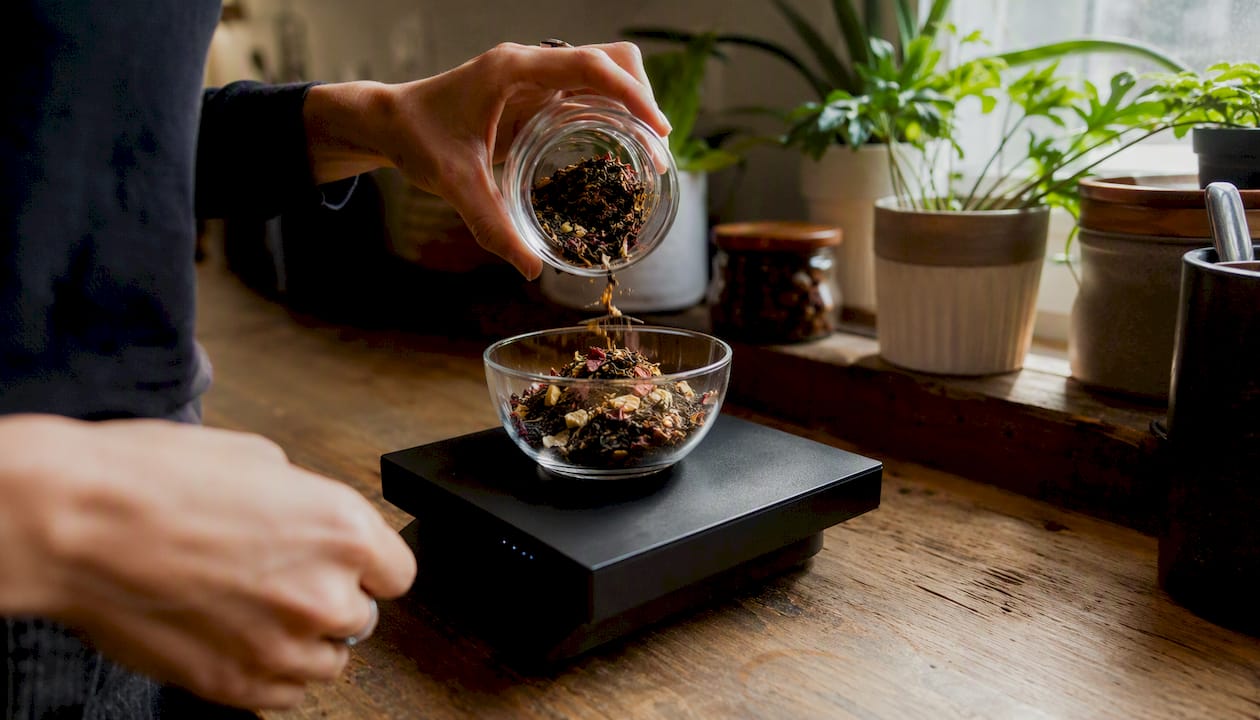
Step 2: Weigh each component
Zero your scale with an empty bowl. Add each ingredient separately, recording the exact weight. For a 10 g batch at 70/20/10: 7 g base, 2 g middle, 1 g top. Simple math, but write it down anyway.
Step 3: Combine and smell
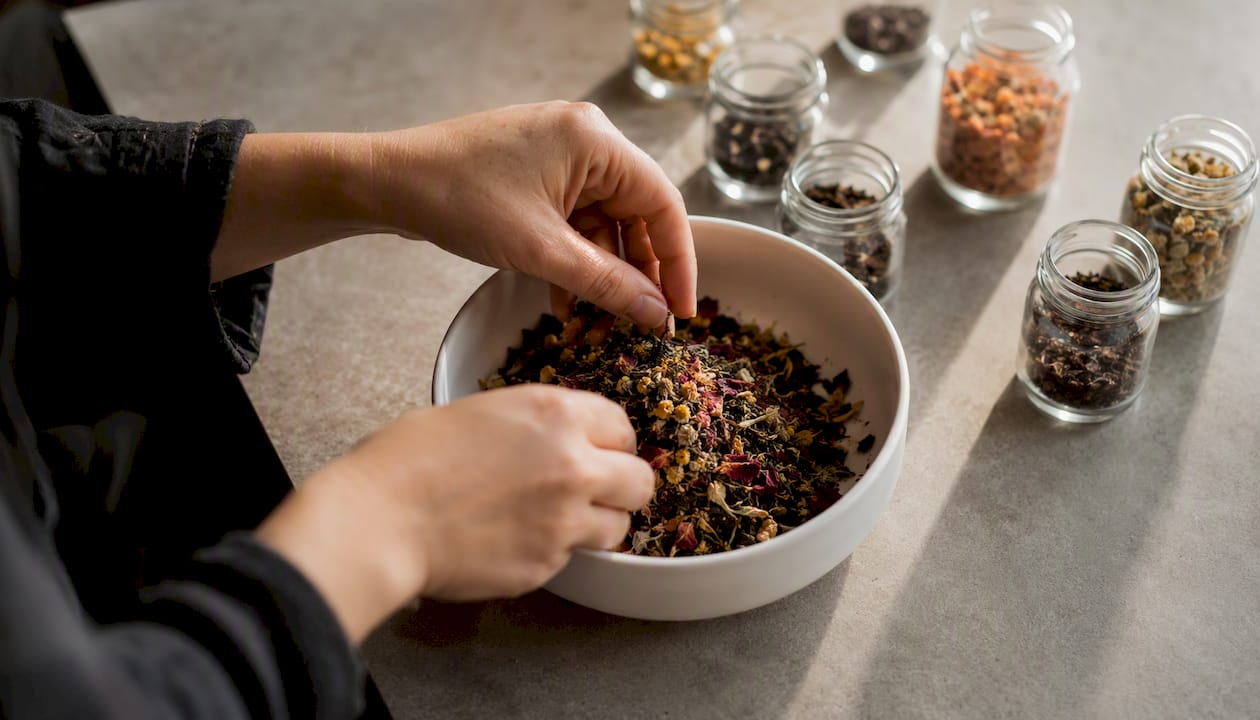
Gently mix the dry ingredients in the bowl. Lift the bowl close to your nose and inhale slowly.
Step 4: Rest the blend
Let the combined blend sit in a sealed jar for at least 24 hours. The aromas marry during this period. A blend that smells disjointed at hour zero often coheres by hour 24. Forty-eight hours is better for blends with strong spices.
Step 5: Brew a test cup
Use the steeping parameters for your base tea (see the brewing section below). Keep water temperature, leaf weight, and steep time identical across every test. Brew into a white or neutral cup so you can see the liquor color clearly.
Step 6: Taste and document
Note aroma, body, balance, and finish. Write it down immediately. Memory is unreliable after two or three cups.
Step 7: Adjust one variable at a time
If the cup is too astringent, reduce steep time before changing ratios. Change one thing per iteration.
Pro Tip: Make 2–3 micro-variants at the same time — for example, a 70/20/10, a 65/25/10, and a 60/30/10 of the same ingredients. Brew them side by side. You’ll learn more in one session than in a week of single-batch testing.
Label each batch with: name, date, total weight, individual component weights, ratios, steeping parameters, and a one-line tasting note. A simple index card works fine.
How do you taste and improve a blend reliably?
Consistent tasting is what separates a blend you can refine from one you’re just guessing at. The protocol matters more than the palate.
Use the same cup volume, leaf weight, water temperature, and steep time for every test. Taste blind when you can — pour two variants into identical cups and swap them before tasting so you don’t know which is which.
A simple cupping protocol
- Black tea base: 2 g per 8 oz water, 200°F, 3 minutes
- Green tea base: 2 g per 8 oz water, 170°F, 2 minutes
- Oolong base: 2 g per 8 oz water, 190°F, 3 minutes
- White tea base: 2 g per 8 oz water, 165°F, 3 minutes
- Rooibos / herbal base: 2–3 g per 8 oz water, 208°F, 5 minutes
Evaluate in this order: aroma (nose the cup before sipping), body (weight and texture on the palate), balance (does any note dominate or disappear?), finish (what lingers after you swallow?).
Adjustment rules that work
- Cup tastes flat? Add a small catalyst: a pinch of ginger or a tiny amount of citrus peel brightens the whole blend.
- Top note disappears in the cup? Increase it by 5% and retest, or switch to a more volatile form (fresh dried peel vs. older stock).
- Blend is too astringent? Reduce steep time by 30 seconds before touching the ratio.
- Flavor is muddy? You likely have too many competing middle notes. Pull one out entirely and retest.
Common tasting pitfalls
- Expectation bias: you know what you put in, so you taste what you expect. Blind tasting fixes this.
- Inconsistent steeping: even 15 seconds of extra steep time changes the result. Use a timer every time.
- Stale ingredients: dried herbs lose volatility fast. If a component smells like paper, replace it before blending.
How professionals approach blending and what you can borrow
Professionals don’t rely on intuition. They rely on documentation and repetition. According to Royal Tea New York, experienced blenders often create four or five versions of a single blend, cupping each one systematically before settling on a final recipe. The goal isn’t a lucky first batch — it’s a repeatable process.
The professional workflow in miniature:
- Define the target flavor profile in writing before blending anything
- Build micro-batches (10–30 g) of two to four variants
- Cup all variants under identical conditions, ideally with a second taster
- Record every parameter and score each variant on aroma, body, balance, and finish
- Select the best-performing variant, make one targeted adjustment, and cup again
- Lock the recipe only when two consecutive batches taste identical
Version control sounds like overkill for a home blender, but even a simple numbering system (Blend A-v1, A-v2, A-v3) prevents the frustrating situation where you made something great and can’t remember what you did differently.
Tri Crow Coffee applies this same small-batch discipline to every tea it produces, weighing components, documenting variations, and testing for consistency before any blend reaches a customer. That’s the standard worth aiming for at home.
Pro Tip: When scaling a home recipe from 10 g to 100 g, keep the percentages identical but re-weigh every component from scratch. Don’t multiply by 10 in your head — rounding errors compound and the cup will taste different.
Starter recipes you can brew on your first try
These six recipes use the Pyramid Method ratios and are designed to give a clear, drinkable result on the first attempt. Each one is a starting point, not a final answer.
Six starter blends
- Morning Boost (black tea + orange peel + ginger): 70% English Breakfast, 20% dried orange peel, 10% dried ginger. Bright, warming, caffeine-forward.
- Calm Evening (rooibos + lavender + chamomile): 70% rooibos, 20% chamomile, 10% lavender. Caffeine-free, floral, gently sweet.
- Floral Black (black tea + rose + cornflower): 70% black tea, 20% dried rose petals, 10% blue cornflowers. Aromatic, classic, good with milk.
- Citrus Green (green tea + lemon verbena + lemon peel): 70% green tea, 20% lemon verbena, 10% dried lemon peel. Clean, bright, best served plain.
- Winter Spice (black tea + cinnamon + cardamom): 60% black tea, 30% cinnamon pieces, 10% cardamom pods (lightly crushed). Rich, warming, pairs well with oat milk.
- Hibiscus Iced (hibiscus + rosehip + dried berry): 60% hibiscus flowers, 30% rosehip, 10% dried mixed berries. Tart, vivid red, cold-brew friendly.
| Blend | Base | Middle | Top | Temp | Steep | 10 g batch |
|---|---|---|---|---|---|---|
| Morning Boost | English Breakfast 70% | Orange peel 20% | Ginger 10% | 205°F | 4 min | 7g / 2g / 1g |
| Calm Evening | Rooibos 70% | Chamomile 20% | Lavender 10% | 208°F | 5 min | 7g / 2g / 1g |
| Floral Black | Black tea 70% | Rose petals 20% | Cornflower 10% | 200°F | 3 min | 7g / 2g / 1g |
| Citrus Green | Green tea 70% | Lemon verbena 20% | Lemon peel 10% | 170°F | 2 min | 7g / 2g / 1g |
| Winter Spice | Black tea 60% | Cinnamon 30% | Cardamom 10% | 205°F | 4 min | 6g / 3g / 1g |
| Hibiscus Iced | Hibiscus 60% | Rosehip 30% | Dried berry 10% | Cold brew | 8–12 hr | 6g / 3g / 1g |
For a 30 g batch, multiply each component weight by three.
What teas and herbs should you never mix?
Some combinations taste bad. Others carry real health risks. Knowing the difference keeps your blending safe and your cups drinkable.
Mixing teas can be safe and create genuinely interesting flavors, but the risks are real: caffeine stacking, herb interactions, and allergic reactions are all possible. Start small and research any medicinal herb before adding it to a blend.
Problematic combinations to avoid
- St. John’s Wort + any mood-modifying herb (valerian, kava): can amplify sedative or stimulant effects unpredictably. Limit medicinal herb blends to 2–3 ingredients and research each one.
- Licorice root + blood-pressure herbs (hawthorn, hibiscus in large amounts): licorice raises blood pressure; combining it with other cardiovascular herbs compounds the effect.
- High-caffeine black tea + green tea + yerba mate: caffeine stacks across all three. A blend of all three can deliver far more caffeine than intended.
- Sedative herbs + sedative herbs (valerian + passionflower + kava): the combined effect can be stronger than any single herb alone.
Flavor incompatibilities
- Delicate white tea + heavy smoke (Lapsang Souchong): the smoke obliterates the white tea entirely. Match delicate-to-delicate, strong-to-strong.
- Earthy pu-erh + light florals: the earthiness buries floral top notes. If you want to blend them, keep florals at 20%+ and use a very short steep.
- When mixing teas with different ideal brewing temperatures, always use the parameters for the most delicate tea in the blend to avoid extracting bitterness from the more sensitive component.
Allergy flags and labeling reminders
- Chamomile: cross-reactive with ragweed, chrysanthemum, and related plants
- Citrus peel and oils: can trigger citrus allergies
- Nut pieces (coconut, almond): major allergen; label clearly if included
- Hibiscus: generally safe but can lower blood pressure; relevant for anyone on antihypertensives
Always label homemade blends with every ingredient, even trace amounts, especially if you’re sharing or gifting.
How should you store and label your homemade blends?
Store blends in airtight, light-blocking containers at cool, dry conditions and label every jar with the date, recipe, and steeping parameters. A blend you can’t identify or reproduce is a blend you’ll never make again.
Storage rules by ingredient type
- Pure tea blends (no fruit or flower pieces): best within 12 months of blending; still drinkable up to 18 months if stored well
- Blends with dried fruit pieces: use within 6–9 months; fruit pieces absorb moisture and accelerate staleness
- Blends with essential oils or citrus peel: most volatile; best within 3–6 months before aroma fades noticeably
- Herbal / caffeine-free blends: generally stable for 12 months; check for off-smells every few months
Moisture, heat, and light are the three enemies. A tin or dark glass jar in a cool cabinet beats a clear jar on a sunny counter every time. If a blend smells like cardboard or wet paper, discard it. No amount of brewing will recover a stale blend.
What to put on every label
- Blend name and version number (e.g., “Morning Boost v2”)
- Date blended
- All ingredients with percentages
- Steeping parameters (temperature, time, leaf weight per cup)
- Allergen flags
- Best-by date
For gifting, add a short brewing instruction on the back. For retail or wider sharing, check local cottage food laws regarding labeling requirements, which vary by state.
A practical guide to tea blend varieties and storage covers additional packaging options for those moving beyond personal use.
How do you brew a test cup to evaluate your blend?
Brew test cups with the same leaf weight, water temperature, and steep time you recorded during mixing. Any variable that changes between test sessions makes comparison meaningless.
Brewing parameters by base type
- Black tea base: 2 g per 8 oz, 200–205°F, 3–4 minutes. Add milk after brewing to evaluate body separately.
- Green tea base: 2 g per 8 oz, 165–175°F, 2–3 minutes. Never exceed 180°F or the cup turns bitter.
- Oolong base: 2 g per 8 oz, 185–200°F, 2–4 minutes.
- White tea base: 2 g per 8 oz, 160–170°F, 3–4 minutes.
- Rooibos / herbal base: 2–3 g per 8 oz, 205–212°F, 5–7 minutes.
If your blend contains finely ground spices (like ground cinnamon or cardamom powder), reduce steep time by 30–60 seconds. Fine particles extract faster than whole leaf and can turn the cup bitter or muddy if steeped at full time.
Iced and cold-brew adjustments
For iced tea, double the leaf weight and brew hot, then pour over ice immediately. For cold brew, use 2–3 g per 8 oz of cold water and steep in the refrigerator for 8–12 hours. Hibiscus and herbal blends are particularly well-suited to cold brew, producing vivid color without bitterness.
Serving suggestions
- A tea latte works well with black or rooibos bases: brew double-strength and steam or froth oat, almond, or whole milk to taste.
- Sweeteners (honey, agave, simple syrup) change the flavor balance. Taste the blend plain first, then with sweetener, and note how the top notes shift.
- Use a fine-mesh infuser or paper filter for blends with small flower pieces or ground spices to keep the cup clear.
The same discipline that applies to coffee brewing applies here. A consistent home brewing process, as outlined for coffee by Third Space Coffee, transfers directly to tea: control the variables, document the results, and adjust one thing at a time.
Why blending tea is a ritual, not just a recipe
Tea blending is one of the few kitchen crafts where the process itself has as much value as the result. The act of weighing, smelling, resting, and tasting a blend is a form of attention that most daily routines don’t offer. That’s not a romantic gloss on a technical process. It’s a practical observation: blenders who treat each session as deliberate practice improve faster than those who treat it as a chore.
The ritual framing matters because it changes how you approach failure. A batch that tastes wrong isn’t a mistake — it’s a data point. The documentation habit, the small-batch discipline, the blind tasting: these aren’t just techniques. They’re the structure that turns a vague creative interest into a repeatable craft.
At Tri Crow Coffee, every blend starts the same way: a defined target, a small test batch, and a cupping session before anything is scaled. That approach is available to anyone with a scale, a jar, and a notebook.
Tri Crow Coffee blends worth tasting as reference points
If you want a calibrated reference before committing to a full DIY session, tasting a professionally blended tea first gives you a concrete target to aim for or push against.
Tri Crow Coffee’s English Breakfast Tea is a strong, smooth black tea that works as an ideal base reference — you’ll immediately understand what a clean, well-bodied black base tastes like before you start layering components on top of it. The Earl Grey Tea, made with Ceylon OP, bergamot oil, and blue cornflowers, is a textbook example of a floral/citrus top note balanced over a black base — exactly the kind of blend the Floral Black and Morning Boost recipes above are modeled on. For herbal and iced blends, the Sweet Hibiscus Berry Tea shows how a tart, vivid herbal base can carry fruit accents without becoming cloying.
All three are available as small-batch loose-leaf teas. Taste them alongside your own test batches and the comparison will sharpen your palate faster than any written description.
Sources
- Tea Blending 101 — Royal Tea New York
- How to Make Your Own Tea Blends: The Pyramid Method — Grow Create Sip
- Tea Blending 101: Create Your Perfect Tea Blends at Home — Tea Perfectionist
- What Herbs Should Not Be Mixed Together in Tea: Complete Guide — Panaprium
- Is it Dangerous to Mix Teas? Understanding the Risks and Benefits — TableAndSpoon
FAQ
How do you blend tea step by step?
What teas blend well together?
Black tea pairs well with citrus peel, rose petals, and warm spices like cardamom. Green tea works with lemon verbena and light florals. Rooibos blends naturally with lavender, chamomile, and dried fruit. Match the intensity of your components to the strength of your base.
What teas should not be mixed together?
Avoid combining teas with very different ideal brewing temperatures, since the more delicate tea will either be under-extracted or the stronger one will turn bitter. On the herb side, avoid mixing St. John’s Wort with other mood-modifying herbs, and don’t stack multiple high-caffeine teas without accounting for the combined caffeine load.
How do you make tea in five steps?
Choose your base, pick one or two supporting components, weigh everything using the 70/20/10 ratio, combine and rest the dry blend for 24 hours, then brew with the correct water temperature and steep time for your base type and taste.
Is it safe to mix herbal teas with caffeinated teas?
Generally yes, but check each herb individually before blending. Some herbs interact with medications or amplify caffeine’s effects. If you take any prescription medication or have a cardiovascular condition, consult a healthcare provider before adding medicinal herbs to your blend.