
Education is the most underused lever in coffee sourcing. When farmers receive structured agronomy training, sourcing teams gain more predictable cup quality, better traceability records, and supplier relationships that hold up under climate and price pressure. SCA curricula now treat sustainability literacy as a core competency alongside sensory skills, and field evidence from IFPRI-backed programs confirms that well-designed training measurably shifts farm-level behavior. Tri Crow Coffee’s own sourcing approach reflects this: every small-batch selection traces back to origin practices that only disciplined, educated producers can sustain.
Direct outcomes sourcing teams can expect from education investment:
- Consistent cup quality across harvests, driven by better post-harvest sorting and fermentation control
- Higher adoption of agronomic best practices (nutrition, pruning, rejuvenation)
- Improved farmer livelihoods, which stabilizes long-term supply relationships
- Stronger traceability documentation and compliance with due-diligence standards
Key Takeaways
Education raises consistent cup quality, improves farm-level practice adoption, and builds the sustainability literacy that sourcing teams need for traceable, resilient supply chains.
| Point | Details |
|---|---|
| Education shifts farm behavior | Agronomy training raises practice adoption by measurable percentage points, directly improving cherry and green coffee quality. |
| Adoption depth drives impact | Farmers who adopt the majority of recommended steps see yield and income gains; partial adoption produces minimal results. |
| Credential stacking matters | Sourcing professionals benefit from combining sensory skills (Q Grader) with SCA sustainability and trade modules for full coverage. |
| Pilot before scaling | A 12-month pilot measuring practice-adoption rate and sample-score stability gives reliable data before committing to full-scale co-investment. |
| Tri Crow Coffee as example | Tri Crow Coffee’s 6 Bean Dark Roast, Tanzania Medium-Light, and Best Sellers Sample Pack reflect sourcing criteria built on origin education and traceability. |
Table of Contents
- Why does education matter across the entire coffee value chain?
- How education changes what sourcing teams do day-to-day
- What training models actually work for sourcing professionals?
- What does the evidence actually show about training outcomes?
- How should sourcing teams integrate education into procurement strategy?
- What Tri Crow Coffee’s sourcing approach shows about education as strategy
- Tri Crow Coffee: small-batch sourcing built on origin knowledge
- Sources
- FAQ
Why does education matter across the entire coffee value chain?
Education changes what sourcing teams receive before a single sample arrives. At the farm level, training in agronomy shifts behavior on soil nutrition, pruning cycles, and crop rejuvenation. Those changes reduce year-to-year variability in cherry quality, which is the upstream cause of inconsistent cup scores. At the processing stage, training in post-harvest sorting, fermentation timing, and drying management converts better cherry into better green coffee. Without that knowledge, even well-grown fruit gets degraded.
The governance layer matters just as much. Cooperative management training builds the record-keeping capacity that sourcing teams need for traceability. A farmer who understands why lot separation and moisture logging matter is a farmer whose coffee can carry a credible origin story. That’s not a soft benefit: it’s the difference between a traceable single-origin and an anonymous commodity lot.
Key mechanisms by which training changes sourcing inputs:
- Production: agronomy modules covering soil nutrition, shade management, and rejuvenation pruning raise cherry uniformity
- Processing: post-harvest curricula reduce defect rates through better sorting and controlled fermentation
- Governance: cooperative and record-keeping training creates the documentation backbone for traceability and certification
- Sustainability literacy: SCA’s modular pathways now integrate carbon basics, due-diligence frameworks, and standards compliance into sourcing credentials.
Statistic: The Sidama Coffee Agronomy Program reported a 14 percentage point increase in adoption of compost and composted manure for the 2019 cohort, with a 21% increase in mean adoption rate relative to untrained households.
University-level programs like ZHAW’s Coffee Excellence Center reinforce this by embedding scientific and data literacy into sourcing curricula, connecting lab analysis directly to trading decisions. Sourcing is increasingly data-driven: agronomy metrics, climate risk scores, and chemical analysis are inputs for contract pricing, not just quality curiosity.
How education changes what sourcing teams do day-to-day
Sourcing workflows shift in four concrete ways when training is taken seriously: sample evaluation, supplier segmentation, contracting and incentives, and data-driven relationship management.
On sample evaluation, cupping competence alone is no longer enough. A buyer who combines Q Grader-level sensory skills with SCA sustainability modules and a trade diploma can evaluate a lot against quality, compliance, and commercial criteria simultaneously. That credential stack, sensory plus sustainability plus trade, covers the three dimensions that determine whether a supplier relationship is worth building. The coffee tasting process becomes a richer diagnostic when the buyer understands the agronomy and processing decisions that produced the cup.
Supplier segmentation gets sharper when buyers understand what training their suppliers have received. A producer who completed a farm-college agronomy program is a different risk profile than one who hasn’t, and contracts can reflect that. Incentive structures, quality premiums, input cost-sharing, and long-term price floors all become more defensible when tied to measurable practice adoption rather than vague “relationship” language.
Data literacy is where the gap shows most clearly. Climate risk mapping, price volatility modeling, and traceability platform management require sourcing teams who can read and act on structured data. Programs like ZHAW’s integrate this from the start. Teams that lack it are flying blind on the variables that most affect supply security.
Sourcing tasks that benefit most from education investment:
- Sample protocols and cupping calibration (sensory training)
- Traceability documentation and lot-separation verification
- Agronomy monitoring during supplier visits
- Blended financing models for input cost-sharing
- Sustainability due-diligence and standards compliance
Pro Tip: Add a “practice adoption score” field to your supplier scorecard. After each farm visit or agronomy check-in, log which recommended practices the producer is actively using. Over two or three seasons, that score predicts cup-score stability better than any single cupping result.
What training models actually work for sourcing professionals?
These five program types each solve a specific sourcing problem, and knowing which fits your context saves time and budget.
Modular professional diplomas (SCA): Built for sourcing managers and buyers, SCA’s diploma pathways combine sensory, green coffee, sustainability, and trade modules. The structure is practical and theoretical, with assessments at each level. Coffee certifications for buyers matter most when they stack: a Q Grader credential covers sensory benchmarking, but it doesn’t substitute for the sustainability and trade modules that cover compliance and negotiation.
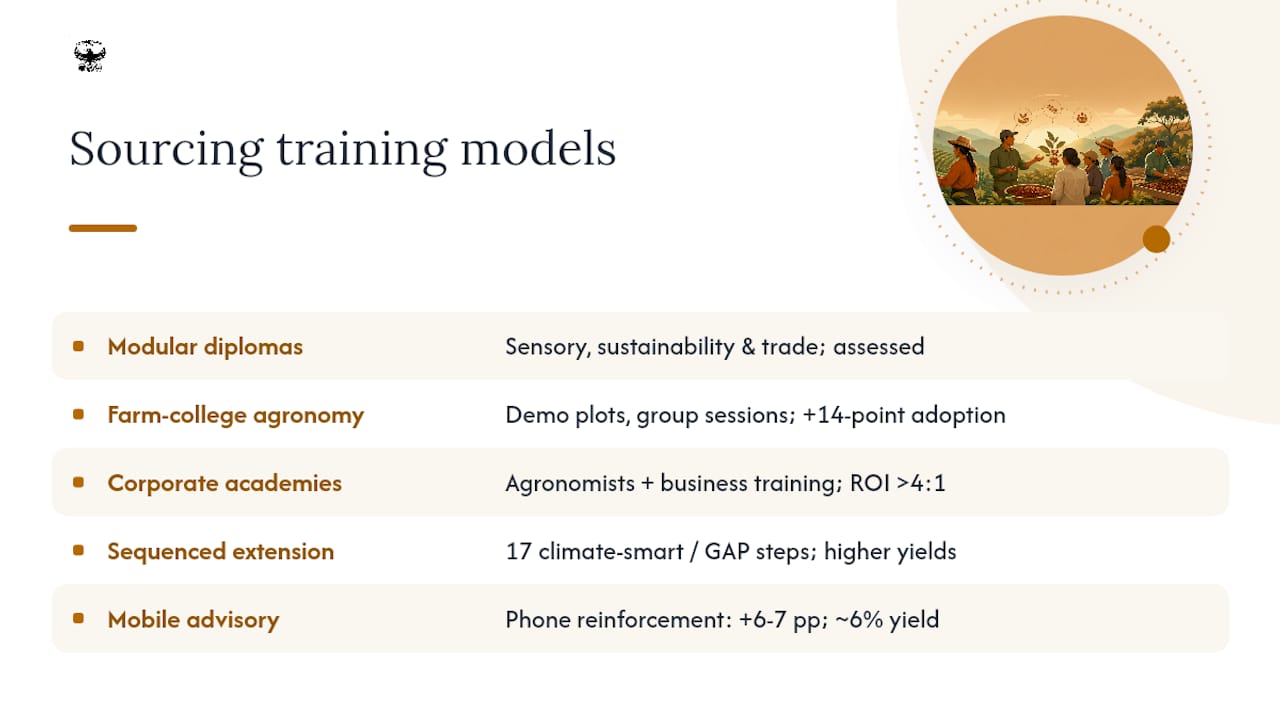
Intensive farm-college agronomy (TechnoServe/HereWeGrow Coffee Farm College): The Sidama model uses activity-based demo plots, repeated group sessions, and follow-up farm visits. That combination, not any single element, is what drove the 14-point adoption increase. Sourcing teams co-investing in this model get a supplier base that adopts practices at a measurably higher rate than untrained peers.
Corporate field academies (Nespresso AAA Sustainable Quality Program): Large-scale programs that embed agronomists in origin communities, pair technical training with business skills, and track income outcomes. The AAA program in Ethiopia and Kenya reported income increases among adopters and ROI exceeding 4:1 on some investments. The key design feature is combining hands-on field learning with business-skill modules so farmers convert agronomy gains into market outcomes.
Sequenced extension (Stepwise approach): Introduces up to 17 climate-smart agriculture and good agricultural practice (GAP) steps in sequence, using demonstration plots and partner engagement. Above-average adopters in one analysis reported a substantial yield increase. The sequencing matters: high adoption intensity, adopting the majority of recommended steps, is where impact concentrates.
SMS and mobile advisory reinforcement: A randomized controlled trial found that agronomy training combined with phone-based reinforcement raised a practice index by 6–7 percentage points and implied a median yield increase of roughly 6% from induced practice changes. Mobile reinforcement extends the reach of in-person training without proportional cost increases.
How Tri Crow Coffee’s product selection connects to these models: The 6 Bean Dark Roast is a multi-origin blend where consistency depends on parallel agronomy standards across several supply relationships. The Tanzania Medium-Light single origin demands the kind of traceability and processing discipline that farm-college training builds. The Best Sellers Coffee Sample Pack reflects cupping-informed selection across six profiles, each shaped by the sourcing criteria that buyer education makes possible.
What does the evidence actually show about training outcomes?
Training reliably raises knowledge. Adoption is more variable. Yield and income gains appear in many but not all trials, and contextual factors, credit access, labor availability, land tenure, and gender dynamics, determine whether practice changes translate into economic outcomes.
| Program | Intervention | Measured outcome | Caveat |
|---|---|---|---|
| Sidama Coffee Farm College (IFPRI) | Demo plots, group training, farm visits | 14 pp adoption increase; 21% higher mean adoption vs. untrained | Matched DID estimate; adoption ≠ yield in all cases |
| Uganda/Regional RCT (CGIAR) | Agronomy training + mobile reinforcement | 6–7 pp practice-index increase; ~6% implied median yield gain | Variable by context; yield response not uniform |
| Stepwise extension | Sequenced GAP/CSA introduction, demo plots | substantial yield increase for above-average adopters | Effect concentrated among high-intensity adopters |
| Nespresso AAA (Ethiopia & Kenya) | Field academy + business skills + agronomy | Income increases; ROI >4:1 on some investments | Corporate program; scale and resources differ from smallholder-only models |
Statistic: The CGIAR randomized trial found a 6–7 percentage point increase on a yield-based practice index, with an implied median yield increase of roughly 6% from induced practice changes.
One consistent constraint: adoption intensity matters more than participation. Farmers who adopt only a few recommended practices see minimal results. Impact concentrates when producers adopt the majority of recommended steps. That finding has a direct implication for sourcing teams: programs that track adoption depth, not just training attendance, produce better sourcing outcomes.
How should sourcing teams integrate education into procurement strategy?
Integrate education as a core sourcing lever through co-investment, measurable KPIs, and contracts that reward practice adoption. Here’s a practical sequence:
- Scope the gap. Audit current supplier practice levels against your quality and sustainability requirements. Identify which gaps, agronomy, processing, traceability, or business skills, are causing the most sourcing problems.
- Select program partners. Match the gap to a model: farm-college agronomy for production issues, SCA modules for your buying team, mobile reinforcement for remote suppliers.
- Pilot with 2–3 suppliers. Run a 12-month pilot with a small cohort. Measure practice-adoption rate, sample-score stability, and traceability coverage at baseline and at 12 months.
- Monitor and adapt. Use farm support visits and farmer ambassadors, both associated with higher long-term retention of practices, to track progress. Feed results back to your trading desk.
- Scale what works. Expand to additional suppliers using the pilot’s adoption data as the selection criterion for scaling.
Suggested KPIs for each stage:
- Practice-adoption rate (% of recommended steps actively used)
- Sample-score stability (standard deviation of cupping scores across lots)
- Traceability coverage (% of purchased volume with complete lot documentation)
- Farmer income proxy (average price received per kg vs. regional baseline)
Budget models worth considering: quality premiums tied to practice adoption, cost-sharing on inputs like compost or pruning tools, and in-kind agronomist time. Direct trade relationships provide the governance structure that makes these arrangements enforceable and mutually beneficial. Traceability systems close the data loop between farm practice and buyer decision.
Pro Tip: Structure your 12-month pilot to separate adoption measurement from yield measurement. Adoption can be tracked at 6 months; yield takes a full harvest cycle. If you conflate them, you’ll misread early results and either scale too fast or abandon a program that needs more time.
What Tri Crow Coffee’s sourcing approach shows about education as strategy
Tri Crow Coffee treats targeted education as a strategic purchasing lever, not a corporate social responsibility add-on. For a small-batch roaster, the logic is direct: flavor consistency and traceability depend on producer knowledge, and producer knowledge doesn’t maintain itself without structured reinforcement.
A small-batch buyer approaches this differently than a large corporate program. The scale doesn’t support a full field academy, but it does support demonstration plot sponsorships, long-term supplier relationships built around quality cycles, and including buyers in cupping training so sensory feedback travels back to origin partners. The importance of coffee origin isn’t just a marketing claim; it’s a sourcing commitment that requires ongoing investment in the people who grow the coffee.
In practice, Tri Crow Coffee’s approach looks like this:
- Select pilot suppliers based on practice-adoption potential, not just current cup scores
- Sponsor agronomy visits tied to specific quality criteria for each product line
- Include buyers in cupping training so sensory feedback loops back to origin partners
- Use the Tanzania Medium-Light single origin as a traceability benchmark and the 6 Bean Dark Roast as a consistency benchmark across multiple supply relationships
- Treat the Best Sellers Sample Pack as a cupping-calibration tool that reflects the range of sourcing criteria the buying team applies
The processing decisions that produce a clean Tanzania cup or a balanced dark roast blend are downstream of farmer education. That’s the operational reality that makes training investment a sourcing decision, not a charity one.
Tri Crow Coffee: small-batch sourcing built on origin knowledge
Sourcing professionals who’ve read this far know that quality at the cup starts with knowledge at the farm. Tri Crow Coffee puts that principle into practice with every small-batch roast. The 6 Bean Dark Roast draws on multi-origin sourcing where consistency depends on parallel agronomy standards. The Tanzania Medium-Light single origin is traceable to origin practices that only educated, supported producers can maintain. The Best Sellers Coffee Sample Pack gives buyers a cupping-calibration tool across six distinct profiles.
Tri Crow Coffee roasts in limited batches, which means every lot gets evaluated against the same quality criteria that this article describes. No filler, no anonymous commodity blends. If you want to see what education-backed sourcing looks like in the cup, order a sample pack and taste the difference that origin knowledge makes. Shop the full range at Tricrowcoffee.
Sources
Use randomized controlled trials to set realistic KPI expectations for adoption and yield; use SCA curriculum resources for designing buyer-side training pathways.
- SCA Education
- Sidama Coffee Agronomy Program (IFPRI impact report)
- Uganda/Regional agronomy training randomized controlled trial (impact evaluation report)
- Educating the next generation of coffee professionals (Global Coffee Report)
FAQ
What is the role of education in coffee sourcing?
Education raises farm-level practice adoption, improves post-harvest processing, and builds the sustainability literacy sourcing teams need for traceability and compliance. Programs like the Sidama Coffee Farm College and SCA diploma pathways show measurable gains in both producer behavior and buyer competency.
How does farmer training affect coffee quality?
Agronomy training improves soil nutrition management, pruning, and post-harvest handling, all of which reduce defect rates and increase cup-score consistency. The IFPRI-backed Sidama program reported a 14 percentage point increase in adoption of composting practices for trained farmers.
Which training credentials matter most for sourcing professionals?
A practical credential stack combines Q Grader sensory certification with SCA sustainability and trade diploma modules. That combination covers quality evaluation, due-diligence compliance, and commercial negotiation, the three dimensions that determine sourcing outcomes.
How do sourcing teams measure the impact of education investments?
Track practice-adoption rate, sample-score stability across lots, traceability coverage, and a farmer income proxy. A 12-month pilot with 2–3 suppliers, measuring adoption at 6 months and yield at harvest, gives reliable baseline data before scaling.
How does Tri Crow Coffee apply education-backed sourcing?
Tri Crow Coffee sources small-batch lots, including the Tanzania Medium-Light single origin and the 6 Bean Dark Roast blend, against traceability and quality criteria that depend on educated, supported producers at origin. The Best Sellers Sample Pack reflects cupping-calibrated selection across six origin profiles.