
TL;DR:
- A tea latte is made by combining a concentrated tea base with textured, frothed milk to create a creamy beverage. The key to quality is using proper ratios, milk temperature between 140°F and 155°F, and selecting robust teas like black, chai, matcha, or rooibos. Proper milk steaming and foam microstructure distinguish a true latte from a simple tea with milk.
A tea latte is a concentrated tea base combined with steamed or frothed milk. Start with a 1:2 concentrate-to-milk ratio — roughly 2 oz of strong-brewed tea to 4 oz of textured milk — and you have the foundation for every variation from London Fog to matcha.
Quick recipe for one serving:
- Tea concentrate: Brew 2 teaspoons of loose-leaf tea (or 2 bags) in 2–3 oz of hot water for 4–5 minutes. Use double the usual leaf amount, not a longer steep.
- Milk: Heat ¾ cup of milk to 140°F–155°F and froth until you get a fine, velvety foam.
- Combine: Pour the concentrate into your mug, add sweetener, then pour the milk while holding back the foam with a spoon. Spoon the foam on top.
Quick options at a glance:
- Hot: Steep concentrate, froth warm milk, combine immediately.
- Iced: Brew a strong concentrate, let it cool, pour over ice, add cold milk.
- Dairy: Whole milk typically produces the richest foam and creamiest texture.
- Non-dairy: Oat milk and barista-blend soy milk froth reliably; almond milk tends to be thinner and suits iced versions.
The single thing that separates a tea latte from a mug of tea with milk poured in? Milk texture. Without properly aerated microfoam, you have milked tea, not a latte.
Table of Contents
- What equipment and ingredients do you actually need?
- Which teas work best for lattes?
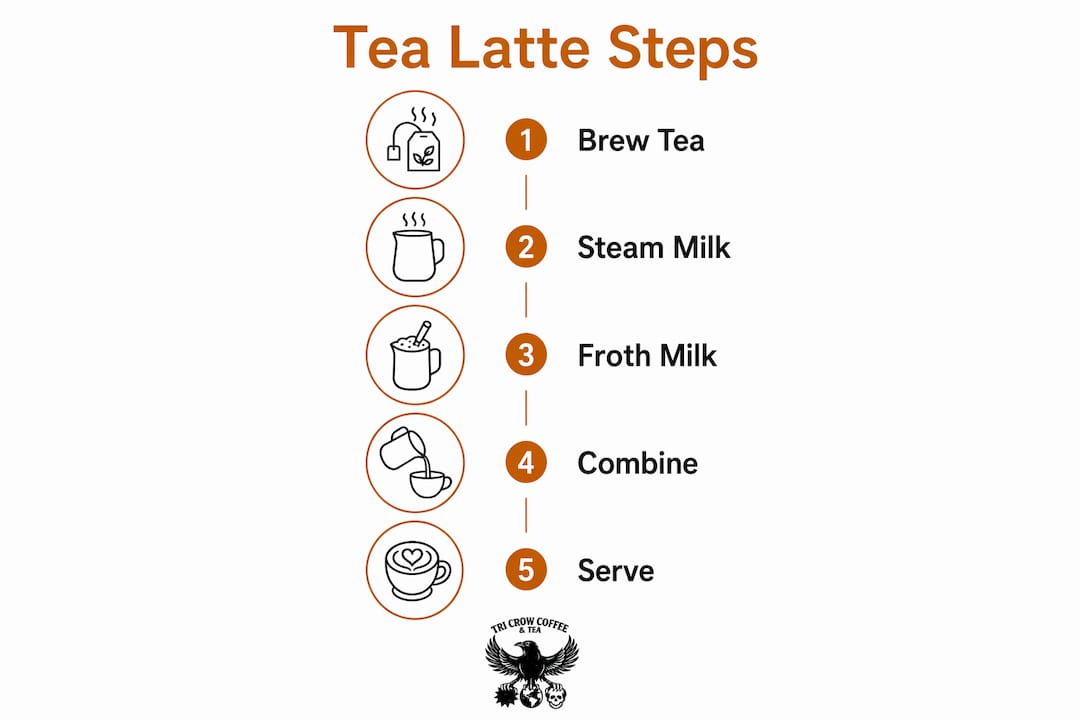
- How to make a hot tea latte step by step
- How to froth milk at home without a steam wand
- How to make an iced tea latte
- Four cafe-style tea latte recipes to try now
- Quick reference: ratios and temperature targets
- Troubleshooting: curdling, weak flavor, and flat foam
- Why milk temperature and concentrate strength actually matter
- Key Takeaways
- The craft behind a consistently good tea latte
- Useful sources and further reading
- Tri Crow Coffee: small-batch teas built for home lattes
- FAQ
What equipment and ingredients do you actually need?
You do not need a commercial espresso machine. Here is what genuinely matters.
Equipment:
- Electric kettle with temperature control (critical for green tea and matcha)
- Fine-mesh strainer or teapot with an infuser basket
- Milk frother: electric all-in-one frother (fastest), handheld frother (cheapest), French press (best low-tech foam), or a steam wand if you have one
- A wide-mouthed latte mug so foam has somewhere to sit
Ingredients:
- Concentrate-grade loose-leaf tea or tea bags (choose robust varieties — more on this below)
- Milk: varieties such as whole dairy, oat, barista soy, or coconut milk
- Sweetener options include honey, maple syrup, vanilla syrup, or cane sugar
- Optional add-ins: cinnamon, cardamom, vanilla extract, nutmeg
Pro Tip: Fat and protein content determine how well milk froths. Whole dairy milk produces the most stable microfoam. Among non-dairy options, barista-formulated oat milk (higher protein and fat than standard oat milk) comes closest to whole milk’s texture. If your foam keeps collapsing, the milk is the first thing to change.
For a deeper look at which teas pair best with different milk types, the tea pairing guide at Tri Crow Coffee breaks down sensory notes by variety.
Which teas work best for lattes?
Not every tea holds up to milk. Delicate teas get buried; acidic ones can curdle non-dairy milk. Here is what actually works.
Recommended:
- Assam and Ceylon black teas: Bold, malty, and built for milk. The go-to base for a classic tea latte.
- Earl Grey: Bergamot oil gives it a floral, citrusy lift that cuts through milk beautifully. The base for a London Fog.
- Masala chai: Spiced blends are practically designed for steamed milk. The spices amplify rather than disappear.
- Matcha: Whisked into a paste before milk is added, it suspends evenly and delivers a grassy, umami-forward flavor.
- Rooibos: Naturally sweet, caffeine-free, and earthy. Pairs especially well with vanilla and oat milk.
Use cautiously or avoid:
- High-citrus fruit teas: The acidity can curdle non-dairy milk and the flavor often gets lost under milk entirely.
- Delicate white and light green teas: Their subtlety disappears. If you love them, use a very light milk ratio and skip frothing.
| Tea | Best for | Milk type | Serving style |
|---|---|---|---|
| Assam / Ceylon | Classic black tea latte | Whole dairy or oat | Hot |
| Earl Grey | London Fog | Whole dairy | Hot |
| Masala chai | Spiced chai latte | Whole dairy or barista oat | Hot or iced |
| Matcha | Matcha latte | Oat or whole dairy | Hot or iced |
| Rooibos | Caffeine-free latte | Oat or coconut | Hot |
For a broader breakdown of flavor profiles by tea variety, Tri Crow Coffee’s tea blend guide is worth bookmarking.
How to make a hot tea latte step by step
The process has three parts: brew the concentrate, texture the milk, combine them carefully.
Brew the concentrate
- Measure double the usual leaf amount (2 teaspoons loose-leaf or 2 bags per 2–3 oz of water).
- Heat water to the correct temperature for your tea type (see table below).
- Steep for the recommended time. Do not go longer to get more strength — use more leaves, not more time. Oversteeping extracts bitter tannins that no amount of milk will fix.
- Strain immediately into your mug.
- Stir in sweetener while the tea is hot so it dissolves fully.
Texture the milk
- Pour ¾ cup of milk into your frother or a small saucepan.
- Heat and froth to a warm temperature optimal for milk sweetness and foam stability, generally just below the boiling point.
- Pour the milk into the mug, holding back the foam with a spoon, then spoon the foam on top.
Scaling up: For two servings, double every measurement. Concentrate keeps in the fridge for up to 48 hours, so batch it ahead and froth milk fresh each time.
| Tea type | Water temp | Steep time | Concentrate ratio |
|---|---|---|---|
| Black (Assam, Ceylon) | 212°F | 4–5 min | 2 tsp per 2–3 oz water |
| Earl Grey | 200°F–205°F | 3–4 min | 2 tsp per 2–3 oz water |
| Masala chai | 212°F | 5 min | 2 tsp per 2–3 oz water |
| Matcha | 160°F–175°F | Whisk, no steep | 1 tsp per 2 oz water |
| Rooibos | 212°F | 5–6 min | 2 tsp per 2–3 oz water |
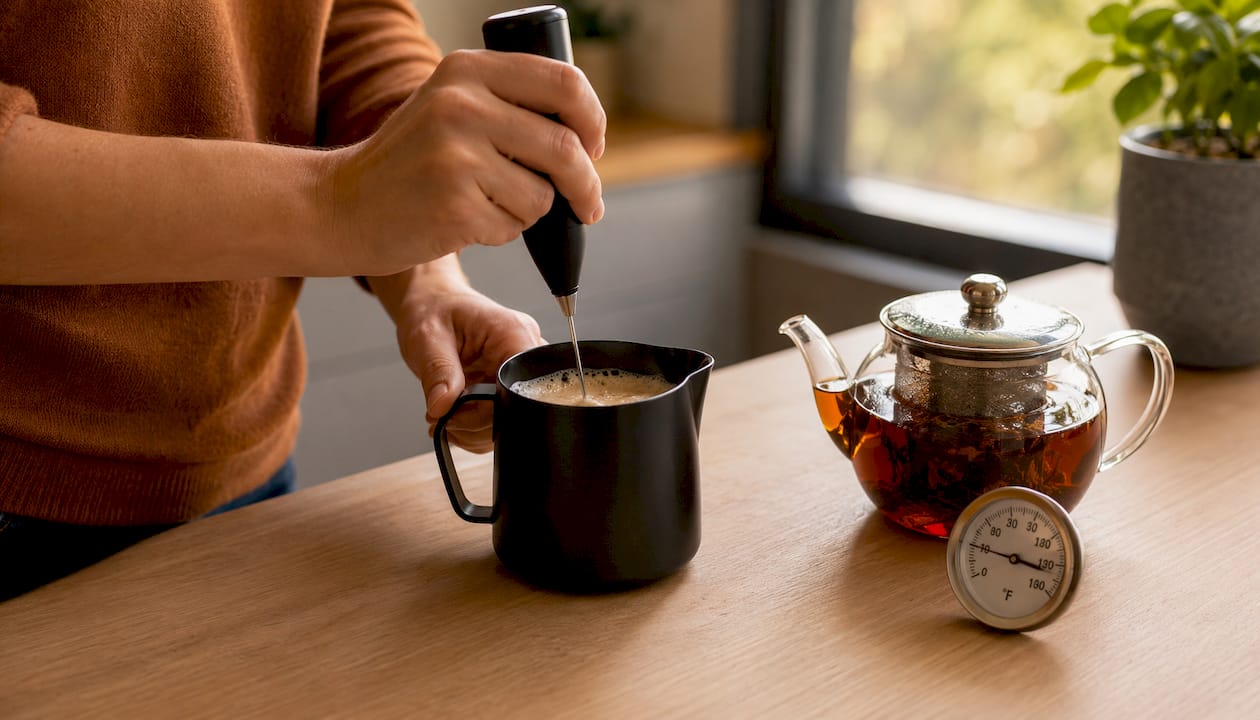
The milk target of 140°F–155°F is the range where foam is stable and the milk tastes its sweetest. Go past 160°F and you risk scalding the proteins, which collapses the foam and introduces a cooked-milk flavor.
How to froth milk at home without a steam wand
You have more options than you think, and the French press method produces genuinely good microfoam.
Electric all-in-one frother
- Pour cold milk into the frother (fill to the max line).
- Select the hot-froth setting.
- Done in about 60–90 seconds. This is the fastest method and produces consistent results.
Handheld frother
- Heat milk in a small saucepan until very warm and steaming but not boiling.
- Pour into a tall glass or pitcher.
- Submerge the frother wand and run it for 20–30 seconds, moving it up and down.
French press frothing
- Heat milk on the stovetop to 140°F–155°F.
- Pour into the French press (fill no more than halfway — it expands).
- Pump the plunger until the milk doubles in volume.
- Tap the carafe on the counter and swirl to collapse large bubbles.
- Pour immediately.
Jar-shake method (last resort)
- Fill a jar halfway with warm milk, seal the lid tightly.
- Shake vigorously for 30–45 seconds.
- Foam will be coarser than other methods but workable for a quick iced latte.
Quick comparison:
- Electric frother: Fast, consistent, minimal cleanup. Best for daily use.
- French press: Excellent foam quality, no extra equipment needed if you already own one.
- Handheld frother: Cheap and portable, but requires a separate heating step.
- Jar shake: Zero equipment, coarser foam.
Pro Tip: After frothing, tap the pitcher or glass firmly on the counter two or three times to pop large bubbles, then swirl in a circular motion. This polishes the foam into the fine, glossy microfoam you see in cafes. Skip this step and your foam will look bubbly and feel thin.
The temperature sweet spot near 140°F matters more than most home brewers realize. Without a thermometer, pull the milk off heat the moment you see a steady, gentle steam rising — before it starts to simmer.
How to make an iced tea latte
Iced tea lattes have one enemy: dilution. The fix is a strong concentrate and thoughtful assembly.
Two reliable approaches:
- Cold-brew concentrate: Steep 3–4 teaspoons of loose-leaf tea (or 3–4 bags) in 8 oz of cold water for 8–12 hours in the fridge. Strain and use directly over ice. This method produces a smooth, low-bitterness concentrate with no chilling step needed.
- Hot concentrate, rapidly chilled: Brew a double-strength hot concentrate (same leaf ratio as the hot latte method), then pour it over a glass filled with ice immediately. The ice displaces and chills the concentrate fast. Use slightly less ice in the glass to account for melt.
Ratios for iced servings: Use the same 1:2 concentrate-to-milk ratio, but pour over ice first, then add cold milk. For a 12 oz glass, that is roughly 3 oz concentrate, 6 oz cold milk, and ice to fill.
Tempering tip for non-dairy milk: Pour a small splash of the concentrate into the cold milk first and stir. This tempers the temperature difference and reduces the chance of curdling — a common problem when hot concentrate hits cold non-dairy milk directly. Cold concentrates and tempering are the two most reliable fixes for iced-latte curdling.
Serving tips:
- Chill your glass in the freezer for 5 minutes before assembling for slower ice melt.
- Add ice first, then concentrate, then milk poured slowly down the side of the glass for a layered visual effect.
- Oat milk and barista soy hold up better than almond milk in iced versions — almond milk tends to separate quickly.
Four cafe-style tea latte recipes to try now
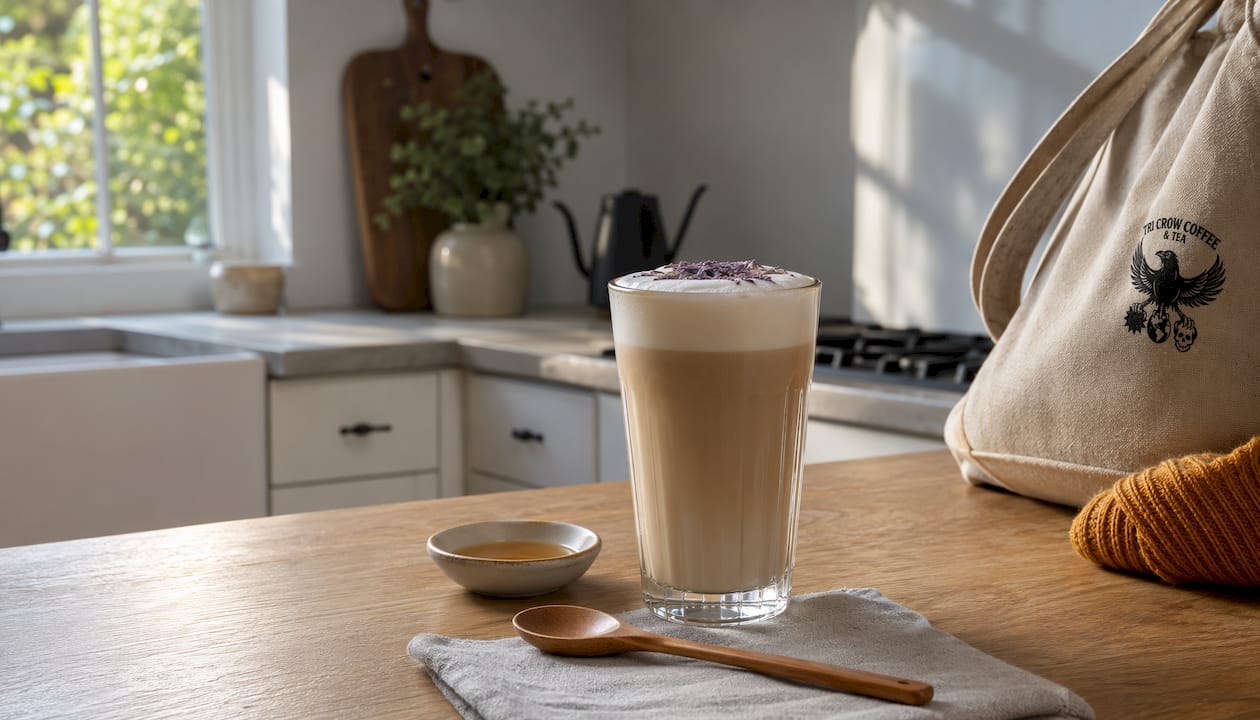
London Fog
A bergamot-forward, lightly sweet classic.
- 2 tsp Earl Grey loose-leaf (or 2 bags) steeped in 2–3 oz of 200°F water for 3–4 minutes
- 1 tsp vanilla syrup (or ½ tsp vanilla extract + ½ tsp sugar)
- ¾ cup steamed whole milk, frothed to 140°F–155°F
Strain the tea into your mug, stir in vanilla syrup, pour the milk, and spoon foam on top.
Chai latte
Rich, spiced, and deeply satisfying.
- Simmer 2 tsp of masala chai loose-leaf (or 2 chai bags) in 3 oz of boiling water for 5 minutes.
- Add a pinch each of cinnamon and cardamom directly to the concentrate if using plain black tea bags.
- Strain into your mug, sweeten with honey or maple syrup.
- Pour ¾ cup of frothed milk (140°F–155°F) over the concentrate.
Pro Tip: For a stronger spice hit, add a small piece of fresh ginger to the concentrate while it steeps. Remove it with the tea when you strain.
Matcha latte
Earthy, vibrant, and worth the whisking.
- Sift 1 tsp of ceremonial-grade matcha into a small bowl or mug.
- Add 2 oz of water heated to 160°F–175°F (never boiling — it turns matcha bitter).
- Whisk in a rapid “W” or “M” motion for 30–45 seconds until fully dissolved and slightly frothy.
- Pour ¾ cup of frothed oat milk (or whole milk) over the matcha base.
For iced matcha: dissolve the matcha in 2 oz of warm water, let it cool briefly, then pour over ice and add cold oat milk.
Dirty tea latte
For days when tea alone isn’t enough.
- Brew 2 oz of strong black tea concentrate (Assam or Ceylon work best).
- Pull a single shot of espresso (or brew 1 oz of very strong coffee).
- Combine the tea and espresso in your mug.
- Top with ¾ cup of frothed milk.
The result is a layered, caffeinated drink with the brightness of tea and the depth of coffee. For more on pulling a clean espresso shot to pair with your tea base, the home barista espresso guide at Tri Crow Coffee covers the extraction basics.
Quick reference: ratios and temperature targets
A tea latte is forgiving once you know the baseline. Adjust from here based on your taste.
| Tea type | Concentrate ratio | Serving size | Milk suggestion | Steam target |
|---|---|---|---|---|
| Black (Assam/Ceylon) | 1:2 (2 oz : 4 oz) | 6 oz total | Whole dairy or barista oat | 140°F–155°F |
| Masala chai | 1:2 (2 oz : 4 oz) | 6 oz total | Whole dairy or barista oat | 140°F–155°F |
| Matcha | 1:3 (2 oz : 6 oz) | 8 oz total | Oat or whole dairy | 140°F–155°F |
| Rooibos | 1:2 (2 oz : 4 oz) | 6 oz total | Oat or coconut | 140°F–155°F |
The standard baseline uses a concentrate-to-milk ratio favoring twice as much milk as tea. Matcha lattes tend to use more milk due to their subtle flavor and suspension characteristics.
Troubleshooting: curdling, weak flavor, and flat foam
Milk is curdling: Acidic teas (fruit blends, some green teas) react with non-dairy milks and cause curdling. Switch to a barista-formulated oat or soy milk, or temper the milk by mixing a splash of concentrate into it before combining fully. Curdling almost never happens with whole dairy milk.
Latte tastes watery or weak: Your concentrate is too dilute. Add more tea leaves — do not steep longer. Doubling the leaf amount without extending steep time gives you strength without bitterness.
Foam is flat or disappears fast: Two likely causes: milk overheated past 155°F (scalded proteins collapse foam), or the milk’s fat and protein content is too low. Check your temperature and switch to a higher-fat milk or a barista-blend non-dairy option.
Pro Tip: Store leftover concentrate in a sealed jar in the fridge for up to 48 hours. Froth fresh milk each time — pre-frothed milk loses its texture within minutes and will not revive.
Why milk temperature and concentrate strength actually matter
The 140°F–155°F milk target is not arbitrary. At this range, heat breaks down some of the lactose in milk, which is why properly steamed milk tastes noticeably sweeter than warm milk straight from a saucepan. The proteins also denature just enough to trap air bubbles in a stable structure — that is what microfoam is. Push past 160°F and those proteins over-denature, the foam collapses, and the milk takes on a faint cooked flavor.
The concentrate approach matters for the same reason. Specialty trade guidance consistently recommends batch-style or shot-style concentrates over long-steeped tea because tannins — the compounds responsible for bitterness — extract aggressively with time, not just heat. More leaves, shorter steep, strain immediately: that sequence gives you a bold concentrate without the astringency that makes a latte taste harsh.
“The secret to making a stronger tea is to add more leaves: You’ll get a concentrated taste without sacrificing the tea’s subtleties.” — Matt Woodburn-Simmonds, ex-barista, via The Takeout
Key Takeaways
A great tea latte comes down to three things: a properly concentrated tea base, milk textured to 140°F–155°F, and the right tea-to-milk ratio.
| Point | Details |
|---|---|
| Core ratio | Use 1:2 concentrate-to-milk (2 oz tea to 4 oz milk) as your starting point. |
| Milk temperature | Froth milk to 140°F–155°F for stable microfoam and natural sweetness. |
| Concentrate method | Double the leaf amount, keep the steep time the same, and strain immediately. |
| Iced latte tip | Temper cold non-dairy milk with a splash of concentrate before combining to prevent curdling. |
| Tri Crow Coffee | Tri Crow Coffee’s artisan tea collection offers concentrate-ready loose-leaf teas suited to every latte variation covered here. |
The craft behind a consistently good tea latte
There is a version of this that most home brewers skip: they measure nothing, heat milk until it “looks right,” and wonder why the result is inconsistent. The technique covered here — measured ratios, a thermometer, more leaves instead of longer steeps — is not fussiness. It is the difference between a drink that works once and one you can repeat every morning without thinking.
Tri Crow Coffee’s approach to small-batch tea and coffee is built on exactly this idea: that attention to the details of sourcing and preparation produces something noticeably better, and that the ritual of making it well is part of the value. A tea latte made with a quality loose-leaf base, properly textured milk, and a consistent ratio is a genuinely different experience from the shortcut version.
Useful sources and further reading
- The Ratio To Use For Tea Latte — The Takeout: Source for the 1:2 concentrate-to-milk ratio and the “more leaves, not longer steep” principle, including barista commentary from Matt Woodburn-Simmonds.
- How to Make a Tea Latte — A Couple Cooks: Practical recipe guidance and the 140°F–155°F milk temperature recommendation.
- Art of the Tea Latte — Tea & Coffee Trade Journal: Specialty trade perspective on concentrate methods and cafe-style steaming technique.
- Tea Latte Recipes — CoffeeExplore: Step-by-step templates for variations and tempering guidance for non-dairy milks.
- French Press Milk Frothing — YouTube: Demonstration of the 20–60 second French press pumping method for home microfoam.
- How to Froth Milk at Home — YesMooreTea: Temperature precision guidance and the sensory case for the 140°F sweet spot.
-
Tri Crow Coffee internal resources:
- Artisan Tea Collection — concentrate-ready loose-leaf and bagged teas
- Tea Latte Workflow Guide — barista-level technique for milk texturing and pouring
- Tea Blend Varieties Guide — flavor profiles and brewing tips by tea type
- Best Sellers Sample Pack — six Tri Crow varieties to explore, including coffee options for dirty tea lattes
- 6 Bean Dark Roast and French Roast — bold coffee bases for dirty tea latte variants
- Italian Roast Dark — Arabica/Robusta blend for readers who want a stronger espresso component
Tri Crow Coffee: small-batch teas built for home lattes
If you have worked through the recipes above and want a tea base that is already dialed in for concentrate brewing, Tri Crow Coffee’s small-batch teas are a natural next step. Each variety is sourced and produced in limited quantities, which means the flavor is consistent batch to batch — exactly what you want when you are building a repeatable morning ritual around a specific ratio and steep time.
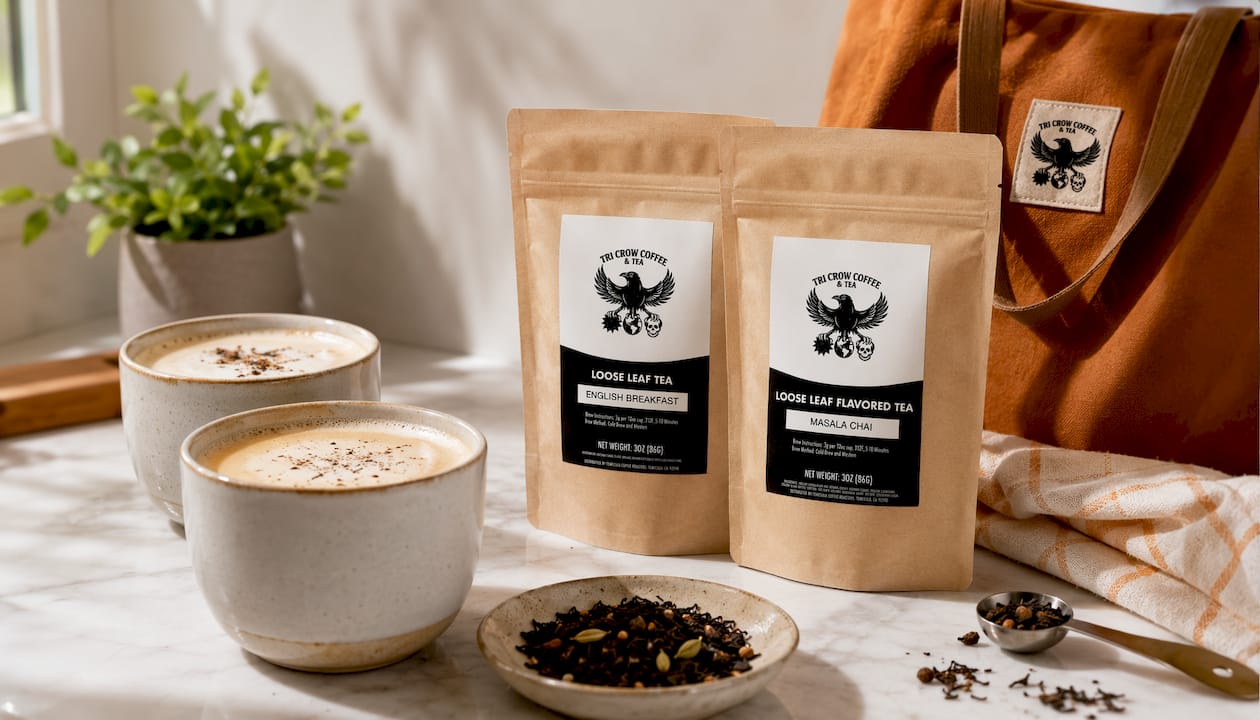
The artisan tea collection includes loose-leaf and bagged options suited to every latte style covered here: robust black teas for classic lattes, chai blends for spiced versions, and specialty options for readers who want to experiment further. And if you are curious about the dirty tea latte, the cold brew coffee makes a smooth, low-acid base that pairs well with a black tea concentrate. Browse the collection and pick a tea that fits the latte you want to make first.
FAQ
What is the ratio of tea to milk in a tea latte?
The standard starting ratio is 1:2 — about 2 oz of tea concentrate to 4 oz of steamed milk for a single serving. Adjust to taste: more concentrate for a stronger tea flavor, more milk for a creamier, milder drink.
What makes a tea a latte?
A tea latte is defined by its milk texture, not just its ingredients. Steamed or frothed milk with microfoam is what separates a tea latte from plain tea with milk poured in — the aerated texture changes the mouthfeel and flavor balance entirely.
How do you make a milk tea latte at home?
Brew a double-strength tea concentrate (double the usual leaf amount, same steep time), froth milk to 140°F–155°F using an electric frother or French press, then combine at a 1:2 ratio with the foam spooned on top. The full step-by-step method is in the hot tea latte section above.
Can you make a tea latte with non-dairy milk?
Yes. Barista-formulated oat milk and soy milk froth most reliably and produce stable foam close to whole dairy milk. Almond milk works but produces thinner foam and can separate in iced versions. Temper non-dairy milk by mixing a small splash of concentrate into it before combining to reduce curdling risk.
What teas work best for lattes?
Assam and Ceylon black teas, Earl Grey, masala chai, matcha, and rooibos all hold up well to milk. Avoid high-citrus fruit teas and very delicate white or light green teas — they either curdle non-dairy milk or disappear under the milk entirely.