
TL;DR:
- A coffee tasting, or cupping, is a structured event where participants evaluate aroma, flavor, and texture across multiple samples. Proper preparation, consistent brewing, and a guided sensory sequence enhance the experience and education. Including food pairings and interactive challenges makes the event engaging and memorable for all skill levels.
A coffee tasting is a structured sensory event where participants evaluate aroma, flavor, body, and finish across multiple coffee samples under consistent conditions. Known in the industry as “cupping,” this practice goes far beyond casual drinking. When you know how to host a coffee tasting well, you give your guests a framework for noticing what’s actually in their cup. The Specialty Coffee Association (SCA) sets the global standard for cupping protocols, and even a simplified home version benefits from the same core principles: fresh grinds, controlled brewing, and deliberate attention. Tri Crow Coffee designs each of its small-batch roasts to reward exactly this kind of intentional tasting.
How to host a coffee tasting: what to prepare first
Good preparation separates a memorable event from a chaotic one. You need the right equipment, the right coffees, and a space that lets guests focus on flavor rather than distractions.
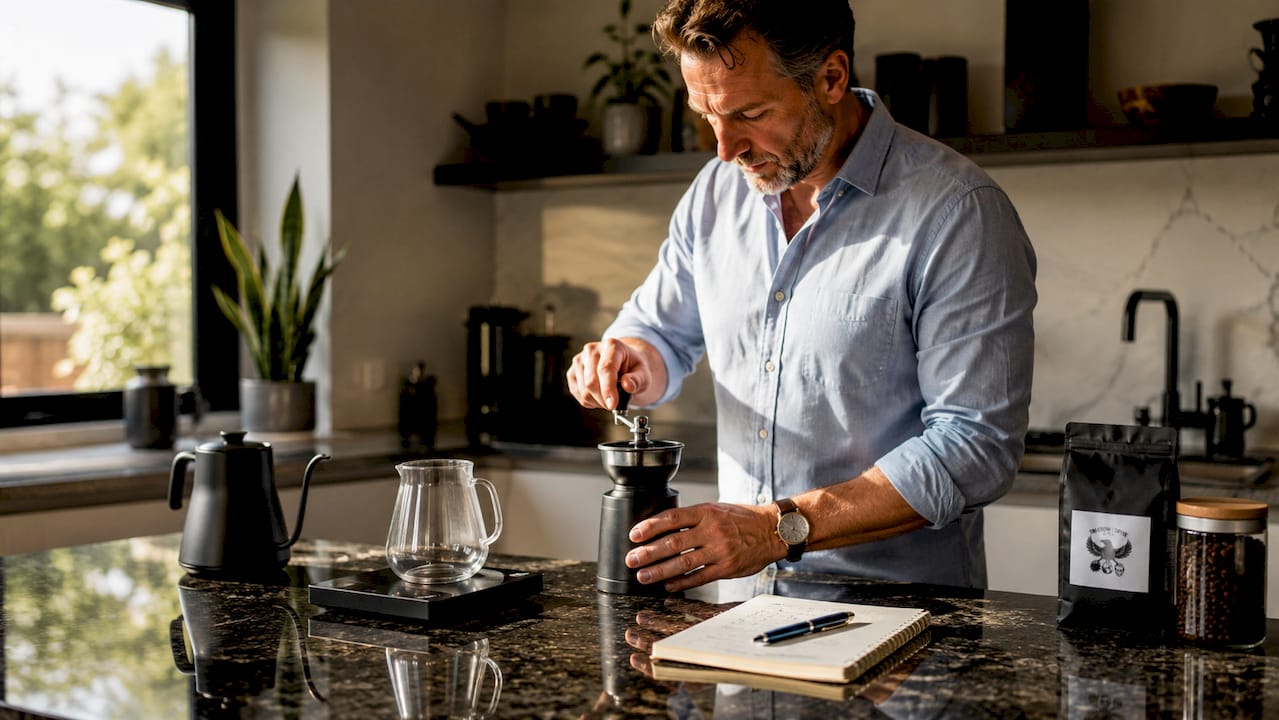
Essential equipment
Gather these items before your guests arrive:
- Burr grinder — a consistent grind size is non-negotiable for fair comparison across samples
- Gooseneck kettle — gives you control over pour speed and water temperature
- Clear glass tumblers or white cups — glass tumblers on light surfaces let you assess visual characteristics like color and transparency before you even smell the coffee
- Tasting spoons — one per sample, rinsed between uses
- Tasting sheets and pens — one set per guest
- Timer — keeps brewing consistent across all samples
- Neutral water — filtered, not distilled; mineral content affects extraction
Choosing your coffee samples
Select 3–5 coffees with clearly different profiles. Contrast is what makes a tasting educational. A useful starting lineup might include one washed Ethiopian (bright, floral, high acidity), one natural Brazilian (nutty, low acidity, heavy body), and one medium-roast Central American (balanced, approachable). Varying the processing method, origin, and roast level gives guests the widest range of sensory data to work with.
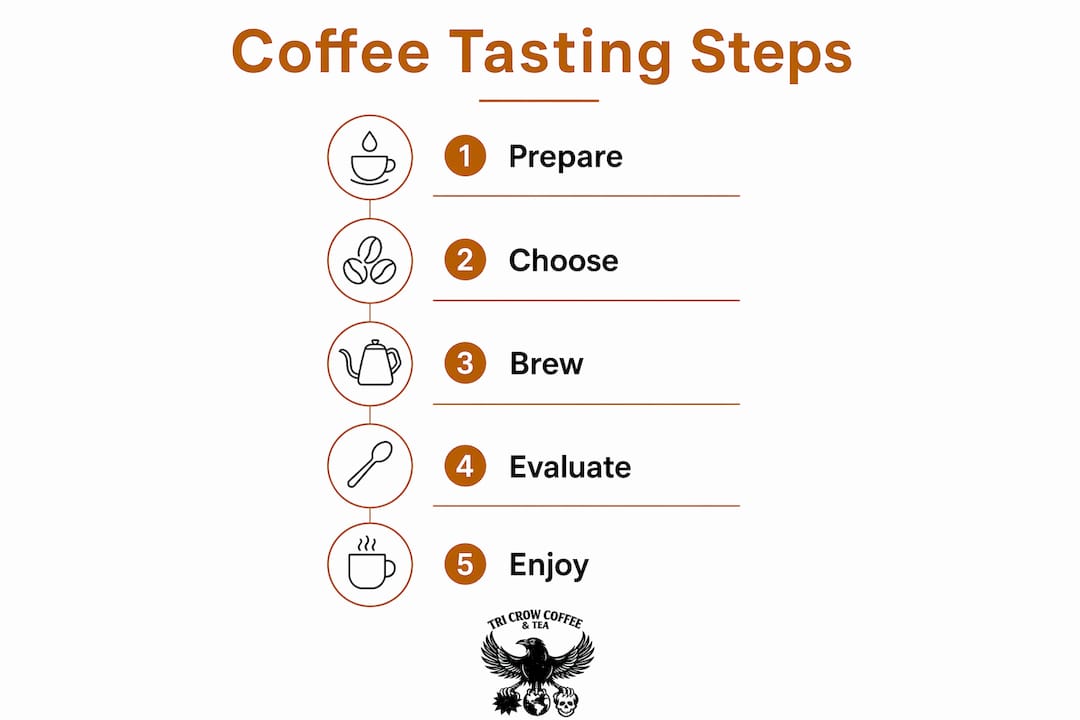
Brewing at SCA standards means using approximately 60 grams of ground coffee per liter of water. That ratio produces a cup strong enough to reveal flavor clearly without overwhelming the palate. Grind each sample fresh, right before brewing, since ground coffee loses volatile aromatics within minutes.
Pro Tip: Print tasting sheets with labeled columns for aroma, body, acidity, and finish. Guests who write notes engage more deeply and remember the experience longer.
Setting up the space
Good lighting matters more than most hosts expect. Bright, neutral light helps guests see the coffee’s color and clarity in the cup. Keep the table free of strong scents, including candles, flowers, and heavily perfumed hand soaps in the bathroom. Invite guests with some prior coffee interest and organize the tasting flow clearly so no one feels lost when multiple samples are on the table at once.
How do you brew coffee samples for a tasting?
Consistency is the single most important brewing principle in a tasting. If one sample is brewed hotter or longer than another, you are comparing brewing errors, not coffee flavors.
Follow these steps for each sample:
- Grind fresh. Grind each coffee immediately before brewing. Use the same grind setting across all samples unless you are specifically comparing grind sizes.
- Control water temperature. Brew near 200°F (93°C). Water that is too cool under-extracts the coffee and masks sweetness.
- Use a consistent ratio. Stick to the SCA standard of approximately 60 grams per liter. Measure by weight, not volume.
- Brew separate batches. Brew each coffee in its own vessel. Never combine samples or reuse grounds.
- Time your pour. Use a timer for every brew. A four-minute steep for a French press or a two-and-a-half-minute pour for a pour-over keeps results comparable.
- Serve at the right temperature. Start tasting once coffee cools to 75°C and finish before it drops below 50°C. That window is where volatile compounds open up and reveal distinct flavor notes.
The temperature window matters more than most home tasters realize. Coffee served too hot numbs the palate and hides acidity. Coffee that has gone cold loses its aromatic complexity. Tasting in the 75°C to 50°C range is where the cup tells its full story.
Pro Tip: Stagger your brews by two minutes so each sample hits the ideal tasting temperature right when guests are ready for it. A simple countdown timer on your phone handles this easily.
The serving vessel also shapes perception. Clear glass tumblers placed on a white or light-colored surface let guests observe the coffee’s body and clarity before tasting. A visually lighter cup primes the palate to expect brightness; a darker, denser pour signals richness. This is not a trick. It is how sensory evaluation actually works.
How do you guide guests through sensory evaluation?
Coffee flavor is a blend of aroma, taste, mouthfeel, and finish that shifts as the cup cools. Your job as host is to give guests a sequence to follow so they notice each element before moving to the next.
Walk guests through this order:
- Smell the dry grounds. Before adding water, pass the ground coffee around. Dry aroma is often more intense than the brewed cup and reveals fruit, chocolate, or floral notes clearly.
- Smell the wet crust. In cupping protocol, you pour hot water directly over the grounds and let a crust form. Breaking the crust releases a concentrated burst of aroma. Even in a simplified home tasting, smelling the brewed cup immediately after pouring captures this effect.
- Slurp to aerate. Slurping is not rude at a tasting. It sprays coffee across the entire palate and forces air through the liquid, which amplifies aroma perception. Encourage guests to try it.
- Assess body. Body is the weight or texture of the coffee in the mouth. Ask guests: does it feel thin like water, medium like juice, or thick like cream?
- Note acidity. Acidity is the bright, lively sensation at the sides of the tongue. It is not sourness. A well-balanced Ethiopian natural has acidity that feels like biting into a ripe berry.
- Evaluate the finish. The finish is what lingers after swallowing. A long, clean finish signals quality. A short or harsh finish often points to over-roasting or poor extraction.
Tasting sheets with note-taking prompts help guests articulate what they are experiencing rather than defaulting to “I like it” or “I don’t.” The SCA’s Coffee Taster’s Flavor Wheel is a widely used reference tool that gives guests vocabulary for over 80 flavor descriptors, from jasmine to dark chocolate to cedar. Print a copy for each guest or display one on the table.
Comparative tasting of two to five coffees side by side turns vague impressions into clear flavor patterns. When guests taste a washed and a natural version of the same origin back to back, the processing difference becomes obvious in a way that no description can match. You can read more about building this skill in Tri Crow Coffee’s guide to coffee flavor profiles.
Pro Tip: Ask guests to score each coffee on a simple 1–5 scale for body, acidity, and overall enjoyment before discussing as a group. Individual scores prevent groupthink and make the group discussion far more interesting.
What makes a coffee tasting party more fun and engaging?
A tasting does not need to feel like a classroom. The best events balance structure with genuine enjoyment.
Food pairings are the easiest way to deepen the experience. Chocolates and pastries complement coffee flavors and give guests a reference point for sweetness and bitterness. A square of 70% dark chocolate alongside a natural Ethiopian shows guests exactly what “chocolate finish” means on a tasting sheet. Nuts, dried fruit, and plain crackers also work well. Avoid strongly spiced foods that linger on the palate between samples. For a full approach to pairing, Tri Crow Coffee’s food pairing guide covers the logic behind flavor matching in detail.
Games and challenges keep energy high, especially for guests who are newer to tasting:
- Blind tasting: Remove labels and ask guests to guess the origin or roast level. The results are always surprising and usually funny.
- Flavor bingo: Create bingo cards with flavor descriptors from the SCA Flavor Wheel. Guests mark off terms as they taste them.
- Origin trivia: Share one fact about each coffee’s growing region before tasting. Knowing that a Yirgacheffe comes from the birthplace of Arabica coffee changes how guests approach the cup.
- Ranking challenge: Ask guests to rank all five coffees from lightest to boldest body before the group reveals their answers.
Tailor the depth of discussion to your group. A table of experienced home baristas will want to debate extraction ratios. A group of casual coffee drinkers will have more fun with the blind tasting game. The best hosts read the room and adjust. A well-organized tasting flow keeps multiple guests from feeling confused when several samples are on the table at once.
Key Takeaways
A successful coffee tasting requires consistent brewing, a structured sensory sequence, and at least three to five contrasting coffees to give guests meaningful comparisons.
| Point | Details |
|---|---|
| Brew with precision | Use 60g of coffee per liter of water at near 200°F for reliable, comparable results. |
| Taste in the right window | Evaluate each cup between 75°C and 50°C to catch the full range of flavor compounds. |
| Use contrast to teach | Select coffees with different origins, roast levels, and processing methods for clear sensory differences. |
| Structure the sensory sequence | Guide guests through aroma, body, acidity, and finish in order before opening group discussion. |
| Add food and games | Chocolate pairings and blind tasting challenges make the event memorable and accessible for all skill levels. |
What I’ve learned from hosting coffee tastings
The biggest mistake first-time hosts make is rushing the tasting to fill silence. Silence is actually productive. When guests go quiet over a cup, they are working. Let them sit with it.
Temperature management is the detail that separates a good tasting from a great one. I have watched guests dismiss a coffee as flat and boring, then taste the same cup five minutes later as it cooled and completely change their assessment. The 75°C to 50°C window is real, and it is worth the effort to time your brews around it.
New tasters often apologize for their descriptions, as if saying “it tastes like a campfire” is wrong. It is not wrong. Sensory vocabulary builds through repetition, not correction. The SCA Flavor Wheel gives guests permission to name what they notice, and that permission changes the whole dynamic of the room.
My honest advice: keep your first tasting to three coffees. Five is ambitious. Three is manageable, memorable, and leaves guests wanting more. You can always scale up once you know your rhythm as a host. The coffee tasting process gets easier every time you run it, and your palate sharpens with every session.
— David
Ready to build your tasting lineup with Tri Crow Coffee?
The hardest part of planning a tasting event is sourcing coffees with genuinely different profiles. Tri Crow Coffee’s small-batch sample packs solve that problem directly.
The Single Origin Favorites pack gives you six 2oz samples from distinct growing regions, which is ideal for teaching guests about terroir and processing differences. The Best Sellers pack covers the crowd-pleasing range, from a bold Cowboy Breakfast to a clean Peruvian. For guests who enjoy sweeter profiles, the Flavored Coffee sampler adds a creative dimension to any tasting table. Each pack arrives fresh-roasted in limited batches, so the flavor you taste is the flavor Tri Crow Coffee intended.
FAQ
What is the difference between coffee tasting and cupping?
Coffee cupping is the formal industry protocol developed by the SCA, using a specific ratio, steep time, and evaluation form. A home coffee tasting follows the same sensory principles in a more relaxed format.
How many coffees should I serve at a tasting?
Three to five coffees is the practical range. Fewer than three limits meaningful comparison, and more than five fatigues the palate and makes note-taking harder to manage.
What temperature should I serve coffee for tasting?
Start tasting at 75°C and finish before the cup drops below 50°C. That range is where volatile flavor compounds are most active and detectable.
Do guests need coffee experience to enjoy a tasting?
No prior experience is needed. Structured tasting sheets, a clear sensory sequence, and food pairings make the event accessible for beginners while still rewarding experienced palates.
What foods pair best with a coffee tasting?
Dark chocolate, nuts, and plain pastries work best because they complement coffee without overpowering the palate between samples.