
Yes, for most healthy adults, drinking green tea daily is a reasonable, evidence-supported habit. Research links roughly 3 to 5 cups a day to real associations with cardiovascular and brain health, driven largely by catechins like EGCG. Some sources place the general upper limit at a moderate higher intake level, though concentrated forms like matcha carry their own dosing ceiling. Anyone on medication, pregnant, or managing liver disease should check with a clinician first.
TL;DR:
- Drinking 3 to 5 cups of brewed green tea daily provides the most consistent cardiovascular and cognitive benefits, with higher intake offering no added advantage.
- Concentrated extracts and matcha should be consumed with caution, as they contain higher catechin levels that may pose safety risks or interfere with medications.
- Green tea’s benefits are associated with long-term daily consumption over years, not short-term detoxes or occasional drinking.
- Caffeine-sensitive individuals should brew at lower temperatures and limit intake later in the day to avoid sleep disruption or jitters.
- Pregnant, breastfeeding, or people with liver issues should consult a clinician before including green tea regularly.
Table of Contents
- Health Benefits of Green Tea Daily: What the Research Shows
- What the Evidence Actually Shows and Its Limits
- How Much Green Tea Should You Drink Daily for Benefits?
- Green Tea Risks, Drug Interactions, and When to Talk to a Doctor
- How to Brew Green Tea to Preserve Its Benefits
- Is Daily Green Tea Sustainable Long Term?
- Who Benefits Most From Daily Green Tea, and Who Should Be Cautious
- Publisher Perspective: Ritual Over Regimen
- Three Tri Crow Green Teas Built for Daily Drinking
- Sources
- FAQ
Health Benefits of Green Tea Daily: What the Research Shows
Green tea’s reputation rests on catechins, a family of antioxidant compounds, and one in particular does most of the heavy lifting.
-
Antioxidant and catechin effects. EGCG (epigallocatechin gallate) is the dominant catechin in green tea and the compound behind most of its studied effects, from cellular protection to anti-inflammatory activity.
-
Cardiovascular benefits. A large observational study of roughly 40,000 Japanese adults followed for 11 years found that drinking 5 or more cups daily was associated with lower cardiovascular mortality, with stroke risk reductions showing up at 4 or more cups.
-
Brain and cognitive support. The combination of L-theanine and caffeine appears to sharpen focus without the jittery crash of coffee alone, and population studies have linked regular intake to lower dementia risk.
-
Blood sugar and metabolic effects. Short-term studies show modest improvements in glycemic markers after green tea intake, though the effect is small and inconsistent across trials.
-
Weight management, sort of. Green tea itself does not meaningfully drive weight loss. Nutrition experts at Harvard’s School of Public Health frame it instead as a smart, calorie-free swap for sugary drinks, which is where the real benefit to a person’s waistline shows up.
-
Bone, oral, and skin outcomes. Evidence here is thinner but suggestive, with some data tying regular catechin intake to modest support for bone density and gum health.
What the Evidence Actually Shows and Its Limits
Cohort studies are powerful, but they show association, not proof of cause. The 40,000-person Japanese study is a good example: people drinking 5+ cups daily had lower cardiovascular mortality, but they might also exercise more, smoke less, or eat differently than the tea-averse. Researchers try to adjust for these confounders statistically, but they cannot eliminate them entirely.
- Randomized controlled trials on green tea are often small, short, and produce mixed results.
- Lab and animal studies show strong anti-inflammatory and anticancer effects for EGCG, but human bioavailability is limited, so those effects don’t translate cleanly to people.
- Supplements concentrate catechins far beyond what brewed tea delivers, which raises the safety stakes considerably.
The cohort finding that anchors most of this guidance: cardiovascular mortality was measurably lower among the highest tea-drinking group in that Japanese study, at 5 or more cups a day.
The honest takeaway: daily green tea is a supportive lifestyle habit, not a substitute for medical treatment.
How Much Green Tea Should You Drink Daily for Benefits?
Most healthy adults land in a 3 to 5 cup daily range, which is roughly 24 to 40 ounces, to capture the benefits studies associate with regular drinking. Some cohort research pushes the beneficial cutoff to 4 or 5+ cups, and a handful of sources cite a higher general ceiling for many adults.
- Brewed tea: aim for 3 to 5 cups spread through the day rather than all at once.
- Matcha or powdered forms: cap intake around a small amount of high-quality matcha, corresponding to an approximate safe limit of EGCG (https://health.clevelandclinic.org/green-tea-health-benefits), the commonly cited safety ceiling for concentrated catechins.
- Caffeine-sensitive drinkers should shift most cups to the morning and consider a caffeine content comparison before adding an afternoon cup.
- Pregnant or breastfeeding readers should talk to a clinician before making green tea a daily habit.
Pro Tip: If you’re new to daily green tea, start at 2 cups for a week before working up to 4 or 5. Your gut and your sleep will tell you fast if the caffeine load is too much.
Green Tea Risks, Drug Interactions, and When to Talk to a Doctor
Brewed tea is generally safe. Concentrated extracts are where the real caution lives.
- Liver risk: rare cases of liver injury have been linked mainly to high-dose extracts and supplements, not to a normal cup of brewed tea.
- Medication interactions: catechins can interact with certain anticancer drugs, cardiovascular medications, and immunosuppressants, so anyone on prescription therapy should review their tea habit with a clinician.
- Iron absorption: green tea can interfere with iron uptake, so people with anemia or on iron supplements should space tea and iron doses by at least 1 to 2 hours.
- Caffeine sensitivity: insomnia and anxiety are the most common complaints, usually solved by shifting cups earlier in the day or choosing a lower-caffeine roasted variety.
How to Brew Green Tea to Preserve Its Benefits
Water temperature makes or breaks the catechin content in your cup. Boiling water scorches delicate compounds like EGCG; gentler heat protects them.
- Brew at roughly 175°F (80°C), not a full boil, and steep for 2 to 3 minutes.
- Matcha delivers the most concentrated catechin dose per serving; sencha and other loose-leaf sencha-style teas sit in the middle; roasted hojicha runs lowest in catechins because roasting breaks some of them down, making it a gentler daily option for caffeine-sensitive drinkers.
- Skip the sugar. Sweetened bottled “green tea” drinks dilute the benefit and add calories that undo the point.
- Buy whole-leaf or stone-milled powder when possible, and store it away from light and heat to protect freshness.
Pro Tip: If a cup tastes bitter, your water was probably too hot. That bitterness is often overextracted tannins, not a sign of more antioxidants.
Is Daily Green Tea Sustainable Long Term?
The research behind green tea’s biggest wins, lower cardiovascular mortality, reduced stroke risk, comes from people who drank it for years, not weeks. That’s the part easy to miss: a single “detox” week of green tea does essentially nothing measurable. The benefit shows up in cohorts tracked over a decade or more, which means the habit only pays off if it’s actually a habit.
That’s good news in one sense. Green tea has no known tolerance effect, no diminishing returns from years of use, and no evidence that long-term drinkers need to cycle off. Caffeine content is moderate enough that most people don’t build the kind of dependence associated with heavier coffee intake, though anyone drinking 5 cups a day should still watch for sleep disruption.
The sustainability question is really a practical one: does the habit survive contact with a normal week? Brewed tea is cheap, doesn’t require supplements, and fits into a morning or afternoon routine without much friction. That’s likely why it shows up so consistently in the population studies driving this whole conversation, people who drink it regularly tend to keep drinking it, which is exactly the behavior pattern researchers need to detect a long-term signal in the first place.
Who Benefits Most From Daily Green Tea, and Who Should Be Cautious
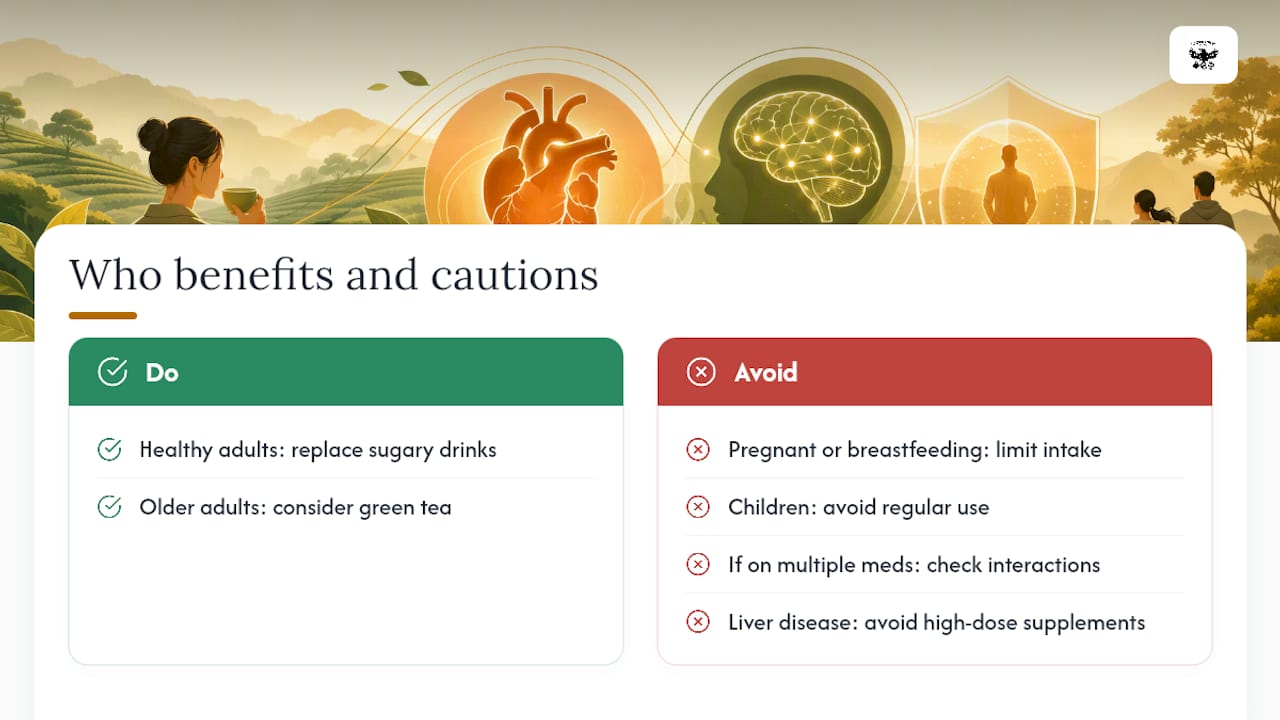
The people most likely to benefit are healthy adults looking to replace sugary or highly processed drinks with something that carries real, if modest, cardiovascular and cognitive associations. Older adults represented heavily in the Japanese cohort data may see the clearest signal, since cardiovascular mortality risk climbs with age and that’s exactly where the benefit showed up.
Several groups warrant more caution. Pregnant and breastfeeding women should limit caffeine intake overall and talk to a clinician before making green tea a daily habit, given both the caffeine and the catechin load. Children can drink green tea occasionally, but it isn’t necessary for their diet and caffeine sensitivity runs higher at lower body weights. Elderly adults on multiple medications need to be more careful about interactions, particularly with anticancer, cardiovascular, or immunosuppressant drugs. Anyone with existing liver disease should stick to brewed tea and avoid concentrated extracts entirely, since liver injury cases trace almost exclusively to high-dose supplements. For safe dosing guidance around supplements generally, this supplement safety overview is a useful reference point.
Publisher Perspective: Ritual Over Regimen
The evidence on daily green tea is genuinely encouraging, but the studies measure people who kept the habit for years, not people chasing a health fad for a month. That’s the piece most coverage skips: consistency, not intensity, is what the cohort data actually rewards. Tri Crow Coffee builds its tea program around that reality, small-batch, intentional, meant to be repeated rather than optimized. A refreshing daily blend, a floral loose-leaf steep, or a roasted powder all serve the same underlying goal: a cup you’ll actually keep drinking.
— David
Three Tri Crow Green Teas Built for Daily Drinking
Consistency is the whole game with green tea, and Tri Crow Coffee makes that easier with three small-batch options built for different daily moods. Moroccan Mint Green Tea is the brightest, most refreshing option, a good fit for readers who want a cup that feels rewarding enough to repeat every morning without added sugar. Jasmine Green Tea is loose-leaf and floral, designed for multiple steeps, which makes it a strong pick for anyone treating the daily cup as a slower, more deliberate ritual rather than a quick habit to check off.
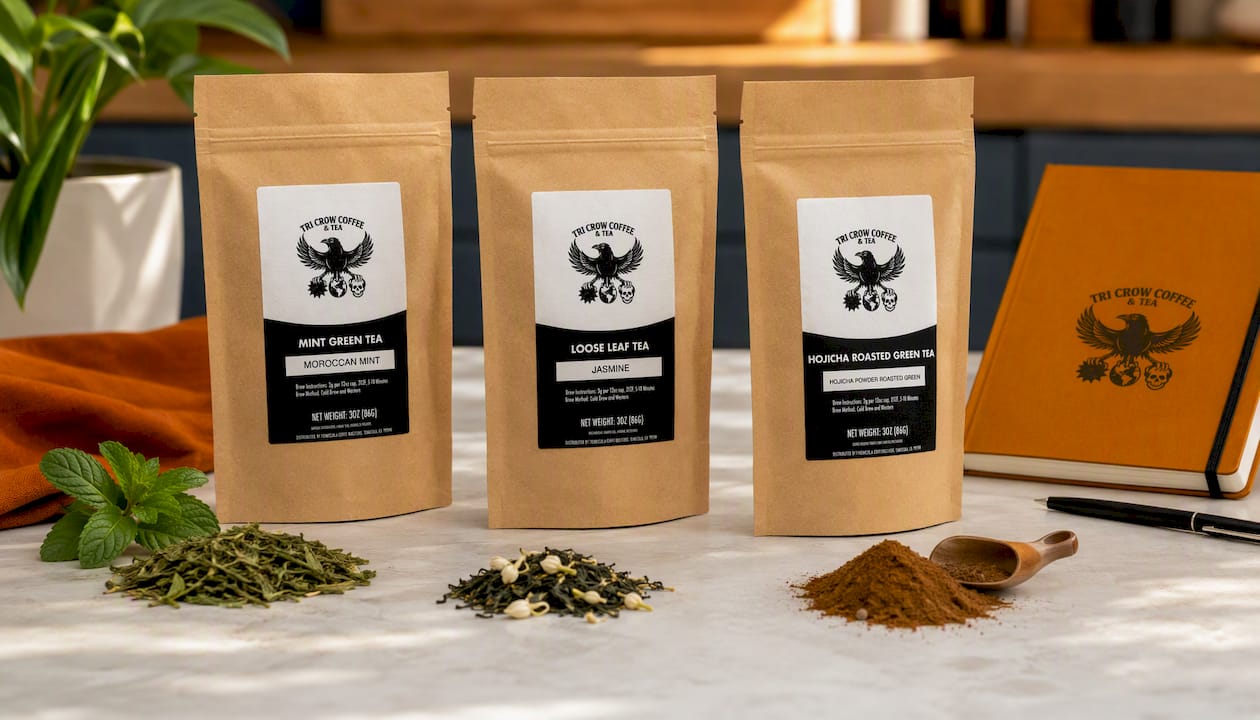
For readers managing caffeine sensitivity or looking for a lower-catechin option to sip later in the day, Premium Hojicha Powder is roasted and stone-milled, which naturally reduces its catechin load compared to matcha. If you do prepare it matcha-style, keep total concentrated catechin intake in mind against the roughly 338 mg EGCG safety ceiling cited by the Cleveland Clinic, and favor brewed or lightly prepared servings over heavily concentrated ones. Each of these small batches is roasted and packaged in limited quantities to protect flavor and freshness. Pick the one that matches your daily rhythm and start your next order at Tri Crow Coffee.
Sources
All three major teas, green, black, and oolong, come from the same Camellia sinensis plant. The difference is processing, and processing changes the antioxidant profile.
Green tea is minimally oxidized, which preserves the highest concentration of catechins like EGCG. Black tea is fully oxidized, converting most of those catechins into a different class of antioxidants called theaflavins and thearubigins, compounds with their own cardiovascular research but a different mechanism. Oolong sits in between, partially oxidized, with a catechin profile that’s lower than green tea but higher than black.
None of this makes black or oolong “worse.” It means they offer a different antioxidant mix, and if the specific research tying EGCG to the cardiovascular and cognitive associations discussed earlier is the draw, green tea is the more direct route to that particular compound. Readers curious about the fuller lineup of tea styles, and how blending and roasting shift their character, can dig into the full breakdown of tea varieties. Compared to other common antioxidant sources like berries or leafy greens, green tea’s advantage is convenience: it delivers a concentrated, repeatable dose in a beverage people already build habits around.
- How Green Tea Can Benefit Your Health — Cleveland Clinic
- Green Tea: Nutrition Facts, Potential Benefits, and Risks — WebMD
- Harvard T.H. Chan School of Public Health — commentary by Teresa Fung
- Foods (MDPI) review on catechins and bioavailability
FAQ
What happens if I drink green tea every day?
Most healthy adults see supportive associations with cardiovascular and cognitive health over years of regular drinking, with no evidence of tolerance or diminishing benefit from long-term use.
What organs does green tea benefit most?
The strongest associations show up for the heart and brain, largely tied to catechins like EGCG, with more limited evidence for bone and oral health.
What is the best time of day to drink green tea?
Morning to early afternoon works best for most people, since it captures the caffeine benefit without disrupting sleep; caffeine-sensitive drinkers should avoid it in the evening.
How much green tea should I drink a day to get benefits?
Most research points to 3 to 5 cups daily, with some cohort studies showing added cardiovascular benefit at 4 to 5+ cups and a general upper limit around 8 cups for many healthy adults.