
Medium to medium-dark roast is the best french press roast for most drinkers, because it balances body, sweetness, and acidity without demanding fussy temperature control. Dark roasts brew forgivingly but flatten the cup into smoke and bitterness fast. Light roasts can shine in a press, but only if you drop the water temperature and shorten the steep time.
Here are three presets to test tonight:
- Classic, full-bodied: Medium roast, coarse grind, approximately a 1:15 ratio, water near 93°C, and a 4-minute steep.
- Bright, origin-forward: Light roast, coarse grind, roughly a 1:16 ratio, water around 90°C, and a 3:30 steep.
- Bold, smoky: Dark roast, extra-coarse grind, about a 1:17 ratio, water near 88°C, and a 3:00 steep.
Pick classic if you want a cup that tastes like “coffee.” Pick bright if you’re chasing fruit or floral notes from a single origin. Pick bold if you like your coffee to taste like it means it. One experimental extraction study found medium roast produced higher total dissolved solids than dark roast under matched conditions, which helps explain why it’s a forgiving roast level to brew.
Key Takeaways
Medium to medium-dark roast gives most French press drinkers the best balance of body, sweetness, and forgiveness, while light and dark roasts need specific temperature and time adjustments to avoid tasting sour or bitter.
| Point | Details |
|---|---|
| Start with medium roast | Use a 1:15 ratio, 93°C water, coarse grind, and a 4 minute steep as your default. |
| Adjust temperature by roast | Drop to 90°C for light roasts and as low as 88°C for dark roasts to control extraction speed. |
| Grind coarse, check for fines | Aim for a texture like coarse sea salt; a burr grinder produces far fewer stray fines than a blade grinder. |
| Change one variable at a time | Use the three-grind dial-in test to isolate what’s actually causing bitterness or sourness. |
| Match the bean to the goal | Tri Crow Coffee’s medium roast cold brew suits balanced daily cups, while its dark French roast fits bold, traditional presets. |
Table of Contents
- Quick Picks: Roast and Grind Presets to Test Next
- How Roast Level Changes Extraction, Body, and Acidity
- Grind Size and Particle Texture: What “Coarse” Actually Means
- Step-by-Step Recipes by Roast Level
- Fixing Bitter, Sour, Weak, or Muddy Cups
- Choosing Beans and Managing Freshness
- A Repeatable Way to Dial In Your Own Roast and Grind
- Tri Crow Coffee’s Roasts Built for the Press
- Try Tri Crow Coffee for Your Next Press
- Sources
- FAQ
Quick Picks: Roast and Grind Presets to Test Next
You don’t need to read the whole science section to start brewing better coffee tonight. Here are three roast-specific presets, each built around a different flavor goal.
Classic French press (medium to medium-dark roast). Coarse grind, 1:15 ratio, water at roughly 93°C (199°F), steep for 4 minutes. This is the default recommended by most French press brewing guides, and it’s the preset to use if you’re not sure where to start. Medium roast is forgiving of small timing errors and gives you sweetness without harsh edges.
Bright, origin-forward (light roast). Light roasts are denser and slower to extract, so they need a nudge in the opposite direction from what most people assume. Use a coarse grind, drop the water temperature to about 90°C (194°F), and pull the steep back to 3:30. Skip this adjustment and you’ll get a thin, grassy cup instead of the citrus or floral notes the roaster intended.
Bold, traditional (dark roast). Dark roast beans are brittle and shed fines easily, which means more sediment and more bitterness if you’re not careful. Go extra-coarse on the grind, drop the ratio to around 1:17 (less coffee relative to water), and cut the steep to 3 minutes. Lower temperature helps here too, since dark roast oils extract fast even in cooler water.
Choose the classic preset when you want a reliable daily cup. Choose bright when you’ve got a single-origin bag with real character you want to taste through. Choose bold when you want something that stands up to milk or just tastes like a gut punch in the morning.
How Roast Level Changes Extraction, Body, and Acidity
Roast level determines how fast and how completely coffee gives up its flavor compounds in an immersion brew, and that’s the whole reason a French press recipe has to change based on what’s in the bag.
Lighter roasts are denser, with less-developed cell structure and lower solubility. That density means slower extraction. A light roast treated like a dark roast recipe, same temperature, same steep time, will underextract and taste sour or hollow. Dark roasts, by contrast, have broken-down cell walls, more surface oils, and higher solubility. They extract fast, front-load bitterness, and can turn ashy if you steep them too long or too hot.
The metal mesh filter in a French press matters more than most brewers realize. Unlike paper filters, it lets oils and microscopic fines pass straight into the cup, which is where that classic syrupy French press body comes from. It’s also why roast level and grind size interact so directly: dark roast beans are brittle and shatter into more fines at the same grinder setting a medium roast would produce cleanly. More fines through that mesh means more sediment, more perceived bitterness, and murkier coffee.
Here’s what to expect from each roast level in a press:
- Light roast: high acidity, floral or fruity notes, thinner body, needs lower temp and shorter steep to avoid tasting sour.
- Medium roast: balanced acidity and sweetness, rounded body, the most forgiving across grind and timing errors.
- Medium-dark roast: lower acidity, more caramel and chocolate notes, fuller body.
- Dark roast: minimal acidity, smoky or bittersweet flavor, heaviest body, but crosses into bitterness fast if overextracted.
Think of it as a dial: as roast gets darker, extraction speed goes up, so both temperature and time need to come down to compensate. The same extraction research identified steep time, grind-to-water ratio, and roast type as the three most significant variables affecting extracted solids, and confirmed that a finer grind and longer steep both push extraction higher regardless of roast. That’s the mechanism behind every recipe adjustment in this guide.
Grind Size and Particle Texture: What “Coarse” Actually Means
Coarse for a French press means particles roughly the size of coarse sea salt or steel-cut oats, noticeably chunkier than what you’d use for drip or pour-over. If your grounds look like table salt or sand, you’re too fine, and you’ll get a muddy, over-bitter cup with sediment that never settles.
You can check your grind without a caliper. Pour water over the grounds and watch how fast it drains through when you eventually plunge; too much resistance on the plunger means the grind is too fine. Look at the cup five minutes after pouring: heavy sludge at the bottom and a hazy surface signal excess fines, while a relatively clean cup with a thin layer of settled grounds signals a solid coarse grind.
Grind distribution matters more than hitting one perfect number. A burr grinder produces a tighter, more consistent particle size across the batch, which is why it’s the better choice for French press despite costing more upfront. Blade grinders chop unevenly, leaving a mix of boulders and dust in the same batch. That dust extracts almost instantly and turns bitter, while the boulders barely extract at all, which is a big reason blade-ground French press coffee often tastes both weak and harsh at the same time. A grind size experiment from Perfect Daily Grind measured roughly 15% extraction yield at a coarse French press setting, notably lower than finer settings used for filter or espresso, which shows just how much grind size alone controls how much flavor ends up in your cup.
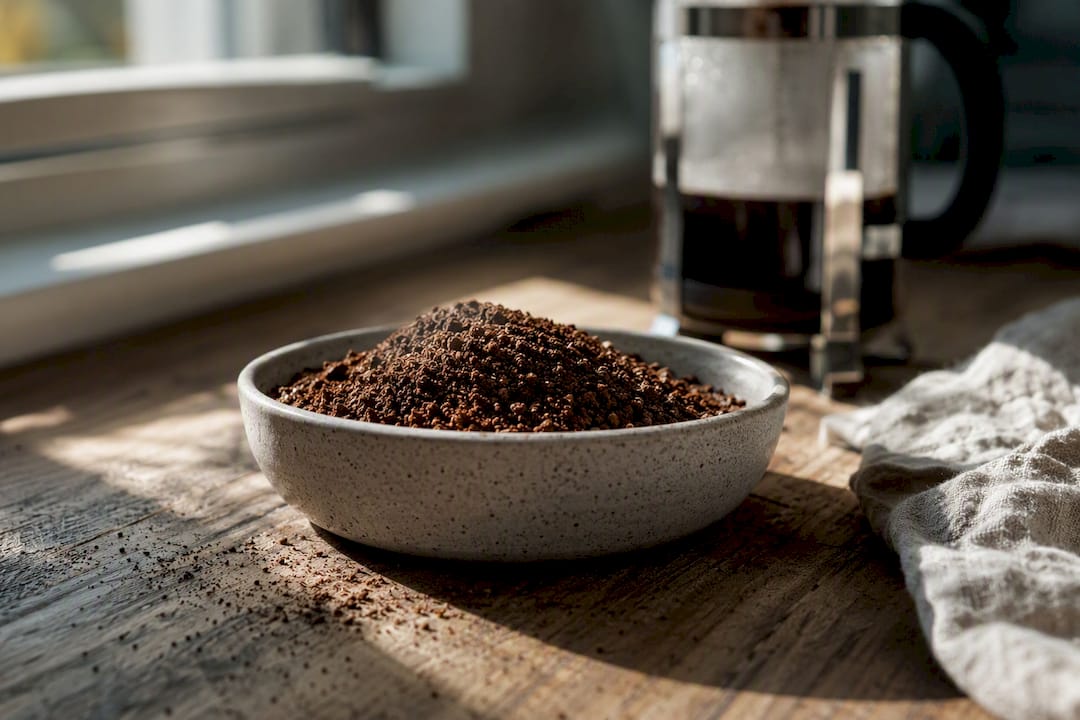
Roast level throws another variable into the same grinder setting. Light roast beans are dense and hold together well, so they tend to produce fewer fines at a given dial position. Dark roast beans are dry and brittle, shattering into more fines and dust at that same setting. If you’re grinding a dark roast, consider going one notch coarser than you would for a medium roast on the same machine to compensate.
Pro Tip: If your dark roast cup consistently tastes muddy no matter how coarse you grind, try a double-settle: let the brewed coffee sit for 30 seconds after plunging, then pour from the top rather than tilting the pot all the way, leaving the heaviest sediment behind.
Step-by-Step Recipes by Roast Level
Each recipe below assumes a standard 32-ounce French press. Scale up or down proportionally by weight, not volume, keeping the ratio fixed. Water quality matters here too: filtered water free of heavy chlorine or mineral taste lets the roast’s actual flavor come through instead of masking it.
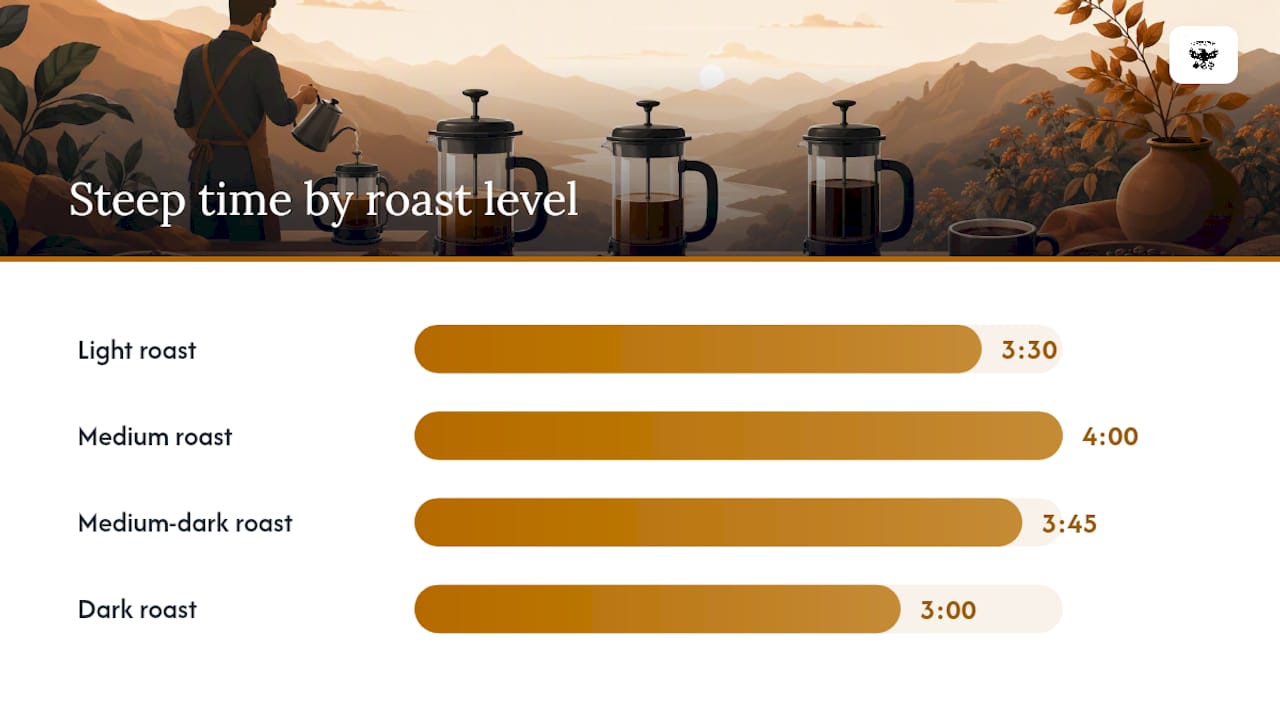
- Light roast: 30g coffee, 480g water (1:16 ratio), water at 90°C (194°F), coarse grind, 3:30 steep. Stir once at the 30 second mark to break up any dry clumps, then let it sit undisturbed.
- Medium roast: 30g coffee, 450g water (1:15 ratio), water at 93°C (199°F), coarse grind, 4:00 steep. This is the default most brew guides recommend, and it’s the easiest to reproduce consistently.
- Medium-dark roast: 30g coffee, 450g water (1:15 ratio), water at 92°C (197°F), coarse grind, 3:45 steep. Slightly lower temperature than medium roast keeps caramel notes from tipping into bitterness.
- Dark roast: 25g coffee, 425g water (roughly 1:17 ratio), water at 88°C (190°F), extra-coarse grind, 3:00 steep. Less coffee and a shorter steep prevent the smoky notes from overwhelming everything else.
For all four, the technique stays the same. Pour the water over the grounds in a slow spiral, let it bloom for 30 to 45 seconds, then stir gently to make sure every particle is saturated. Serious Eats calls this a “low-and-slow” extraction method, and that patience is exactly what builds the syrupy body a press is known for. Place the lid on with the plunger pulled all the way up, and let the coffee steep undisturbed for your target time.
When the timer hits zero, press the plunger down slowly and steadily, applying gentle even pressure rather than forcing it. Pour immediately once you’ve plunged. Leaving brewed coffee sitting on the grounds, even with the plunger down, keeps extracting and will push a perfectly good cup toward bitter within minutes. Scaling any of these recipes is simple: double the coffee and water together, and the ratio, temperature, and steep time all stay exactly the same.
Fixing Bitter, Sour, Weak, or Muddy Cups
Most French press problems trace back to one of four causes, and each has a specific one-line fix.
| Problem | Likely cause | Fix |
|---|---|---|
| Bitter | Overextraction from too fine a grind, too long a steep, or water too hot | Go coarser, cut steep time by 30 seconds, or drop temperature 3 degrees |
| Sour | Underextraction, usually from water too cool or steep too short (common with light roasts) | Raise water temperature or extend steep by 30 seconds |
| Weak | Ratio too diluted or grind too coarse for the roast | Increase coffee dose or grind slightly finer |
| Muddy or sludgy | Too many fines from an inconsistent grinder or a dark roast that shattered | Switch to a burr grinder, go one notch coarser, or try a double-settle pour |
A quick decision tree works faster than troubleshooting from scratch every time. If the cup tastes bitter, try a coarser grind first since that’s the single biggest lever. If it tastes sour or thin, raise the temperature before touching anything else. If it’s muddy but the flavor itself is fine, that’s a filtration issue, not an extraction issue, and a double-screen or settling pour solves it without changing your recipe at all.
It helps to separate sludge from haze. Sludge, the wet grounds at the bottom of the pot, only matters if you’re pouring it into the cup along with your coffee. Haze in the cup itself, a cloudy look from suspended fines, does affect mouthfeel and can read as muddiness on the palate even when the underlying extraction is dialed in correctly.
Choosing Beans and Managing Freshness
Single-origin beans reveal terroir in a French press. Immersion brewing extracts fully enough to carry through the subtle differences between, say, a washed Ethiopian and a natural-process Brazilian, in a way that faster methods sometimes blur. Blends exist for the opposite reason: consistency. If you want the same cup every morning regardless of seasonal crop variation, a well-built blend is the more reliable choice.
Roast date matters more than most home brewers assume, but a French press is genuinely forgiving here. Beans roasted 7 to 30 days before brewing tend to perform well in a press, since immersion brewing tolerates the slight staleness that would show up more obviously in something like pour-over, where clarity is the whole point. Roaster guidance on brew timing backs this up directly.
Store beans in an airtight container, away from light and heat, and grind just before brewing rather than in advance. If your bag is a few weeks past its ideal window, bump the dose up slightly, an extra gram or two per serving, since older beans lose some of their soluble compounds to natural degassing over time.
Reach for a medium roast from your regular stash on a weekday when you just want a solid cup fast. Save a light roast for a slower morning when you actually want to sit with the flavor, and pull out a dark roast when you’re making coffee for someone who takes it with cream and sugar anyway.
A Repeatable Way to Dial In Your Own Roast and Grind
Recipes get you close. A short experiment gets you exact, tuned to your water, your grinder, and your own palate.
- Pick one roast you drink regularly and commit to it for the whole test.
- Set three grind settings: one notch finer than your current default, your default, and one notch coarser.
- Brew all three using the same ratio, water temperature, and steep time, changing nothing but the grind.
- Taste side by side and record which one tastes balanced versus bitter versus weak, then repeat the winning grind setting with one variable at a time, either temperature or steep time next, adjusted in small steps.
Change only one variable per round. If you adjust grind and temperature at the same time, you won’t know which change actually fixed or broke the cup. A basic log makes the pattern obvious after just a few rounds:
Three or four rounds is usually enough to land on a setting worth writing down permanently.
Tri Crow Coffee’s Roasts Built for the Press
Tri Crow Coffee’s medium roast cold brew coffee leans into chocolate and floral notes, and its balance makes it a reliable starting point if you’re testing the classic preset above. For a bolder cup, the Max Caf blend combines Tanzania and India Robusta for higher caffeine and a heavier body that holds up well against a shorter steep. If you want the traditional smoky profile, the dark French roast, coarse ground is already cut to a press-friendly texture out of the bag.
Store any of these beans airtight and away from heat, and grind just before brewing rather than ahead of time. A single bag lets you dial in one roast fully using the protocol above; a sampler is the better move if you want to compare roast levels side by side before committing.
Author’s Note From David
Roast-specific dialing changed how I think about French press entirely. I used to treat one recipe as universal, and I was constantly blaming my grinder for problems that were actually roast mismatches. Run the dial-in protocol above with whatever roast is in your cabinet right now, and you’ll taste the difference within three brews.
Try Tri Crow Coffee for Your Next Press
Most roast-specific advice tells you what to look for. It doesn’t tell you where to find beans already roasted with French press extraction in mind. Tri Crow Coffee small-batches every roast to keep flavor consistent bag to bag, so the same recipe you dial in this week still works the next time you order.
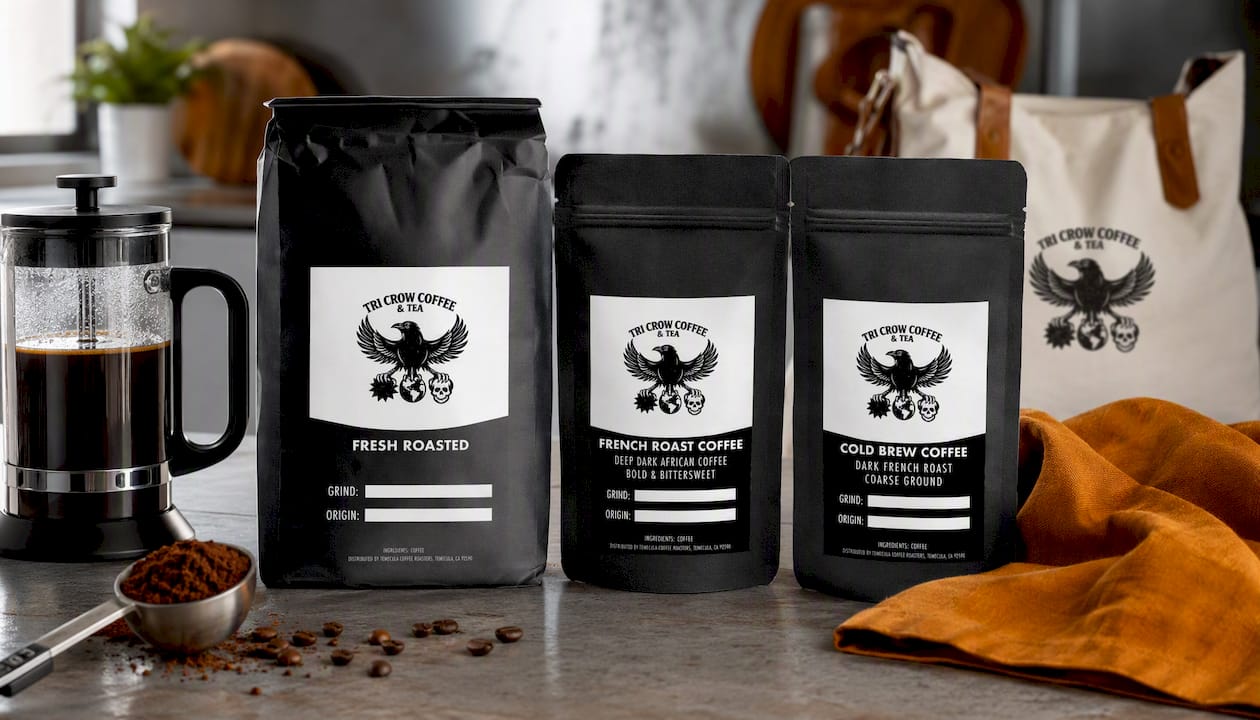
If you brew mostly bold, traditional cups, the dark French roast, coarse ground comes pre-ground to a press-friendly texture, which removes one variable from your testing entirely. Prefer something balanced for everyday brewing? The medium roast cold brew coffee works equally well hot in a press. Not a coffee morning? Tri Crow Coffee’s English Breakfast loose leaf tea holds up to milk the same way a dark roast does, brewed in the same press. Order a single bag to run the dial-in protocol, or start with a sampler if you want to compare roast levels before settling on your default.
Sources
- Experimental optimization of factors affecting coffee extraction (DOI:10.1177/2319510x221136690)
- How long to brew French press coffee — Espro blog
- Coffee Science: How to Make the Best French Press Coffee at Home — Serious Eats
- Using the right grind size for your brewing method: an experiment — Perfect Daily Grind
- French Press Brew Guide: Ratio, Grind, Temp & Steps (2026) — Coffee Gear Hub
FAQ
Which roast is best for French press?
Medium to medium-dark roast works best for most drinkers, offering balanced sweetness and body without the temperature precision light roasts need or the bitterness risk dark roasts carry.
What is the best store-bought coffee for French press?
Look for a bag labeled coarse-ground or one you can grind yourself to a coarse sea salt texture; a medium roast blend like Tri Crow Coffee’s medium roast cold brew coffee is a solid, consistent starting point.
What kind of grind should I use for French press?
Use a coarse grind, roughly the texture of coarse sea salt or steel-cut oats, produced ideally on a burr grinder for even particle distribution.
How many scoops of coffee per cup in a French press?
A standard 1:15 ratio works out to about two level tablespoons, roughly 15 grams, of coffee per 8 ounce cup of water, adjusted slightly finer or coarser depending on roast.