
Start with a 1:15 coffee-to-water ratio by weight, meaning 1 gram of coffee for every 15 grams of water. That’s the baseline the Specialty Coffee Association and most published French press recipes converge on, and it’s where Tri Crow Coffee’s David tells home brewers to begin before touching anything else.
From there, the adjustments are simple:
-
Want a bolder, heavier cup? Move to 1:13–1:14.
-
Want something lighter that shows off origin flavor? Try 1:16–1:17.
-
Always measure coffee and water by weight on a kitchen scale, not scoops.
-
Decant the coffee into a separate carafe the moment you finish pressing, so it stops brewing.
Everything else in this guide is about fine-tuning that one number.
Key Takeaways
The ideal French press ratio starts at 1:15 by weight and moves to 1:13–1:14 for strength or 1:16–1:17 for a lighter, brighter cup.
| Point | Details |
|---|---|
| Start at 1:15 | Use 1 gram of coffee per 15 grams of water as your default recipe. |
| Adjust one variable at a time | Change ratio, grind, or time individually so you know what actually fixed the cup. |
| Weigh instead of scooping | Tablespoons vary 5 to 7 grams each; a scale removes that guesswork. |
| Decant immediately | Pour the brewed coffee out of the press right after pressing to stop extraction. |
| Pair ratio with roast | Tri Crow Coffee’s French Roast is built for the 1:14 to 1:15 range without turning bitter. |
Table of Contents
Why 1:15 Is the Right Coffee to Water Ratio to Start With
French press is an immersion method: the grounds sit in water for minutes rather than getting a quick pass like a pour-over filter. That extra contact time pulls out more oil and body, which is why French press coffee tastes heavier even at ratios that would seem light in a drip machine. A 1:15 coffee to water ratio hits a sweet spot for most roasts. It’s concentrated enough to taste full, but dilute enough that you’re not just drinking bitter sludge.
The National Coffee Association lists an acceptable range of roughly 1:10 to 1:16, which tells you there’s real room to move depending on what you like. Here’s how to use that range:
-
Milk-based or heavier drinks: shift to 1:13 or 1:14. The added dose stands up to milk without disappearing.
-
Light, origin-forward cups: shift to 1:16 or 1:17. Thinning out the ratio lets floral or fruity notes come through instead of getting buried under body.
-
Anything in between: stay close to 1:15 and adjust grind or time before you touch the ratio again.
The single biggest mistake home brewers make when dialing in a recipe is changing three things at once. Move one lever, taste, then decide.
Pro Tip: Keep a small notebook or note on your phone with the exact grams, grind setting, and steep time for your last brew. It turns guessing into an actual repeatable recipe.
How to Measure and Scale Your French Press Recipe
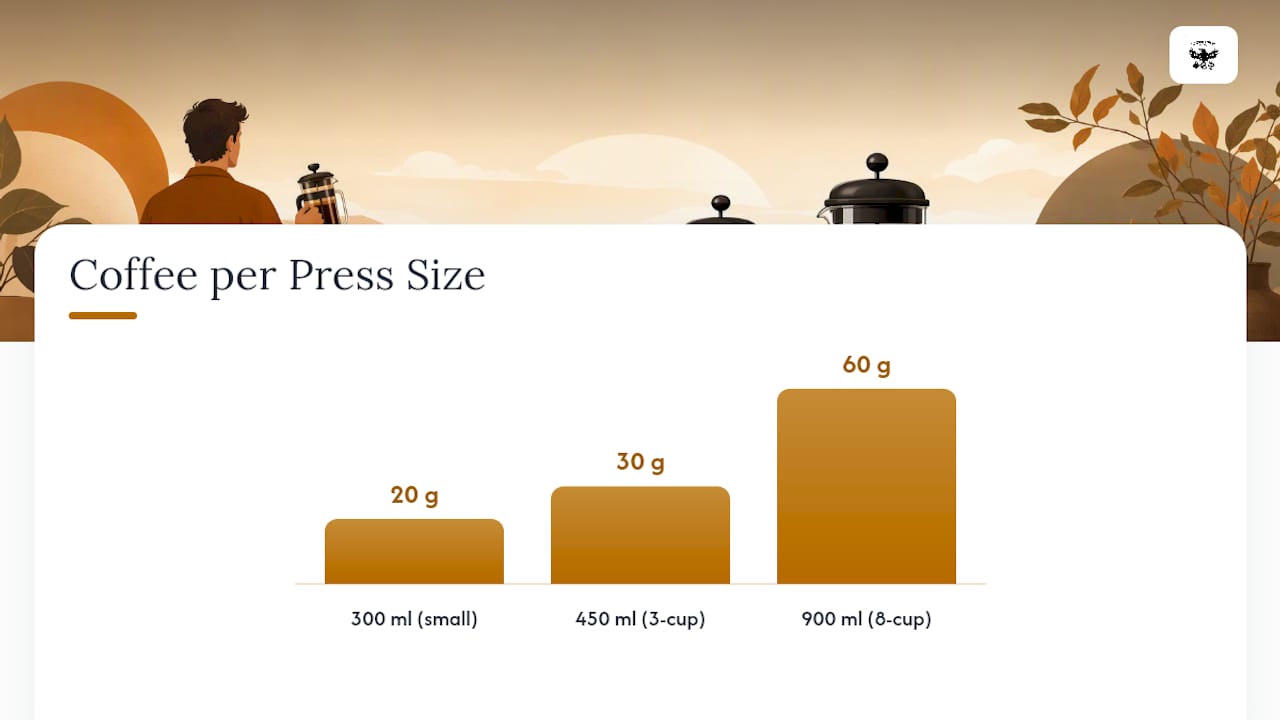
The math behind any French press measurement is one line: water in grams divided by 15 equals coffee in grams. That’s it. Once you know your press’s capacity, you can scale a recipe up or down without ever guessing.
Here’s what that looks like at three common sizes:
-
300 ml water ÷ 15 = 20 g coffee (a small single-serving press)
-
450 ml water ÷ 15 = 30 g coffee (a standard 3-cup press), the exact figure a detailed French press brew guide also lands on
-
900 ml water ÷ 15 = 60 g coffee (a large 8-cup press), matching the scaling in the Pulled Journal’s ratio breakdown
Tablespoons are a rougher stand-in. A tablespoon of coffee can weigh anywhere from 5 to 7 grams depending on grind size and how tightly it’s packed, so “two tablespoons per cup” is really a range, not a measurement. If you don’t own a scale, a rough mental check is 1 level tablespoon per 4 ounces of water, then adjust to taste. A $15 kitchen scale removes the guesswork entirely.
Grind Size, Water Temperature, and Steep Time Matter as Much as Ratio
Ratio only works as intended when grind, temperature, and time cooperate with it. Change one without the others and you can throw off a perfectly good recipe.
-
Grind: French press needs a coarse grind, roughly the texture of coarse sea salt or large breadcrumbs. Fine particles slip past the metal mesh filter and end up in your cup no matter what ratio you use.
-
Water temperature: Aim for about 93°C (200°F). If you’re using boiling water straight off the stove, let it sit for 30 to 45 seconds first. Lighter roasts can handle slightly hotter water; darker roasts do better a touch cooler to avoid tasting scorched.
-
Steep time: Four minutes is the standard baseline, a figure backed by NCA brewing guidance as well as most published French press recipes. Add or subtract 30 seconds depending on roast: lighter roasts often want a touch longer, darker roasts a touch shorter.
In many cases, adjusting the ratio gets you closer to the flavor you want faster than fiddling with steep time. If a cup tastes flat, try 1:14 before you add another minute to the clock.
Troubleshooting a Bad Cup Without Starting Over
Most French press problems trace back to one of three issues, and each has a specific fix instead of a random reset.
-
Tastes weak or watery. Increase your dose by 2 to 3 grams, or shift from 1:15 to 1:14. A slightly finer grind can also help, but change only one thing and taste before adjusting again.
-
Tastes bitter or harsh. Cut your steep time by 30 seconds, coarsen the grind, or lower your water temperature a few degrees. If bitterness persists after those tweaks, try loosening the ratio to 1:16.
-
Tastes silty or muddy. This is almost always a grind problem, not a ratio problem. Go coarser, and if your current grinder produces a lot of fine dust even on a coarse setting, a burr grinder will solve it outright. Decant the coffee the moment you finish pressing, and avoid forcing the plunger down hard, which pushes fine particles through the mesh.
Pro Tip: If your press consistently tastes gritty, test your grinder before blaming your ratio. Fine particles bypass a metal filter regardless of how much coffee or water you use.
French Press Measurements by Press Size
Here’s what 1:13, 1:15, and 1:17 look like across the press sizes most home brewers actually own.
These numbers match the sizing math used in step-by-step French press guides that scale grams directly against press capacity. Round to the nearest whole gram if your scale doesn’t show decimals. It won’t affect the cup.
David’s Notes on Roast and Ratio Pairing
Different roasts behave differently at the same ratio, and Tri Crow Coffee’s brewing notes reflect that in practice, not just theory.
-
French Roast, Dark: start at 1:14 to 1:15, steep 3.5 to 4 minutes, and lean toward a slightly coarser grind than you’d use for a medium roast. Dark roasts extract faster, so a tighter ratio without adjusting grind tends to push toward bitterness.
-
For a deeper walk-through of grind settings by roast, see Tri Crow Coffee’s grind size dialing guide.
-
For roast-specific recipes beyond French Roast, the roast pairing guide covers how ratio shifts across lighter profiles too.
A Quick Word on Ritual and Repetition
Good coffee isn’t luck, it’s the same numbers repeated on purpose. Try 1:15 with Tri Crow Coffee’s French Roast this week and taste the difference precision makes.
— David
Try This Ratio With Tri Crow Coffee’s French Roast
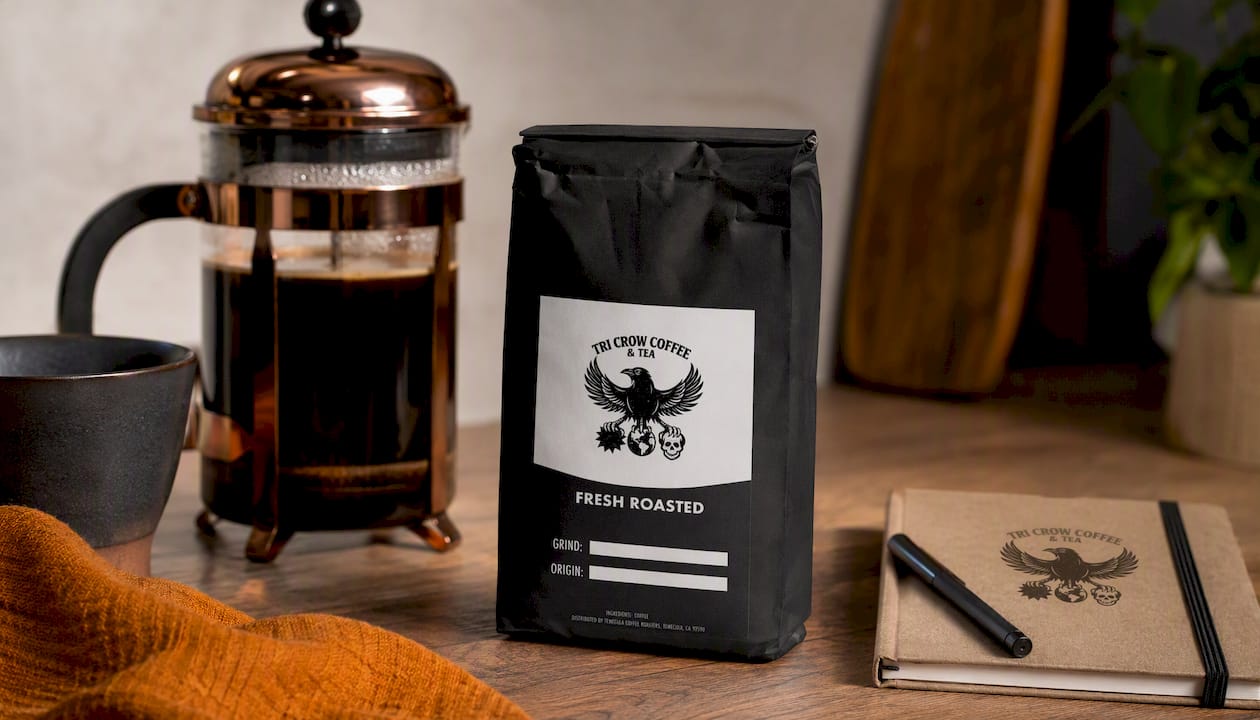
A dark roast with real body needs a ratio that can carry it, and that’s exactly where 1:14 to 1:15 earns its keep. Tri Crow Coffee’s French Roast is a bold Central American blend built with that heavier immersion style in mind: enough density to stand up to a tighter ratio without turning harsh, and a roast profile that stays smooth even at the low end of the steep-time window.
If you’ve been brewing a generic supermarket bag and wondering why your ratio math never quite lands the way it does in guides, the coffee itself is often the missing variable. Small-batch roasting means tighter consistency from bag to bag, so a recipe that works today still works next month. Grab the French Roast blend and run it at 1:14, 4 minutes, coarse grind, and decant the moment you press. Adjust from there using the troubleshooting steps above.
Sources
FAQ
What’s a good ratio for French press coffee?
A ratio of 1:15 (1 gram coffee to 15 grams water) is the standard starting point, with 1:13–1:14 for a stronger cup and 1:16–1:17 for a lighter one.
How much coffee for 4 cups of French press?
A standard 4-cup French press holds about 450 ml of water, which works out to approximately the typical amount of coffee called for at a 1:15 ratio.
How do I make 2 cups of coffee in a French press?
Two cups is roughly 300 ml of water, so use approximately the proportional amount of coarsely ground coffee at a 1:15 ratio, steeped for 4 minutes.
How much coffee is needed for a single cup of French press coffee?
For a single cup, use the proportional amount of coffee and steep for 4 minutes before pressing and decanting immediately.