
Roasting changes almost everything about a coffee bean except caffeine itself. The molecule survives heat that destroys most of the acids and sugars around it, so roast level is not the lever most people think it is. What actually swings caffeine in your cup is extraction: how much dose you use, how fine you grind, how long water touches the coffee, and whether you measure by weight or by scoop.
Caffeine is one of the more thermally stable compounds in a coffee bean. It holds up under roasting temperatures that break down chlorogenic acids and other phenolic compounds well before caffeine starts to degrade in any meaningful way, according to a peer-reviewed analysis of roasting conditions. What changes during roasting is mass and structure, not the caffeine molecule itself. Beans lose water and organic material as they roast, which concentrates the compounds that remain, while porosity increases and makes the bean easier or harder to extract from depending on how far you push it.
Roast still matters, just not in the way most people assume:
- Measuring by scoop instead of weight distorts caffeine comparisons because dark roast beans are larger and less dense, so a scoop of dark roast holds fewer beans and often less caffeine than the same scoop of light roast.
- Extreme roast profiles (very light or very dark) can shift caffeine slightly at the margins, but the effect is small next to what brewing method does.
- Matched extraction yields tell a different story than matched brew times. A controlled study in Scientific Reports found that at identical extraction yields, darker roasts could actually show higher caffeine concentration, even though light and medium roasts often produced more caffeine under standard brewing conditions.
Key Takeaways
Roast level changes flavor and bean density far more than it changes caffeine, and brewing variables like dose and extraction yield are the real controls for caffeine in your cup.
| Point | Details |
|---|---|
| Roast is not the caffeine dial | Caffeine is thermally stable during roasting; apparent differences trace back to mass loss and measurement method. |
| Measure by weight, not scoops | Dense light roast beans and airier dark roast beans throw off volume-based dosing significantly. |
| Medium roasts often peak | Controlled testing found brewed caffeine highest near typical roast mass losses seen in medium roast territory. |
| Extraction yield rules the cup | Dose, grind, water temperature, and brew time move caffeine more than roast choice alone. |
| Trust the controlled study | Berry College and Drexel’s Scientific Reports research, paired with roaster experience, backs brewing over roast as the real lever. |
Table of Contents
- Does Roast Affect Caffeine at the Chemical Level?
- What Do the Studies Actually Say About Roast and Caffeine?
- Why Brewing Matters More Than Roast for Caffeine
- How to Raise or Lower Caffeine in Your Cup
- Common Myths About Roast and Caffeine
- What Our Roasters See in the Cupping Room
- Where to Learn More About Roast and Caffeine Science
- A Final Word on Roast, Caffeine, and What Actually Matters
- Sources
- FAQ
Does Roast Affect Caffeine at the Chemical Level?
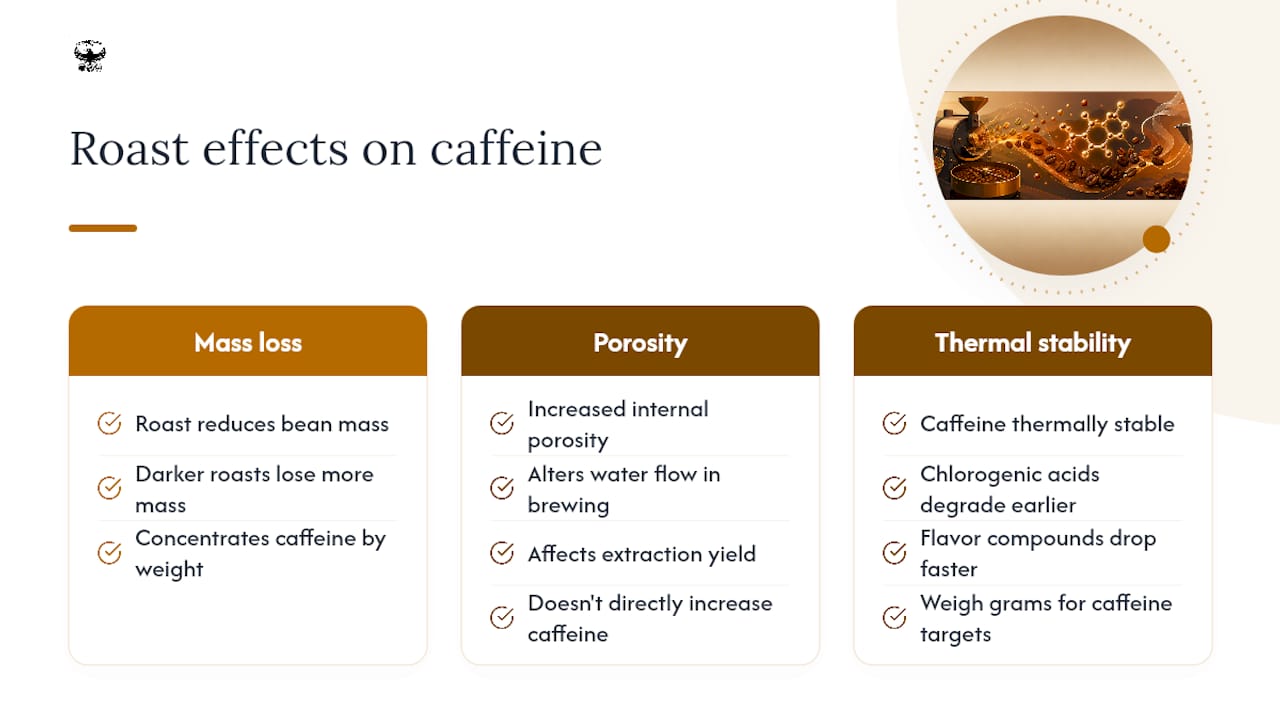
Roasting reshapes a coffee bean through heat, pressure, and rapid chemical reactions, but caffeine rides out most of that process intact. Two mechanisms explain why people keep assuming otherwise: mass loss and porosity.
Mass loss concentrates what’s left behind. Green coffee beans lose water weight and volatile compounds as they roast, and darker roasts lose more mass than lighter ones. This means a gram of dark roast coffee isn’t the same gram it was before roasting. If caffeine barely degrades while everything around it burns off, the caffeine that remains gets more concentrated by weight, not less. That’s the opposite of the popular myth that dark roast “burns off” caffeine.
Porosity changes how water moves through the grounds. As beans roast longer, they expand and develop more internal air pockets. That structural change affects how efficiently hot water can pull soluble compounds out during brewing, which is part of why extraction yield and roast degree interact instead of acting independently. A bean with more porosity isn’t automatically giving up more caffeine. It’s giving up compounds more easily, and caffeine is only one of many things dissolving into your cup.
Caffeine’s thermal stability is the real headline. Research on roasting’s effect on physicochemical characteristics found caffeine holds up far better under heat than compounds like chlorogenic acids, which start degrading at earlier roast stages and lower temperatures. Picture two dials on a roaster: one controls flavor compounds, which drop fast as roast darkens, and the other controls caffeine, which barely moves until you approach the edge of what’s drinkable. That gap is why cupping a dark roast can taste bold and smoky while its caffeine content stays close to a lighter batch of the same bean.
Pro Tip: If you’re chasing a specific caffeine target, stop reading roast labels for clues. Read your scale instead. Roast tells you about flavor and body; grams tell you about caffeine.
What Do the Studies Actually Say About Roast and Caffeine?
The clearest data on this question comes from a 2024 controlled study, and it complicates the simple “light roast has more caffeine” claim that circulates online.
Researchers from Berry College and Drexel University tested 30 different roast and brew combinations to isolate how roast degree and extraction yield each affect brewed caffeine. Under identical brewing parameters, light and medium roasts typically produced more caffeine in the finished cup than dark roasts. But when the team controlled for extraction yield instead, holding it constant across roast levels, darker roasts sometimes showed higher caffeine concentration. Brewed caffeine peaked near roast losses typically seen in medium roasts rather than light or dark roasts, according to the Scientific Reports study.
Berry College’s own summary of the research frames medium roast as a practical sweet spot: enough porosity for efficient extraction, without pushing so far into dark roast territory that you lose the density advantage of less mass loss. Zachary Lindsey, the Berry College researcher behind the work, has pointed out that the common belief about roasting “burning off” caffeine is largely a misconception. What people are noticing is really a mix of porosity differences and how they’re measuring their coffee, not the bean chemistry itself.
Coverage from Daily Coffee News summarized the study’s core message bluntly: brewing matters more than roasting. Separate research published in the International Journal of Food Science & Technology backs this up from another angle, finding that brewing method and cultivar shifted caffeine levels more than roast degree alone, with boiled brews showing higher measured caffeine than some filtered methods regardless of roast.
| Study | Method | Headline finding |
|---|---|---|
| Scientific Reports (Berry College/Drexel) | 30 roast/brew combinations, controlled extraction yield | Medium roasts at moderate mass loss peaked for brewed caffeine; extraction yield outweighs roast alone |
| PMC physicochemical analysis | Lab measurement of roasted vs. green bean compounds | Caffeine more thermally stable than chlorogenic acids; apparent caffeine shifts trace back to mass loss |
| IFST/Wiley cultivar and brewing study | Cross-cultivar brewing comparison | Brewing procedure and cultivar affect caffeine transfer more than roast degree alone |
Different studies land on slightly different numbers because they use different brew methods, bean origins, and units of measurement (some report caffeine per gram of dry coffee, others per brewed serving). That inconsistency is exactly why isolated headlines like “light roast has more caffeine” oversimplify a relationship that depends heavily on how the coffee was actually brewed.
Why Brewing Matters More Than Roast for Caffeine
If roast degree only shifts caffeine at the margins, what actually drives the number in your cup? Extraction. The variables you control at the brew station do more heavy lifting than the roast level printed on the bag.
Five variables determine how much caffeine ends up in your coffee, and roast level is the smallest lever among them:
- Dose (weight of coffee used): More coffee grounds per serving means more caffeine, full stop. This is the single biggest variable most people never adjust.
- Grind distribution: Finer grinds expose more surface area to water, which speeds up extraction and pulls more caffeine into the cup faster.
- Water temperature: Hotter water extracts more efficiently within a normal brewing range, though extreme overheating risks bitterness rather than added caffeine.
- Brew time and extraction yield: Longer contact time between water and grounds generally means higher extraction, and higher extraction generally means more caffeine, up to a point of diminishing returns.
- Brew method: Espresso, pour-over, French press, and boiled coffee all pull compounds out at different rates and ratios, which is part of why the cultivar and brewing study found boiled brews yielding more measured caffeine than some filtered methods.
Here’s where roast quietly sneaks back into the picture: measurement method. A scoop of dark roast beans weighs less than a scoop of light roast beans because dark roast beans are larger, more porous, and less dense. If you’re dosing by volume instead of weight, you could be brewing a noticeably weaker or stronger cup purely because of how much air is trapped in your scoop, according to CoffeeGeek’s breakdown of common caffeine misunderstandings. This is the single most overlooked source of “roast changes caffeine” confusion, and it has nothing to do with the bean’s chemistry.
| Measurement method | What it captures | Why it misleads |
|---|---|---|
| By weight (grams) | Consistent mass of coffee regardless of roast | Removes density differences; caffeine per gram stays comparable across roasts |
| By volume (scoop/tablespoon) | Consistent volume, variable mass | Dark roast beans take up more space per gram, so scoops under-dose relative to light roast |
| By brewed cup (mg per serving) | Final caffeine delivered to the drinker | Reflects extraction yield and brew method more than roast level alone |
Pro Tip: A cheap kitchen scale accurate to 0.1 grams solves more caffeine inconsistency than switching roast levels ever will. If you want more caffeine, add two grams of dose before you reach for a darker bag.
How to Raise or Lower Caffeine in Your Cup
Once you accept that brewing controls caffeine more than roast does, the fix becomes mechanical instead of mysterious. Here’s a sequence that works whether you’re troubleshooting a cup that’s too weak or trying to wind down your afternoon intake.
- Weigh your beans. Start with a baseline ratio, commonly around 1:16 (coffee to water by weight), and adjust from there instead of eyeballing scoops.
- Pick your grind size based on brew method: coarser for French press and cold brew, finer for espresso and pour-over.
- Set your brew ratio. More coffee per liter of water raises caffeine; less coffee lowers it, independent of roast.
- Adjust your time. Longer steeps and slower pours pull more out of the grounds; shorter contact time pulls less.
To bring caffeine down: reduce your dose slightly, shorten your brew time, switch to a coarser grind, or use a paper-filtered pour-over, which tends to extract less than immersion methods. Beans naturally lower in caffeine, like Arabica compared with Robusta, are also worth knowing about if you want a lower-caffeine baseline before you even touch your brew ratio.
A few dos and don’ts worth pinning to your kitchen wall:
- Don’t rely on scoop size as a caffeine control. Do measure in grams every time.
- Don’t assume a darker bag means a stronger jolt. Do check your extraction yield and brew method first.
- Don’t chase caffeine by switching roasts alone. Do treat dose and extraction as your real dials.
Pro Tip: If you want a reliable starting point, Tri Crow Coffee’s medium-roast house blend brews well around 18 grams per 300 grams of water for drip methods. Adjust dose up or down in one-gram increments and taste your way to the caffeine level you actually want.
Common Myths About Roast and Caffeine
Coffee culture repeats a few claims about roast and caffeine so often they’ve become accepted wisdom. None hold up well under lab conditions.
Myth: “Roasting burns off most of the caffeine.” Caffeine is one of the more heat-resistant compounds in the bean. Lab analysis shows it degrades far less readily than chlorogenic acids and other phenolics during standard roasting, which is why apparent caffeine shifts trace back to mass loss and concentration rather than the molecule actually breaking down.
Myth: “Dark roast always has more caffeine.” This depends entirely on how you measure. By weight, dark and light roasts land closer together than people expect, and controlled studies found light and medium roasts often edging out dark roast under matched brewing conditions. By volume, dark roast usually loses because the beans are bigger and less dense per scoop.
Myth: “Stronger flavor means more caffeine.” Roast intensity comes from Maillard reactions and caramelization, not caffeine concentration. A bold, smoky dark roast can carry a similar caffeine load to a bright, acidic light roast. Flavor and caffeine are separate systems that happen to share a roasting process.
What Our Roasters See in the Cupping Room
Tri Crow Coffee’s roasters spend more time thinking about porosity and extraction yield than most customers realize, and it changes how we advise people who come to us asking for “the strong stuff.”
When someone tells us they want more caffeine, we don’t automatically point them toward a darker roast. We ask about their brew method and how they’re measuring their dose first, because that conversation solves more caffeine complaints than a roast swap ever does. Customers chasing an energy boost usually get more mileage from adding a gram or two of coffee to their normal ratio than from switching bags entirely.
A few patterns we see consistently on the roasting floor:
- Customers who switch from scoop-based dosing to a kitchen scale report more consistent energy from cup to cup, regardless of roast.
- Requests for “extra caffeine” blends are almost always better solved with brew ratio adjustments than with roast changes.
- People reducing caffeine intake do better cutting dose gradually than jumping to a different roast and hoping for a weaker cup.
If you want to experiment with these adjustments at home, our guide to coffee extraction walks through how grind, time, and ratio interact in more detail than we can cover here.
Where to Learn More About Roast and Caffeine Science
The Scientific Reports study from Berry College and Drexel University remains the most rigorous controlled test of roast degree against brewed caffeine, and it’s worth reading directly if you want the full data set behind the medium-roast findings.
- Berry College’s research summary explains the study’s findings in plain language, including the porosity and extraction reasoning behind the medium-roast peak.
- PMC’s analysis of roasting conditions covers the thermal stability data behind why caffeine survives roasting better than other compounds.
- Daily Coffee News’s coverage translates the study into accessible terms for home brewers and industry readers alike.
- FDA guidance on caffeine intake offers useful context for how roast-based caffeine differences compare to daily consumption limits.
- For readers curious about how caffeine timing affects the body once it’s in your system, this breakdown of caffeine onset and duration is a solid next read.
A Final Word on Roast, Caffeine, and What Actually Matters
Stop treating roast level as a caffeine control and start treating it as a flavor decision. Once you separate those two questions, brewing gets a lot simpler: weigh your beans, pick a grind that matches your method, and adjust your ratio until the cup tastes and hits the way you want.
If you want a starting point that doesn’t force you to choose between flavor and caffeine consistency, Tri Crow Coffee’s medium-roast house blend sits right in the range the research points to as a practical sweet spot. And if you’re still figuring out which roast fits your palate before you start dialing in caffeine, the single origin sampler pack lets you taste your way through a few options without committing to a full bag. For days when you’re cutting back on caffeine entirely, our artisan tea collection is worth a look too.
Experiment with dose in small increments. Change one variable at a time. The bean matters less here than the scale sitting next to it.
Sources
- Caffeine content in filter coffee brews as a function of degree of roast and extraction yield | Scientific Reports
- Do Light Roasts or Dark Roasts Have More Caffeine? | Berry College
- The effect of roasting conditions on physicochemical characteristics of coffee beans (PMC7679248)
- Do Light Roasts or Dark Roasts Have More Caffeine? Study: Maybe Medium? | Daily Coffee News
- Spilling the beans: How much caffeine is too much? | FDA
FAQ
Does Dark Roast Keep You Awake Longer Than Light Roast?
Not because of roast level itself. Caffeine content depends more on dose and extraction than on how dark the beans are roasted, so a well-dosed light roast can keep you just as alert as a dark roast brewed the same way.
Is Light Roast the Strongest Coffee for Caffeine?
Under matched brewing conditions, light and medium roasts often measured slightly higher in caffeine than dark roasts in controlled testing, but the difference is small compared to what dose and brew method produce. “Strongest” in flavor terms (dark roast) and “highest in caffeine” are not the same claim.
Which Roast of Coffee Has the Lowest Caffeine?
No roast level reliably has the lowest caffeine once you control for how you measure it. Research suggests very dark roasts measured by volume can come out lower simply because the beans are less dense per scoop, not because caffeine actually dropped.
How Does Roast Level Affect Coffee Extraction?
Darker roasts are more porous, which changes how quickly water pulls compounds out during brewing, and that porosity shift is part of why extraction yield and roast degree interact in ways that matched brewing alone doesn’t reveal. Roast changes structure and flavor extraction far more than it changes the caffeine locked inside the bean.