
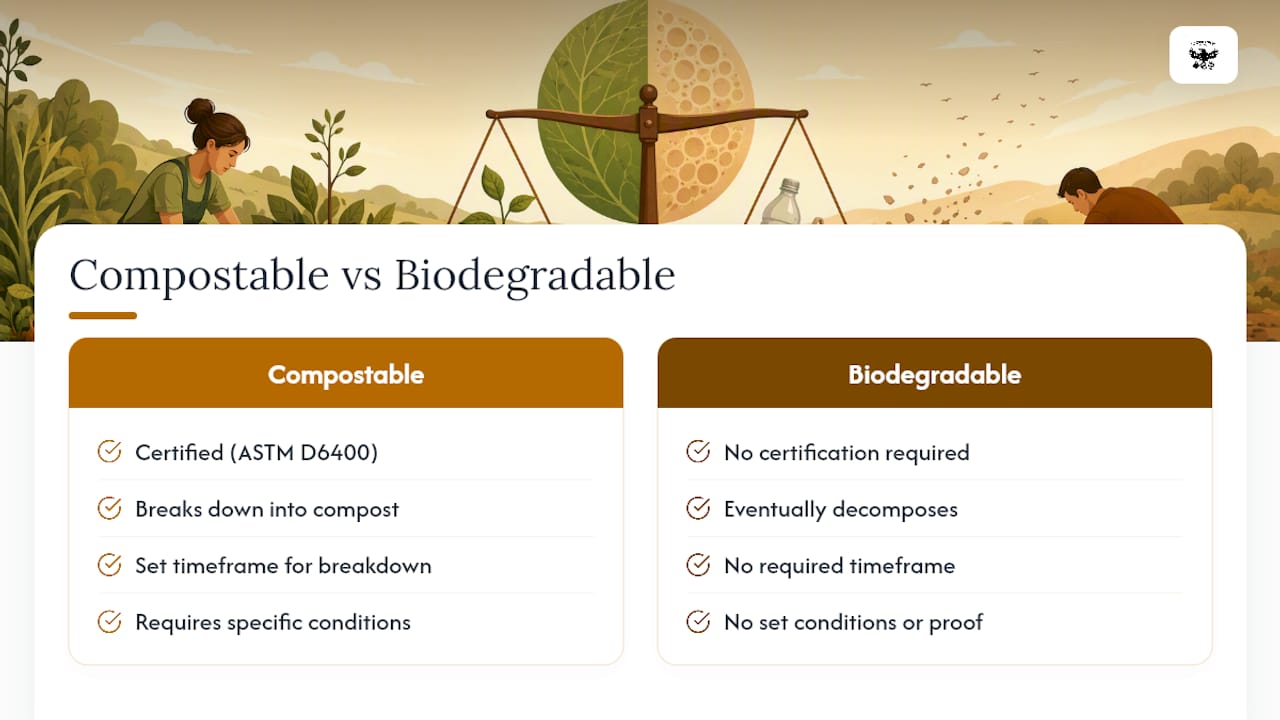
Compostable packaging is engineered to break down into usable compost within a defined timeframe under specified conditions, usually verified by third-party certification. Biodegradable just means a material will eventually break down, with no set timeline, no required conditions, and often no proof at all.
Here’s the practical move: only choose certified compostable packaging (look for BPI or ASTM D6400 on the label) when your local program or facility actually accepts it. If it doesn’t, pick recyclable or reusable materials instead. A vague “biodegradable” label isn’t a disposal instruction. It’s a marketing word the FTC’s Green Guides says needs backup evidence to mean anything.
- Compostable: defined timeframe, defined conditions, third-party tested
- Biodegradable: no timeframe, no conditions, no guarantee
- Action: check for certification first, local acceptance second
Key Takeaways
Compostable packaging requires certified testing and specific breakdown conditions, while biodegradable is an unregulated, timeframe-free claim that often misleads buyers.
| Point | Details |
|---|---|
| Certification beats claims | Look for BPI or ASTM D6400 marks rather than trusting the word “biodegradable” alone. |
| Match to local infrastructure | Certified compostable packaging only helps if your city or hauler actually accepts it. |
| Avoid oxo-degradable plastics | These fragment into microplastic instead of truly decomposing, despite the misleading label. |
| Reuse and recycling often win | Life-cycle impacts frequently favor reusable containers or recyclable materials over compostables. |
| Tri Crow Coffee prioritizes verified materials | Product packaging favors recyclable and, where accepted, certified compostable formats over vague claims. |
Table of Contents
- Compostable vs Biodegradable Packaging: The Core Definitions
- Why “Biodegradable” Plastic Often Doesn’t Break Down
- What Makes Packaging Truly Compostable?
- How to Read Packaging Labels Without Getting Fooled
- Will Your Local Composting Program Actually Accept It?
- Reuse, Recycle, or Compost: Picking the Lower-Impact Option
- Coffee and Tea Made With the Same Care We Put Into the Packaging
- Sources
- FAQ
Compostable vs Biodegradable Packaging: The Core Definitions
“Biodegradable” describes any material that microorganisms can eventually break down into natural elements. There’s no clock attached. A cotton shirt is biodegradable. So, technically, is a chunk of plastic with an additive that lets it fragment over decades. Nobody enforces the word, which is exactly why regulators keep flagging it.
“Compostable” is narrower and testable. It means a material breaks down into compost, usually within 90 to 180 days industrially, without leaving toxic residue, verified against a standard like ASTM D6400 or EN 13432.
- Biodegradable: eventual breakdown, no timeframe, no required conditions, rarely certified
- Compostable: specific timeframe, specific conditions (industrial or home), typically certified
Pro Tip: If a package only says “biodegradable” with no certification mark or timeframe attached, treat it the same as any other trash until your city says otherwise.
Paper decomposes almost anywhere, wet soil, a compost bin, a damp corner of your yard, because it’s cellulose that microbes recognize instantly. PLA plastic, on the other hand, needs sustained heat above 140°F to break down. Drop it in your backyard pile and it can sit there looking exactly the same a year later.
Why “Biodegradable” Plastic Often Doesn’t Break Down
Biodegradable packaging shows up most often as kraft paper, unbleached fiber, and other plant-based materials that genuinely decompose fast in normal outdoor conditions. Those are the honest cases. The trouble starts with biodegradable plastics and coatings, where the claim gets stretched far past what actually happens on a compost pile or in a landfill.
Oxo-degradable plastic is the worst offender. Manufacturers add metal salts to conventional plastic so it fragments into smaller pieces faster, but fragmenting isn’t the same as breaking down at the molecular level. The result is microplastic, not compost, and regulators across North America increasingly restrict the label because it misleads buyers.
- Kraft paper, jute, and untreated wood fiber: genuinely biodegradable in most environments
- Oxo-degradable plastic: fragments into microplastic, doesn’t fully decompose
- Standard polyethylene film: resists microbial breakdown for years
Take the zip-top sandwich bag in your kitchen drawer. It’s almost always LDPE or HDPE, a petroleum plastic that microbes simply can’t digest. Cutting it into pieces doesn’t help; it just creates more surface area for microplastic to shed into soil or water.
What Makes Packaging Truly Compostable?
Compostable packaging is built from materials designed to fully return to soil, not just break apart. The most common are PLA (plant-starch plastic), PHA (a bio-based alternative that performs better in marine and home settings), molded fiber, and paperboard with compostable coatings instead of conventional plastic laminate.
Where it gets confusing is the split between industrial and home compostability. Industrial facilities run at sustained high heat with controlled moisture and turnover, conditions most backyard compost bins never reach. PLA typically needs that industrial environment; PHA and some certified films are built to break down in a home pile. Certifications tell you which bucket a product belongs in:
- BPI certification: verifies compostability in industrial facilities and tells buyers the correct end-of-life route, per BPI’s own standard
- ASTM D6400 / D6868: the underlying US test methods for compostable plastics and coated paper
- EN 13432: the European equivalent, often seen on imported packaging
- OK Compost HOME: specifically verifies home compostability, a separate and stricter bar
Pro Tip: A certification mark tells you the material passed lab testing under specific conditions. It doesn’t guarantee your city’s composting program will take it. Check both.
How to Read Packaging Labels Without Getting Fooled
Certifications exist because “eco-friendly” language is unregulated but “compostable” backed by a testing standard is not. BPI certification means a product passed ASTM D6400 testing for industrial composting. EN 13432 is the international parallel, common on products manufactured overseas. OK Compost HOME is the only mark that specifically confirms a product breaks down in a backyard bin rather than a commercial facility running at 140°F plus.
Here’s a five-step checklist worth keeping on hand when you’re sourcing packaging or trying to figure out what to do with something already in your hand:
- Identify the certification. Look for BPI, the ASTM number, or EN 13432 printed directly on the package, not just a green leaf logo.
- Check the end-of-life instruction. Does it say “industrial composting only” or “home compostable”? Those are different disposal paths.
- Confirm local acceptance. Call your municipal program or check its website; many only take food and yard waste, not packaging.
- Default to reusable or recyclable when infrastructure is missing. A certified compostable item with nowhere to go often ends up in a landfill anyway.
- Ask suppliers for documentation. A legitimate compostable product manufacturer can produce test certificates on request.
Watch for these red flags on packaging you’re evaluating:
- Unqualified “biodegradable” claims with no timeframe or testing standard
- “Oxo-degradable” or “oxo-biodegradable” language
- “Plant-based” without any certification backing it
- Green coloring or leaf icons used as the only environmental signal
Will Your Local Composting Program Actually Accept It?
Composting facility operators deal with a real headache: packaging that says “compostable” but doesn’t behave that way once it hits an industrial pile. Oregon’s Department of Environmental Quality has published direct feedback from composters describing partially degraded serviceware showing up in finished compost, driving up screening costs and sometimes making batches unsellable to farms that need clean material.
That’s why most municipal programs are conservative. Many accept only food scraps and yard waste, full stop. Some accept BPI-certified serviceware but explicitly exclude compostable plastic bags or films because contamination from look-alike plastic bags is too common a problem. The EPA advises checking local rules directly before assuming anything labeled compostable is welcome.
For kitchen scraps specifically, community waste districts often recommend skipping compostable liners altogether. Newspaper, plain uncoated paper, or dry leaves work reliably where a “compostable” bag might not, especially if your program hasn’t verified that specific brand.
Pro Tip: If you run a café or ship products, print the exact disposal instruction on the packaging itself, “BPI certified, industrial compost only, check local acceptance”, rather than leaving customers to guess.
- Verify your city or hauler’s accepted-materials list before buying compostable serviceware in bulk by consulting expert advice on recurring catering arrangements for businesses
- Prefer BPI-certified items only where your program specifically lists them as accepted
- Avoid compostable film bags unless your facility confirms it takes them
Reuse, Recycle, or Compost: Picking the Lower-Impact Option
Compostable packaging isn’t automatically the greenest choice. Life-cycle assessments and facility feedback both point to a less obvious hierarchy where reuse usually wins, recycling often beats composting for manufactured materials, and certified compostable packaging only pulls ahead when local infrastructure genuinely exists to process it.
A ranked approach for most buying decisions:
- Reuse first. A durable container or refillable format beats any single-use option on emissions and waste, full stop.
- Recyclable material accepted locally. If your municipal program recycles it, that’s usually a lower-friction path than compost.
- Certified compostable, only if accepted locally. Confirm acceptance before treating this as your default.
- Avoid vague biodegradable claims and oxo-degradables entirely. Neither delivers a reliable outcome.
For a small café, that might mean washable mugs for dine-in and BPI-certified cups only where the city composting program confirms it. For a roaster shipping beans, it often means recyclable kraft bags over compostable film, since most curbside programs handle paper far more reliably than compostable plastic. Retailers weighing sustainable packaging for shipped goods run into the same math: infrastructure availability decides the outcome more than the material itself.
Why Tri Crow Coffee Treats Packaging as Part of the Ritual
Packaging choices should match how a product actually gets used and disposed of, not just what sounds good on a bag. That’s why Tri Crow Coffee favors recyclable and, where infrastructure supports it, compostable materials across the lineup, from the 6 Bean Dark Roast to the Tanzania Medium-Light single origin, the Italian Roast Dark blend, the Italian Roast Extra Dark, and the Best Sellers Sample Pack. Check each product page for the specific disposal instruction before you toss the bag.

Coffee and Tea Made With the Same Care We Put Into the Packaging
If you’ve read this far, you already know that “eco-friendly” only means something when it’s backed by real material choices and honest labeling, not a green leaf on the front of a bag. Tri Crow Coffee applies that same standard to small-batch roasting: limited quantities, tested blends, and packaging decisions we can actually explain when you ask.
Every batch we roast, from single origins to curated variety packs, gets the same scrutiny on flavor and packaging alike. If you want to taste the difference small-batch roasting makes while sampling several profiles at once, the Best Sellers Sample Pack gives you six varieties in 2oz portions, an easy way to find your everyday blend without committing to a full bag. Order it today and see which roast becomes part of your routine.
Sources
- A Message from composters (Oregon DEQ)
- Frequently asked questions about plastic recycling and composting (EPA)
- FTC issues revised Green Guides
- ASTM D6400-23
- Biodegradable vs Compostable (BPI)
FAQ
What Is the Difference Between Compostable and Biodegradable Packaging?
Compostable packaging is certified to break down into compost within a set timeframe under specific conditions, typically verified against ASTM D6400. Biodegradable simply means a material will eventually decompose, with no required timeframe, conditions, or proof.
Why Are Compostable Bags Not Allowed in Some Areas?
Many composting facilities restrict or ban compostable bags because look-alike conventional plastic bags contaminate loads, and even certified compostable film sometimes doesn’t fully break down under real facility conditions. Some jurisdictions also legally restrict unqualified compostable claims to prevent consumer confusion.
Is 100% Biodegradable the Same as Compostable?
No. “Biodegradable” still carries no timeframe or condition requirement, while compostable packaging must meet tested standards like ASTM D6400 or EN 13432 to earn that label legitimately.
Is a Ziploc Bag Compostable?
No. Standard zip-top bags are made from polyethylene, a petroleum plastic that resists microbial breakdown and will not compost in a home or industrial facility.
Does Tri Crow Coffee Use Compostable or Recyclable Packaging?
Tri Crow Coffee favors recyclable materials and certified compostable options where local infrastructure supports them, with disposal details listed on individual product pages like the 6 Bean Dark Roast Coffee.