
Colombian coffee tastes medium-bodied with bright, clean acidity and a sweet core built around chocolate, caramel, and red fruit. That profile comes from three things working together: Colombia grows exclusively Arabica, washed processing is the dominant method across the country, and altitudes range roughly from around 1,200 to over 2,000 meters depending on the region. The result is a cup that’s approachable but layered, with enough clarity to taste what’s actually there.
Here’s the quick sensory snapshot before we go deeper:
- Dominant notes: Chocolate, caramel, red fruit (cherry, plum), citrus, nuts, occasional floral
- Body: Medium, smooth, rarely heavy or thin
- Acidity: Bright and clean, not sharp or sour
- Finish: Sweet, lingering, often with a caramel or mild fruit aftertaste
- Roast range: Light to dark, though medium roast is the most common commercial expression
Colombia is one of the world’s most significant Arabica-producing origins, and that scale means you’ll encounter real variety from bag to bag. Region, altitude, varietal, and roast level all shift the cup noticeably.
Key Takeaways
Colombian coffee’s defining characteristic is a clean, medium-bodied cup with bright acidity, sweet caramel and chocolate notes, and a lingering finish, shaped by Arabica genetics, washed processing, and altitude-driven regional variation.
| Point | Details |
|---|---|
| Core flavor profile | Medium body, bright acidity, chocolate, caramel, and red fruit are the most common notes. |
| Region determines acidity | Southern regions (Huila, Nariño) are brighter and more floral; central regions (Antioquia, Eje Cafetero) are sweeter and more chocolatey. |
| Washed processing is key | Colombia’s dominant wet-processing method produces the clean, clarity-forward cup the origin is known for. |
| Roast and brew shift the cup | Light roast highlights fruit and acidity; medium balances caramel and chocolate; dark roast and cold brew mute acidity and emphasize chocolate. |
| Tri Crow Coffee | Small-batch roasts including a Medium Roast Cold Brew and Dark French Roast Cold Brew showcase Colombian-style chocolate and floral notes. |
Table of Contents
- What does Colombian coffee taste like in a typical cup?
- Why does Colombian coffee taste the way it does?
- What flavors come from each Colombian region?
- How do varietals and processing methods shift the flavor?
- How do roast level and brewing method change the cup?
- How to taste Colombian coffee at home
- What to look for on the bag when buying Colombian coffee
- How history and culture shaped Colombian coffee’s flavor
- An editorial note on tasting and selecting Colombian coffee
- Tri Crow Coffee: small-batch Colombian and beyond
- Sources
- FAQ
What does Colombian coffee taste like in a typical cup?
Most bags labeled “Colombian” without a named region come from blended lots across the central growing zones. Expect a balanced, crowd-pleasing cup: chocolate and caramel up front, mild citrus or berry in the mid-palate, and a clean, sweet finish. The acidity is present but never aggressive. Understanding coffee flavor profiles helps you read what those descriptors actually mean on the palate.
| Tasting Note | Frequency in Commercial Lots | What It Feels Like |
|---|---|---|
| Milk chocolate | Very common | Smooth, rounded, low bitterness |
| Caramel / brown sugar | Very common | Sweet, lingering finish |
| Red fruit (cherry, plum) | Common | Bright, slightly tart mid-palate |
| Citrus (orange, lemon zest) | Common in high-altitude lots | Clean, lively acidity |
| Nuts (almond, hazelnut) | Common | Subtle, dry, adds depth |
| Floral (jasmine, rose) | Less common, mostly Nariño | Delicate, aromatic top note |
When a bag says “sweet,” it usually signals low bitterness and a caramel-like finish rather than added sugar. “Bright” means the acidity is lively and noticeable. “Clean finish” means no muddy or fermented aftertaste, which is a direct result of washed processing.
Why does Colombian coffee taste the way it does?
The flavor starts with genetics. Colombia produces almost exclusively Arabica coffee, which naturally delivers more nuanced, aromatic flavor than Robusta. Arabica beans have lower caffeine and higher sugar content, which translates to that characteristic sweetness and complexity. Robusta, by contrast, tends toward earthy, rubbery, and bitter.
Washed processing amplifies Arabica’s natural clarity. When the fruit pulp is removed before drying, the bean’s intrinsic flavors come through without fermentation-derived sweetness or funkiness. The result is a cup where acidity, floral notes, and fruit character read cleanly. Selective hand-picking of ripe cherries reduces defects further, which is why Colombian coffee has a reputation for consistency.
Altitude does the rest. At higher elevations, cooler temperatures slow cherry development, giving the bean more time to accumulate aromatic compounds and organic acids. That’s why a Nariño lot from 2,000 meters tastes noticeably brighter and more floral than a lower-altitude Antioquia lot.
Family-sized farms and selective harvesting practices, both deeply embedded in Colombian coffee culture, reinforce this quality floor. Most Colombian coffee is picked cherry by cherry rather than strip-harvested, which means fewer unripe or overripe beans in the lot.
What flavors come from each Colombian region?
Colombia’s three-cordillera geography and 19 producing regions create meaningful flavor variation. The Andes split into three mountain ranges, each with distinct microclimates, soils, and altitude profiles. Huila, in the south, received a Denomination of Origin in 2013, a formal recognition that its coffees carry a distinctive, place-specific character: fruity, aromatic, and caramel-forward.
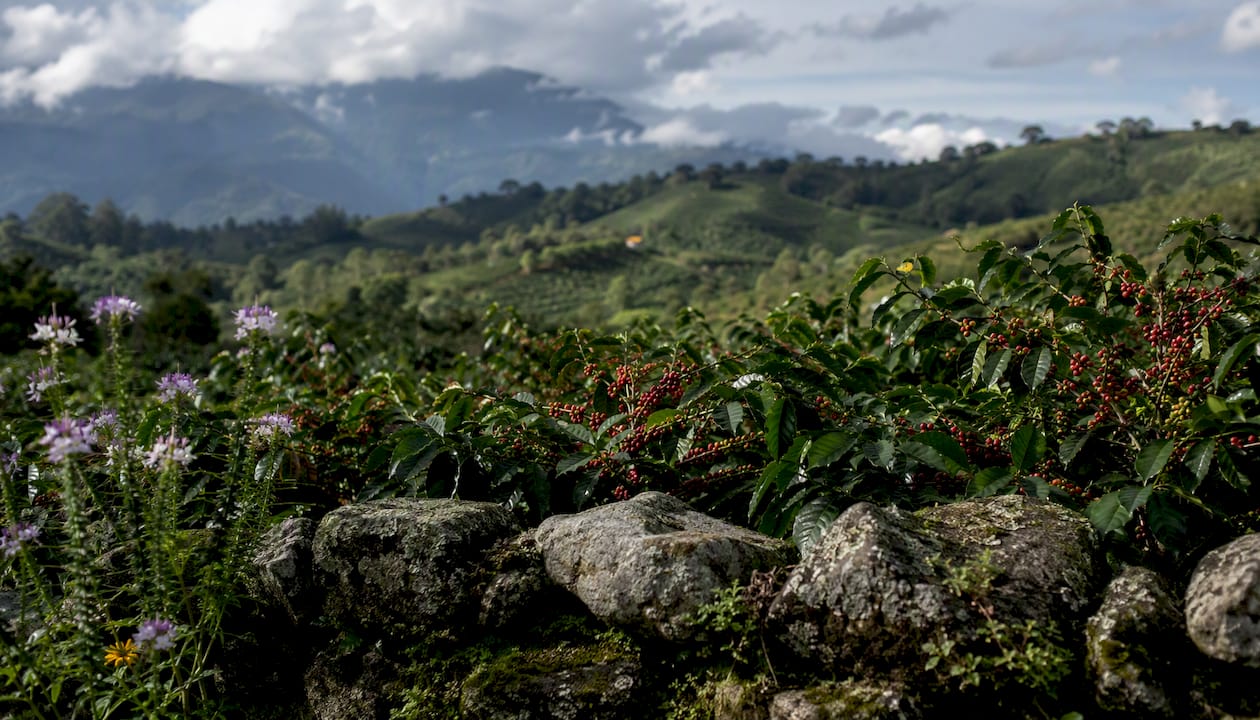
High-altitude southern zones like Nariño and Huila produce brighter, more floral and acidic cups because slower cherry development concentrates aromatic and acid compounds. Central regions tend toward sweeter, more chocolatey, and balanced profiles.
| Region | Altitude (m) | Acidity | Body | Common Notes |
|---|---|---|---|---|
| Huila | from mid to high altitude | High | Medium | Red fruit, caramel, aromatic |
| Nariño | from high altitude | Very high | Light-medium | Citrus, floral, bright |
| Cauca | from high altitude | High | Medium | Stone fruit, floral, sweet |
| Tolima | mid altitude | Medium-high | Medium | Stone fruit, chocolate, spice |
| Antioquia | from medium to high altitude | Medium | Medium-full | Milk chocolate, almond, balanced |
| Santander | mid altitude | Medium | Full | Dark chocolate, earthy, nutty |
| Eje Cafetero | mid altitude | Medium | Medium | Caramel, mild citrus, clean |
| Sierra Nevada | mid altitude | Low-medium | Full | Chocolate, dried fruit, earthy |
The practical takeaway: if you want brightness and fruit, look south toward Huila or Nariño. If you prefer a sweeter, more chocolatey cup with less acidity, central regions like Antioquia or Eje Cafetero are your target. Santander and Sierra Nevada lean heavier and earthier, closer to what you might expect from a Sumatra coffee taste profile.
How do varietals and processing methods shift the flavor?
Colombia’s most common varietals each bring a slightly different cup tendency:
- Castillo: Developed by Cenicafé for disease resistance; tends toward mild, balanced, and chocolatey with moderate acidity. The workhorse of Colombian production.
- Caturra: Brighter and more acidic than Castillo, with citrus and red-fruit notes. Smaller bean, high yield.
- Typica: Older, lower-yield variety with elegant, complex flavor; often sweeter and more aromatic.
- Bourbon: Rich sweetness, stone fruit, and caramel; less common but prized in specialty lots.
- Tabi: A newer hybrid with Typica and Bourbon lineage; complex, floral, and fruit-forward.
Processing method changes the cup just as much as varietal. The traditional washed style keeps things clean and acidity-forward. Natural processing, where the cherry dries intact around the bean, adds fruit-forward sweetness, body, and sometimes a wine-like or fermented quality. Honey processing sits between the two: some fruit mucilage stays on the bean during drying, producing a sweeter, fuller cup than washed but without the intensity of a natural. Anaerobic fermentation, increasingly popular in Colombian specialty lots, pushes flavor toward tropical fruit, complexity, and occasionally a distinctive savory or funky note.
Understanding how processing shapes flavor is one of the fastest ways to decode what a bag label is actually telling you.
Pro Tip: If a Colombian bag says “natural” or “anaerobic,” expect a noticeably different cup from the classic washed profile. Start with washed lots to calibrate your baseline, then explore processed lots once you know what the origin tastes like without intervention.
How do roast level and brewing method change the cup?
Roast level is the single biggest variable most buyers overlook. The same Colombian beans roasted light versus dark taste like different coffees.
| Roast Level | What It Emphasizes | What Fades |
|---|---|---|
| Light | Floral, citrus, red fruit, bright acidity | Chocolate, body, sweetness |
| Medium | Caramel, chocolate, balanced acidity and sweetness | Floral top notes |
| Dark | Dark chocolate, roasty, bittersweet | Fruit, acidity, origin character |
Brewing method shapes the experience on top of roast. Pour-over and drip methods highlight clarity and acidity, making them ideal for light-to-medium roasts where you want to taste the origin character. Espresso concentrates sweetness and chocolate, which is why Colombian beans work well in milk drinks. French press adds body and texture by letting oils through, softening acidity and making the cup feel heavier. Cold brew, like Tri Crow Coffee’s Medium Roast Cold Brew, softens acidity significantly and pulls forward chocolate and floral notes, making it one of the most approachable ways to taste Colombian coffee’s sweeter side. For a darker expression, the Dark French Roast Cold Brew leans into chocolate and roasty depth with almost no perceived acidity.
Perceived strength is worth separating from caffeine content. Colombian Arabica has moderate caffeine. What most people call “strong” is actually roast intensity and brew concentration, not caffeine. Adjusting your coffee-to-water ratio does more to change perceived strength than switching origins.
How to taste Colombian coffee at home
A simple cupping routine lets you actually notice what’s in the cup instead of just drinking it.
- Grind fresh. Use a medium grind, roughly the texture of coarse sand. Stale coffee masks origin character.
- Use the right water temperature. 195–205°F (90–96°C). Boiling water over-extracts and adds bitterness.
- Dose consistently. About 10 grams of coffee per 6 oz of water is a standard cupping ratio.
- Smell dry, then wet. Before adding water, smell the grounds. After pouring, let it steep 4 minutes and smell again. Aroma changes dramatically.
- Break the crust. Stir the top layer and inhale. This is often the most intense aromatic moment.
- Slurp the coffee. Slurping aerates the liquid and spreads it across your palate. Note acidity first (sides of the tongue), then body (weight and texture), then finish (what lingers after you swallow).
- Let it cool. Colombian coffees often reveal more fruit and sweetness as they drop below 140°F. Don’t rush.
Pro Tip: To calibrate your palate to Colombian profiles specifically, brew a light roast and a medium roast from the same region side by side. The contrast makes it easy to isolate what roast adds versus what the origin itself contributes.
What to look for on the bag when buying Colombian coffee
A bag that names the region, altitude, processing method, and roast date gives you everything you need to predict the cup before you open it.
- Named region or department (Huila, Nariño, Antioquia) beats a generic “Colombia” label every time. Region tells you acidity level, body, and likely flavor range.
- Altitude above 1,700 meters signals higher acidity and more aromatic complexity. Below 1,400 meters leans chocolatey and full-bodied.
- Processing method (washed, natural, honey) tells you how much fruit influence to expect.
- Varietal (Castillo, Caturra, Bourbon) gives a secondary flavor cue, though it matters less than region and processing for most buyers.
- Roast date matters more than expiration date. Coffee is best between 7 and 30 days post-roast for most brewing methods. Cold brew can handle slightly older beans.
- Farm or microlot name is a strong traceability signal. It means someone in the supply chain cared enough to track the coffee to a specific producer, which usually correlates with better cup quality.
Store beans in an airtight container away from light and heat. Avoid the freezer unless you’re storing a large quantity long-term and sealing it completely.
How history and culture shaped Colombian coffee’s flavor
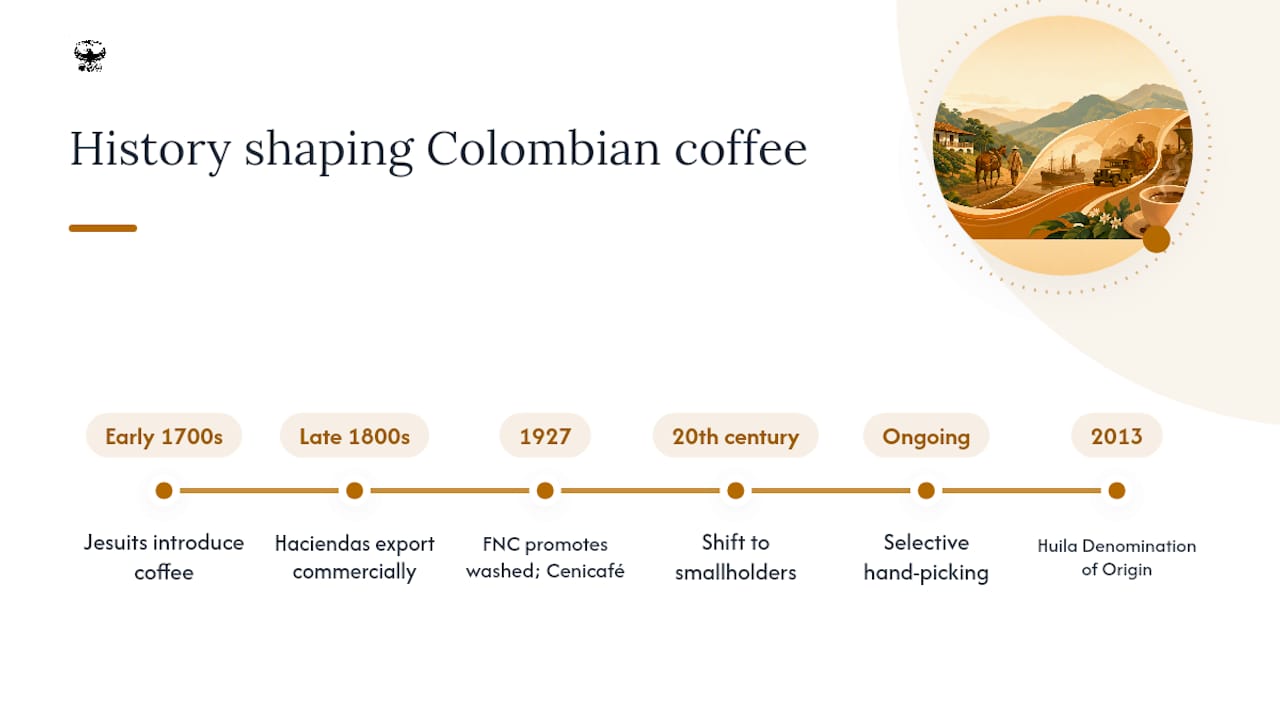
Colombia’s coffee identity didn’t happen by accident. Coffee arrived in the country in the early 1700s, brought by Jesuit priests, and spread slowly through the Andean highlands over the following century. By the late 1800s, large haciendas in Santander and Cundinamarca were exporting commercially. The shift toward smallholder farming, which defines Colombian production today, accelerated through the 20th century as land reform and the growth of the Federación Nacional de Cafeteros (FNC) created infrastructure for small farms to compete globally.
The FNC, founded in 1927, standardized quality practices across hundreds of thousands of small producers. Washed processing became the norm partly because the FNC promoted it as a quality-control measure, and that institutional push is a direct reason the “clean Colombian cup” became a recognizable global standard. Cenicafé, the FNC’s research arm, developed disease-resistant varietals like Castillo specifically to protect smallholder yields without sacrificing cup quality.
The cultural emphasis on selective hand-picking, passed down through generations of family farms, also shaped the flavor profile. When a farm picks only ripe cherries, the sugar content is higher and defect rates drop. That practice, more than any single varietal or processing choice, is what gives Colombian coffee its reputation for balance and dependability. The Denomination of Origin system, which Huila received in 2013, formalizes this connection between place, practice, and flavor, giving specialty buyers a provenance signal they can trust.
An editorial note on tasting and selecting Colombian coffee
The thing most people miss when they first start buying Colombian coffee is that “Colombian” is not a flavor. It’s a geography. A Nariño lot at 2,100 meters processed naturally tastes nothing like a washed Antioquia lot at 1,500 meters. Both are Colombian. Both are good. But they’re solving different problems in the cup.
What I listen for when evaluating Colombian lots is clarity first. A well-processed, well-roasted Colombian coffee should have a clean mid-palate where you can actually identify the notes. If it’s muddy or flat, something went wrong in processing or roasting, not at origin. The second thing is finish length. Colombian coffees at their best have a sweet, lingering finish that doesn’t turn bitter or hollow. That’s the Arabica genetics and the washed process doing their job.
The regional diversity is genuinely one of the most underused tools available to coffee buyers. Most people pick a roast level and stick with it. The smarter move is to pick a region that matches your acidity preference, then adjust roast level from there. Huila for fruit and brightness. Antioquia for chocolate and balance. Santander when you want something heavier and earthier.
Tri Crow Coffee: small-batch Colombian and beyond
Tri Crow Coffee roasts in limited batches specifically to keep flavor consistent from bag to bag. For Colombian coffee enthusiasts, that means you’re not buying from a blend that shifts seasonally without notice. The Medium Roast Cold Brew highlights exactly the chocolate and floral balance this article describes, and the Dark French Roast Cold Brew is the right call when you want roasty depth with minimal acidity. Beyond coffee, the range includes the Earl Grey Tea with bergamot oil and blue cornflowers, English Breakfast Tea for a strong, smooth black tea, and the Sweet Hibiscus Berry Tea for a fruit-forward cold-brew-friendly herbal option.
Every product ships direct to your door. Browse the full range at Tri Crow Coffee and find the roast or blend that fits how you actually drink.
Sources
- Coffee Semi-annual_Bogota_Colombia_CO2022-0022
- Statista — Coffee market outlook: Colombia
- A roaster’s guide to the coffee-producing regions of Colombia — Perfect Daily Grind
- Colombian Coffee: Regions, Varietals and What to Expect — My Home Coffee
- What Is Colombian Coffee? Origins, Flavor, And Why It’s Special — CoffeeExplore
FAQ
Why does Colombian coffee taste so good?
Colombia grows almost exclusively Arabica, uses washed processing to preserve clarity, and harvests selectively by hand, all of which reduce defects and produce a clean, balanced cup. The combination of altitude variation and diverse microclimates adds aromatic complexity on top of that quality foundation.
Is Colombian coffee stronger than other origins?
Not inherently. Colombian Arabica has moderate caffeine, and perceived strength depends far more on roast level, grind size, and brew ratio than on origin. A dark-roasted Colombian tastes bolder, but a lighter roast from the same beans is noticeably mild and fruit-forward.
Does Colombian coffee have a bitter taste?
A well-roasted, properly brewed Colombian coffee should have very little bitterness. The washed processing and Arabica genetics both work against bitterness. If your cup tastes bitter, the most likely culprits are over-extraction, water that’s too hot, or a roast that’s darker than you prefer.
Which is better, Colombian or Brazilian coffee?
They solve different problems. Colombian coffee tends toward brighter acidity, red fruit, and a cleaner finish. Brazilian coffee is typically lower-acid, fuller-bodied, and more chocolatey and nutty. Neither is objectively better; the right choice depends on whether you prefer brightness or body in the cup.