
Chicory coffee is roasted, ground root, with zero caffeine, while regular coffee is roasted, ground beans loaded with it. Blends split the difference proportionally, and many blends include a substantial portion of chicory, often around one-third to two-fifths of the total mix. If you want caffeine and classic flavor, drink coffee. If you want a fuller-bodied, lower-acid cup with none of the buzz, chicory wins.
TL;DR:
- Blends with 60:40 or 70:30 coffee to chicory provide a lower caffeine content while maintaining most coffee flavor and a fuller body.
- Pure chicory has no caffeine, offers the heaviest body and earthy flavor, but may cause digestive discomfort for sensitive individuals.
- Roast level and grind size significantly influence flavor and extraction, with darker roasts leaning toward richer, coffee-like qualities.
- Moderate daily consumption is generally safe, but high inulin levels may trigger digestive issues in sensitive people, especially those with allergies or pregnancy concerns.
Table of Contents
- Chicory Coffee vs Coffee: Flavor, Caffeine, and Body Compared
- What Is Chicory Coffee, and Why Does It Taste Like Coffee?
- Is Chicory Coffee Healthier Than Regular Coffee?
- How to Brew Chicory Coffee (Pure, Blended, or Espresso-Style)
- Tri Crow Coffee’s Take on Chicory as a Ritual Choice
- Chicory Won’t Replace Your Coffee Ritual, and It Shouldn’t Try To
- Where Chicory and Chicory Blends Fit in Tri Crow’s Lineup
- Sources
- FAQ
Chicory Coffee vs Coffee: Flavor, Caffeine, and Body Compared
The two drinks share a roasted, bitter backbone, which is exactly why people confuse them. But the similarities stop fast once you look at caffeine, acidity, and how each one sits in your stomach.
Pure chicory root contains no caffeine, while regular brewed coffee typically has a caffeine content in the range commonly reported for typical coffee. Blends have caffeine levels proportional to their coffee:chicory ratio, such as those around 70:30 or 60:40. Reviews of these blends describe them as enhancing color, body, and functional attributes compared to straight coffee, while adding inulin fiber that coffee alone doesn’t have.
On the palate, chicory reads earthier and woodier than coffee, with a nutty, almost toasted-grain sweetness that shows up as the root’s natural sugars caramelize. Coffee brings brighter acidity, more aromatic complexity, and the sharper bitterness most people associate with a “real” cup. Chicory’s lower acid content also makes it gentler on a sensitive stomach or reflux-prone gut.
Here’s the quick breakdown by common blend ratio:
- 100% chicory: zero caffeine, heaviest body, most earthy and root-forward flavor.
- a coffee to chicory ratio around sixty to forty: noticeably softer acidity, still some caffeine kick, and rounder mouthfeel.
- a coffee to chicory ratio around seventy to thirty: closer to standard coffee taste, with a caffeine trim and extra body.
- 80:20 coffee to chicory: subtle flavor shift, minor caffeine reduction, good starter ratio for skeptics.
- 100% coffee: full caffeine, brightest acidity, the flavor profile you already know.
A complete guide to chicory coffee from Coffee Studies notes that sensory descriptors like “roasted,” “earthy,” and “slightly sweet” come up consistently across chicory tastings, which lines up with what home brewers report once they get past the first sip.
What Is Chicory Coffee, and Why Does It Taste Like Coffee?
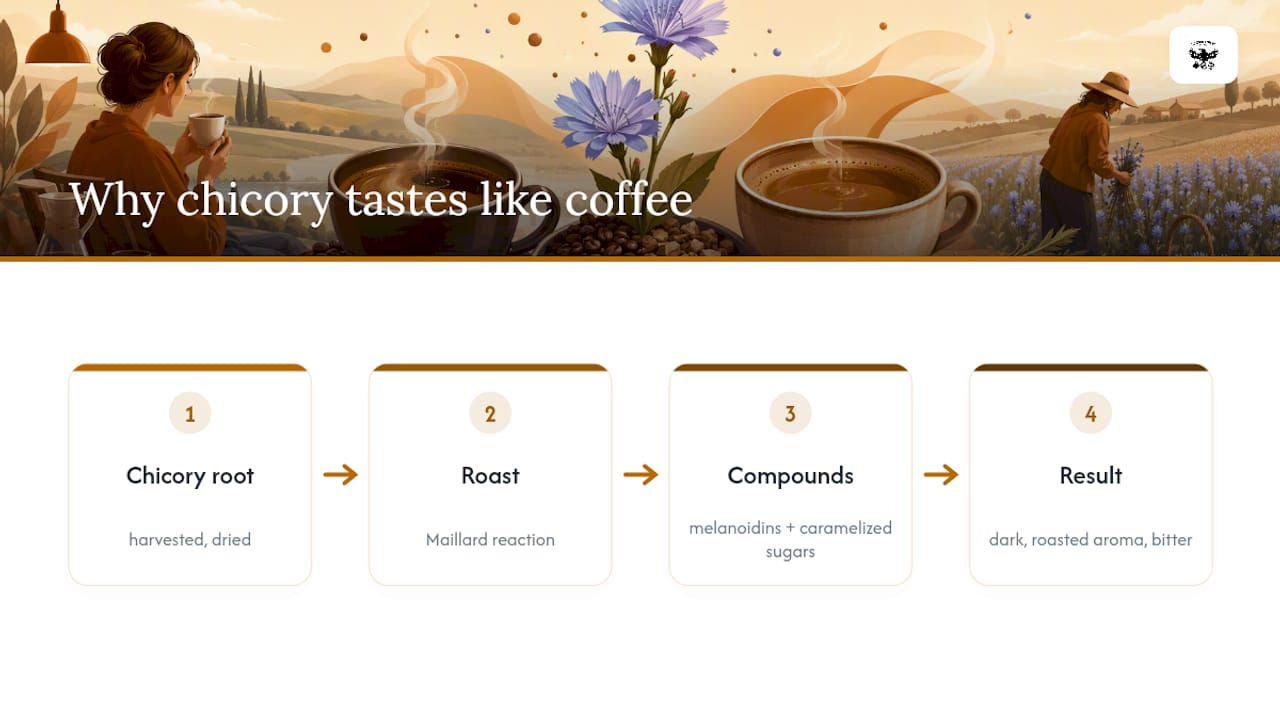
Chicory coffee comes from the root of Cichorium intybus, a leafy plant related to endive and radicchio, not from any coffee plant at all. Producers harvest the root, dry it, roast it, then grind it into something that looks and brews almost identically to ground coffee.
The resemblance isn’t an accident of marketing. Chicory root is loaded with inulin, a starchy carbohydrate that behaves very differently under heat than the compounds in green coffee beans, but the Maillard reaction still kicks in during roasting. That reaction produces melanoidins, the same browning compounds that give coffee its color and part of its aroma, along with caramelized sugars from the inulin breaking down. The result is a drink that pours dark, smells roasted, and tastes bitter enough to pass for coffee at a glance.
Roast level and grind size matter here just as much as they do with coffee beans. A lighter roast keeps more of chicory’s vegetal, slightly bitter edge, while a darker roast pushes it toward that deep, almost coffee-like richness. Finer grinds extract faster and give a heavier body, which is part of why chicory works so well in French press and espresso-style brewing rather than quick drip methods.
Is Chicory Coffee Healthier Than Regular Coffee?
Neither drink wins outright, and anyone telling you otherwise is oversimplifying. Chicory’s biggest nutritional claim to fame is inulin, a prebiotic fiber that feeds beneficial gut bacteria and may support digestive regularity. Coffee’s studied benefits run in a different direction, with its polyphenols and other bioactive compounds tied to a separate set of research on antioxidant activity that chicory doesn’t replicate the same way.
A quick fact worth remembering: pure chicory contains no caffeine at all, which makes it one of the few roasted, coffee-like drinks that’s genuinely caffeine-free rather than just “low caffeine.”
The tradeoff is digestive. Inulin may cause digestive symptoms like gas, bloating, or cramping in some sensitive individuals, particularly when consumed in larger amounts initially, and side effect reports note this happens often enough to warrant starting small. People with:
- Diagnosed IBS or fructan sensitivity should introduce chicory slowly, if at all.
- Ragweed allergies should be cautious, since chicory belongs to the same plant family.
- Pregnancy concerns should check with a doctor first, since data on chicory during pregnancy is limited.
Roasting itself introduces some risk on both sides. Studies note that roasted coffee typically forms more furans than roasted chicory root, a compound created during high-heat roasting, though the difference doesn’t make either drink dangerous in normal amounts. Moderation still applies to both.
How to Brew Chicory Coffee (Pure, Blended, or Espresso-Style)
Ground chicory root brews almost like coffee, but not quite. It extracts more slowly because of its density, so it rewards a longer contact time than a fast drip method gives it.
- French press method: Use roughly 2 tablespoons of ground chicory per 8 ounces of water, steep 5 to 7 minutes (longer than coffee), then press.
- Pour-over or drip: Use a slightly finer grind than you would for coffee and expect a heavier, syrupy pour.
- Espresso-style: Pack chicory into a portafilter like espresso grounds; it won’t crema the same way, but it produces a concentrated shot good for milk drinks.
- Blend transition strategy: People transitioning can start with a blend favoring more coffee and gradually increase the chicory proportion over time if you’re weaning off caffeine, and settle wherever your taste and energy needs land.
- Iced version: Brew double-strength using the French press method above, then pour over ice, which also works well for chicory au lait style, cut with warm milk instead of water.
Pro Tip: Never scoop chicory into your machine at a 1:1 ratio with your usual coffee dose on the first try. It’s denser and steeps stronger than bean grounds, so start at half your normal scoop and adjust up.
Tri Crow Coffee’s Take on Chicory as a Ritual Choice
We think about chicory the way we think about most non-bean additions: as a tool for adjusting a ritual, not a health upgrade you bolt onto your morning. If you’re cutting caffeine for sleep or sensitivity reasons, blending in chicory lets you keep the weight and warmth of a coffee habit without losing it entirely.

Small-batch roasting is what makes that kind of blending actually work. Roast profile and particle size determine how any added ingredient extracts, and that’s true whether we’re pairing origins for a balanced flavor or considering chicory alongside a darker roast. Consistency at small scale is easier to control than at industrial volume, which is part of why we keep batches limited.
In practice, we see chicory fitting best as a morning caffeine-trim swap or an evening ritual drink when you want something warm and roasted without the stimulant.
Chicory Won’t Replace Your Coffee Ritual, and It Shouldn’t Try To
The research here supports a narrower conclusion than most coffee-alternative articles want to admit: chicory is a legitimate tool for caffeine management and gut fiber intake, not a healthier stand-in for coffee across the board. Treating it as a straight swap misses what each drink actually does well.
Where conventional advice falls short is the all-or-nothing framing. Most people don’t need to choose one drink forever. They need a way to dial caffeine up or down depending on the day, the sleep schedule, or the stomach they woke up with, and blending gives you that dial instead of a binary switch.
If you’re experimenting, prioritize the ratio before you worry about the brand or the brew method. Get the 70:30 or 60:40 split right for your taste and tolerance first, then refine the roast and grind around it. That order matters more than most guides let on, and it’s the difference between chicory becoming a permanent fixture in your rotation or a bag that sits half-used in the cabinet.
— David
Where Chicory and Chicory Blends Fit in Tri Crow’s Lineup
If you’re leaning toward keeping full caffeine and classic flavor, our House Blend makes a solid everyday foundation, and the 6 Bean Dark Roast gives you more complexity in the same small-batch spirit. Need more of a jolt than a standard cup delivers? The Max Caf Blend, built from Tanzania and India robusta, is the higher-caffeine option worth reaching for.
For flavor experimenters curious about pairing a little chicory into their cup, the cocoa and caramel notes in our Cowboy Blend and the boldness of our Italian Roast Dark both hold up well against chicory’s earthiness rather than getting lost under it. And if you’re cutting caffeine entirely rather than trimming it, our Peach Paradise, Masala Chai, and Earl Grey teas give you a full ritual with zero caffeine math required. Browse the full lineup and find your next cup.
Sources
This article draws on the peer-reviewed review of coffee-chicory blends published via PubMed, along with consumer health explainers from Healthline and Medical News Today. For readers digging deeper into prebiotic fiber and gut effects, NutriBliss’s guide to prebiotic supplements offers additional context, and Just Move Supplements covers caffeine alternatives more broadly.
- Coffee and chicory blend: properties, nutrition, and health implications — PubMed
- Chicory coffee: Benefits and side effects — Medical News Today
- Chicory coffee: a complete guide — Coffee Studies
FAQ
Is Chicory Coffee Better for You Than Regular Coffee?
Neither is universally better. Chicory offers prebiotic fiber and zero caffeine, while coffee brings antioxidant compounds and the alertness caffeine provides, so the right choice depends on your goals and tolerance.
Is It Safe to Drink Chicory Coffee Every Day?
For most people, yes, daily chicory in moderate amounts is considered safe, though the inulin content can cause gas or bloating in sensitive individuals if you increase your intake too quickly.
Who Should Not Consume Chicory?
People with ragweed allergies, diagnosed IBS or fructan sensitivity, and pregnant individuals should limit or avoid chicory and check with a doctor first, since research on its effects during pregnancy is limited.
Does Starbucks Put Chicory in Their Coffee?
No, standard Starbucks coffee is made from roasted coffee beans without chicory. Chicory blends are more commonly found in specialty and small-batch products like those from Tri Crow Coffee or in traditional New Orleans style coffee.