
Yes, daily black coffee is associated with measurable health benefits, and the strongest signal in the research points to roughly one to three cups a day. Observational studies tie that range to lower risk of death from any cause, better cardiovascular outcomes, and reduced type 2 diabetes risk. The caveat: if you’re pregnant, prone to anxiety, or sensitive to caffeine, the calculus changes, and the cup counts below need adjusting downward.
TL;DR:
- Drinking one to three cups of black coffee daily is most strongly associated with lower risks of mortality, diabetes, and liver disease, especially when consumption remains within the 200 to 300 milligram caffeine range.
- Coffee’s health benefits are driven mainly by polyphenols like chlorogenic acids and non-caffeine compounds, which stay active through filtering methods and roast levels, rather than caffeine alone.
- Most studies indicate that optimal benefits occur at moderate intake, with three to four cups lowering mortality risk by around 17 percent, while higher consumption may reverse these gains.
- Caffeine limits for healthy adults are around 400 milligrams daily, with lower caps of 200 milligrams for pregnant or breastfeeding women, to avoid side effects such as sleep disruption and anxiety.
- Consistency and avoiding added sugars or creams are crucial, as high-calorie, sweetened coffee drinks erase most of the health benefits seen in black coffee.
Table of Contents
- The Health Benefits of Drinking Black Coffee Daily
- What in Black Coffee Actually Drives These Effects
- How Strong Is the Human Evidence, Really?
- Risks, Side Effects, and Who Should Be Careful
- Building a Smarter Daily Black Coffee Routine
- Where This Guidance Comes From
- What Actually Matters Once You Cut Through the Noise
- Simple, Functional Options for Your Daily Cup
- Sources
- FAQ
The Health Benefits of Drinking Black Coffee Daily
The case for black coffee rests on outcomes researchers have tracked across hundreds of thousands of people for decades, not a single trendy study. A large U.S. cohort analysis found that black coffee drinkers had a 14% lower risk of all-cause mortality than non-drinkers, with a hazard ratio of 0.86, and an even sharper reduction in cardiovascular mortality, where the hazard ratio dropped to 0.65. That’s a real difference between black coffee and the version loaded with syrup and cream, which showed no mortality benefit at all in the same data.

Life expectancy numbers back this up from a different angle. A prospective cohort study using NHANES data estimated that people drinking one to two cups a day at age 50 could expect about two additional years of life compared to non-drinkers. The relationship isn’t linear, though. It’s U-shaped: benefits climb through the first few cups, plateau, then start reversing at high intakes, which is why “more is better” doesn’t hold once you’re past four or five cups.
Here’s a rundown of what daily black coffee is most consistently linked to:
- Lower all-cause and cardiovascular mortality. The 0.86 and 0.65 hazard ratios above hold up across multiple cohorts, and the effect concentrates specifically in black or lightly sweetened coffee.
- Reduced type 2 diabetes incidence. Multiple long-term cohorts show a dose-related drop in diabetes risk as intake rises through moderate levels, likely tied to caffeine’s effect on insulin sensitivity and the antioxidant load of chlorogenic acids.
- Liver protection. Higher coffee intake correlates with lower rates of cirrhosis and hepatocellular carcinoma, one of the more consistent findings in nutritional epidemiology, and one doctors bring up often with patients who have fatty liver disease.
- Lower Parkinson’s disease and some dementia risk. Cohort data links regular coffee drinking to reduced Parkinson’s incidence, and some studies find a similar (weaker) pattern for cognitive decline.
- Short-term alertness, mood, and exercise gains. Caffeine’s acute effects on reaction time, perceived exertion, and mood are well documented and kick in fast, unlike the long-term disease associations above, which build over years.
An umbrella review pooling multiple meta-analyses found that three to four cups a day produced the largest relative risk reductions for several outcomes, with all-cause mortality risk around 17% lower than non-drinkers at that intake. That’s a wider range than some other cohorts suggest, and it’s a good reminder that “optimal” dose varies somewhat by outcome and by population.
None of this means coffee cures anything. These are associations from people who already drink coffee as part of a broader lifestyle, and coffee drinkers as a group tend to differ from non-drinkers in ways researchers can’t fully untangle. Still, the consistency across outcome types (mortality, liver, metabolic, neurological) and across different countries and cohorts is what makes coffee’s benefit profile more credible than most food-and-disease headlines.
What in Black Coffee Actually Drives These Effects
Coffee isn’t just caffeine in water. It’s one of the most chemically complex beverages people drink daily, containing more than a thousand identified compounds, and several of them appear to do real biological work.

Caffeine is the most obvious actor. It blocks adenosine receptors in the brain, which is why it sharpens alertness and reaction time within twenty minutes of your first sip. It also affects glucose metabolism, though the direction is complicated: acute caffeine intake can temporarily reduce insulin sensitivity, while habitual coffee drinking over years associates with lower diabetes risk. Those two facts aren’t contradictory. They just operate on different timescales.
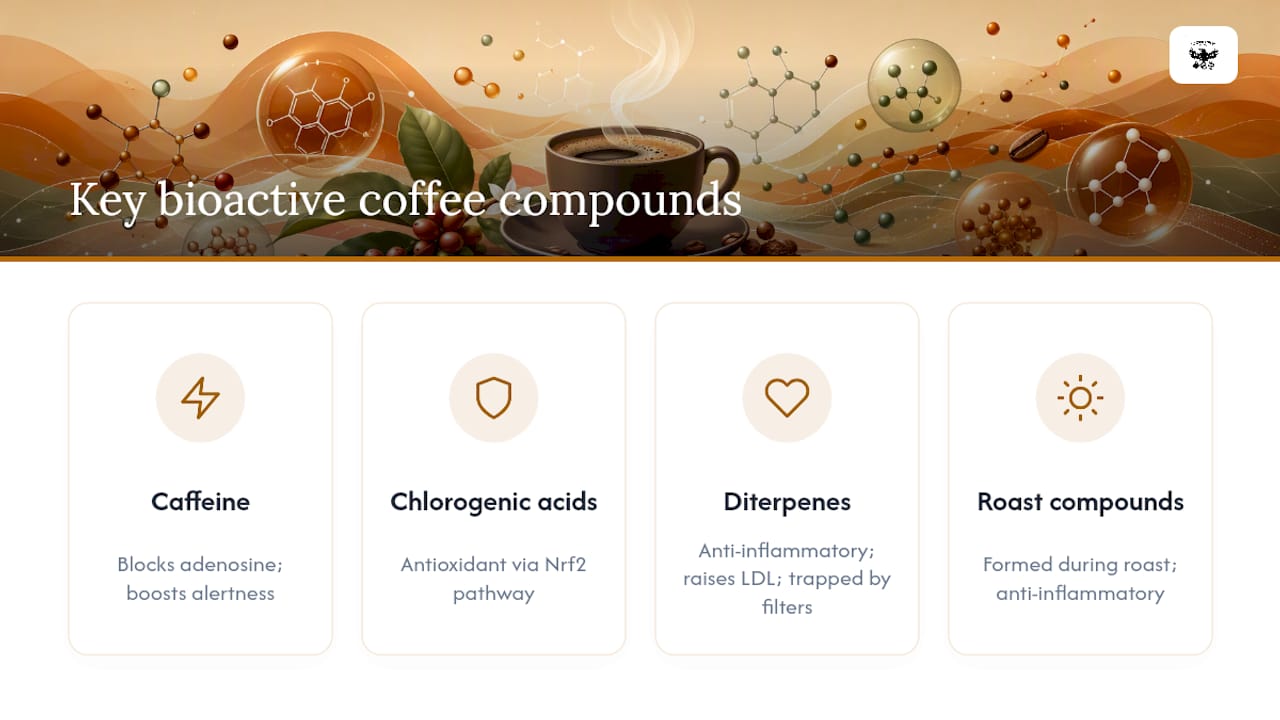
Chlorogenic acids, a class of polyphenols that make up a large share of coffee’s antioxidant content, appear to work through the Nrf2 pathway, a cellular defense system that ramps up production of protective enzymes when cells encounter oxidative stress. A review of coffee’s bioactive compounds describes this as one of the more plausible mechanisms behind coffee’s anti-inflammatory associations, alongside trigonelline and melanoidins formed during roasting.
Diterpenes, mainly cafestol and kahweol, are where things get more nuanced. These compounds show anti-inflammatory activity in lab studies, but cafestol also raises LDL cholesterol when consumed in quantity. The practical detail that matters here: paper filters trap most of the diterpenes, so drip coffee through a filter contains far less cafestol than French press, espresso, or Turkish coffee, all of which let the oils through unfiltered.
That distinction explains a genuinely useful pattern in the research: decaffeinated coffee often shows similar protective associations to regular coffee for several outcomes. If caffeine alone drove the benefit, decaf shouldn’t track the same way. It suggests the polyphenols and other non-caffeine compounds are doing meaningful work on their own.
Roast level shifts the compound balance too. Darker roasts lose some chlorogenic acid content to heat but gain other antioxidant compounds formed through the Maillard reaction, so “healthier roast” isn’t a settled question the way people sometimes assume. Bean species matters less than most marketing suggests; Arabica and Robusta differ mainly in caffeine concentration, with Robusta running roughly double.
Pro Tip: If cholesterol is a concern for you, switch to a paper-filtered brew method. It’s the single easiest change that meaningfully reduces diterpene intake without giving up your daily cup.
Worth being honest about the limits here: most of this mechanistic work comes from cell studies and animal models, or from measuring biomarkers in short human trials. It tells you why coffee plausibly helps. It doesn’t, on its own, prove that drinking it changes your personal disease risk.
How Strong Is the Human Evidence, Really?
The evidence base for coffee’s health associations is unusually large by nutrition-science standards, spanning cohort studies with hundreds of thousands of participants tracked over ten, twenty, sometimes thirty years. That volume is exactly what makes the consistency of the findings meaningful, even though most of it is observational rather than randomized.
The NHANES-based cohort study cited earlier found that people drinking one to two cups daily had an estimated life expectancy at age 50 of about 32 years compared to roughly 30 years for non-drinkers, a gap of just over two years. The dose response curved upward through low-to-moderate intake and then flattened, the signature U-shape that shows up again and again in coffee research. That shape matters practically: it tells you the goal isn’t maximizing cups, it’s landing in the range where the curve peaks.
The BMJ umbrella review, which pooled evidence across more than 200 meta-analyses covering dozens of health outcomes, found coffee consumption was more often associated with benefit than harm. The strongest relative risk reductions for several outcomes, including all-cause mortality, clustered around three to four cups per day rather than one or two, which is a slightly higher range than the NHANES study suggests. The two findings aren’t in conflict so much as evidence that the “best” dose shifts a little depending on which outcome you’re measuring and which population was studied.
A few other patterns worth knowing:
- Randomized trials exist, but they’re short and narrow. Several controlled trials found reduced spontaneous DNA strand breaks in blood cells after four to eight weeks of coffee consumption compared to water, a genuine mechanistic signal, but nowhere near proof of long-term disease prevention.
- Confounding is the elephant in the room. Coffee drinkers in most cohorts are more likely to be non-smokers with steadier income and better healthcare access, and researchers adjust for this statistically but can never fully eliminate it.
- Reverse causation is a real possibility for some findings. People who feel unwell sometimes cut back on coffee before diagnosis, which can make coffee drinkers look artificially healthier in a snapshot.
- Effect sizes are modest, not dramatic. A hazard ratio of 0.86 is meaningful at a population level across millions of people. For any one individual, it’s not a guarantee of anything.
What separates coffee’s evidence from a lot of nutrition headlines you’ve probably rolled your eyes at is replication. The mortality and cardiovascular findings show up across independent cohorts on different continents, using different dietary assessment methods, and they keep landing in the same general direction. That’s a genuinely different evidence tier than a single study claiming a superfood cures inflammation.
Risks, Side Effects, and Who Should Be Careful
Here’s the boundary that matters most: 400 milligrams of caffeine per day is the upper limit most healthy adults can handle without meaningfully raising their risk of side effects, according to Harvard’s Nutrition Source. That’s roughly four 8-ounce cups of brewed coffee, though the actual caffeine content varies a lot by bean, roast, and brew strength.
Pregnant and breastfeeding people face a lower ceiling: 200 milligrams a day, about two cups, based on the same Harvard guidance. Caffeine crosses the placenta freely, and a developing fetus metabolizes it far more slowly than an adult does, which is why the threshold drops so sharply for this group.
Past your personal tolerance point, the side effects are predictable and well documented:
- Insomnia and disrupted sleep architecture, even when the coffee was consumed hours before bed
- Anxiety, jitteriness, or a racing heartbeat, especially in people with an underlying anxiety disorder
- Heart palpitations, which are usually benign but worth mentioning to a doctor if new or frequent
- Acid reflux and stomach irritation, since coffee stimulates gastric acid production
- Mild diuretic effects that can contribute to dehydration during intense heat or exercise
There’s also a bone-density signal worth flagging honestly rather than glossing over. Some studies in postmenopausal women link very high coffee intake to modestly lower bone mineral density, likely tied to caffeine’s effect on calcium absorption. The fix isn’t quitting coffee. It’s making sure calcium and vitamin D intake are adequate, which offsets most of the effect in the research.
The additive question deserves its own callout, because it changes the entire risk-benefit picture. The same U.S. cohort data showing black coffee’s mortality benefit found that high-sugar, high-fat coffee drinks showed no mortality benefit whatsoever. A splash of milk doesn’t appear to erase the effect. A daily flavored latte with syrup and whipped cream plausibly does, simply because you’ve added enough sugar and saturated fat to offset whatever coffee itself is doing.
Building a Smarter Daily Black Coffee Routine
Turning the research into an actual morning habit comes down to five decisions: how much, when, how it’s brewed, what you add, and how you handle cutting back.
- Land in the one to three cup range. That’s where most of the cohort evidence clusters, translating to roughly 200 to 300 milligrams of caffeine for an average 8-ounce cup. Check actual caffeine content by brew method since a strong pour-over can pack noticeably more caffeine than a diner-style drip cup.
- Cut off caffeine by early-to-mid afternoon. Caffeine’s half-life runs roughly five hours, meaning half the caffeine from a 2 p.m. cup is still active in your system at 7 p.m. If you’re sensitive, push your last cup even earlier and build a consistent morning ritual around it instead.
- Brew filtered if cholesterol is on your radar. Paper filters catch most of the cafestol and kahweol that can raise LDL, so drip or pour-over beats French press or unfiltered espresso if that’s a personal concern.
- Skip the syrup, keep the milk light. Black or lightly milked coffee tracks with the mortality benefits described above; sugary, high-fat versions don’t. If your stomach reacts poorly to acidity, a few practical fixes, like darker roasts or cold brew, can help without reaching for cream as a buffer.
- Taper instead of quitting cold. If you’re cutting back, drop by half a cup every few days rather than stopping outright. Caffeine withdrawal headaches, fatigue, and irritability typically peak around 24 to 48 hours after your last dose and fade within a week, and tapering blunts most of that.
Pro Tip: If you get an acidic stomach after your morning cup, try switching to a low-acid dark roast before assuming coffee itself is the problem. Roast level changes acidity more than most people expect.
If you deal with reflux or a genuinely sensitive stomach, it’s worth reading through more targeted strategies for that specific issue rather than guessing at fixes, since the right adjustment depends on whether the trigger is acidity, caffeine load, or brew strength.
Where This Guidance Comes From
Tri Crow Coffee builds its content around the same principle that shapes its roasting: precision over guesswork. This article draws on cohort studies, umbrella reviews, and public-health caffeine guidance rather than trend pieces, because a daily habit as personal as coffee deserves sourcing that holds up.
David, who covers coffee’s health research and brewing science for Tri Crow Coffee, focuses on translating cohort data and mechanistic reviews into guidance people can actually use at home. That approach runs through the brand’s broader library, including a deeper look at coffee’s health benefits and a guide to black coffee brewing styles for readers who want to fine-tune flavor without piling on sugar or cream.
Small-batch roasting gives Tri Crow Coffee direct control over roast profile and freshness, two variables that shape both flavor and the compound balance discussed above. That control is also why the brand leans on published research rather than internal claims when talking about health effects.
What Actually Matters Once You Cut Through the Noise
The evidence on black coffee is stronger and more specific than most health trends get credit for, but the conventional advice around it tends to flatten everything into “coffee is good for you,” which misses the parts that actually matter. The mortality and liver associations are real and well replicated. The cognitive and Parkinson’s data are promising but thinner. And the entire benefit picture depends heavily on what’s in the cup, not just whether coffee is present.
If I had to name the single most underrated point in this research, it’s the additive finding. People spend energy debating organic versus conventional beans or arguing about roast dates, while pouring in enough sugar and cream to erase the benefit they’re trying to protect. The dose range matters less than most headlines suggest, too. Anywhere from one to four cups shows up as protective across different studies. The bigger lever is consistency: black, moderate, and daily beats occasional and loaded with extras every time the data gets analyzed.
— David
Simple, Functional Options for Your Daily Cup
If you’re building a black coffee habit around the guidance above, the brewing method and additives matter, but so does having a reliable option on hand for the mornings you don’t have time to fuss over a pour-over. Tri Crow Coffee offers a few small-batch products built specifically for that kind of low-additive, everyday use.

The Instant Coffee 30-serving pouch is the fastest way to keep a consistent black coffee habit going without sacrificing flavor for convenience. If you’re specifically interested in the cognitive and antioxidant angles covered above, Instant Coffee with Mushrooms, blended with lion’s mane, cordyceps, and reishi, offers a functional variation worth trying on days you want something beyond straight caffeine. And for a ritual break from coffee altogether, the English Breakfast loose leaf tea gives you a lower-caffeine option that still fits the “black, unsweetened” pattern tied to the strongest health associations. As always, if you’re pregnant, caffeine-sensitive, or managing a health condition, check with a doctor before making any of these a daily habit. Browse the full lineup at the Tri Crow Coffee shop and find the fit for your routine.
Sources
- Hold the cream and sugar: Black coffee linked to lower risk of death
- Caffeine — The Nutrition Source, Harvard T.H. Chan School of Public Health
This article is general information, not a substitute for advice from a qualified doctor. Consult a qualified healthcare professional about your own circumstances before acting on anything here.
FAQ
Is it okay to drink black coffee every day?
Yes, for most healthy adults, one to three cups of black coffee a day fits within the range linked to the strongest health associations, provided total caffeine stays under 400 milligrams.
What organ benefits most from black coffee?
The liver shows some of the most consistent protective associations, with higher black coffee intake linked to lower rates of cirrhosis and liver cancer in long-term cohort studies.
What are the main benefits of drinking coffee?
The best-supported benefits include lower all-cause and cardiovascular mortality, reduced type 2 diabetes risk, liver protection, potentially lower Parkinson’s risk, and short-term gains in alertness and exercise performance.
What happens when you drink black coffee for 30 days?
Most people notice improved alertness and mood within days, and short controlled trials have found measurable reductions in oxidative DNA damage markers after four to eight weeks of regular coffee intake.
How much black coffee is too much?
Caffeine intake above 400 milligrams a day for healthy adults, or 200 milligrams for pregnant and breastfeeding people, raises the risk of insomnia, anxiety, and heart palpitations without added benefit.
Recommended
- The Real Benefits of Drinking Coffee, Backed by Science – Tri Crow Coffee
- Examples of Black Coffees: Styles, Methods, and Flavors – Tri Crow Coffee
- Does Roast Affect Caffeine? Here’s What the Research Shows – Tri Crow Coffee
- Maximize your energy: proven coffee benefits and smart rituals – Tri Crow Coffee